


Language of Light
2.Concepts
2.3 PHOTOMETRY
2.3.1 LUMINOUS FLUX
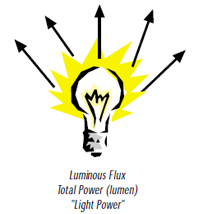
A source of light radiates energy in the form of electromagnetic waves. We speak of light energy as ‘flux’
and luminous flux is a measure of the flow of light energy emitted by a source, or received by a surface. The quantity is derived from the radiant flux, W (in Watts), by evaluating the radiation in accordance with the relative luminous efficiency of the ‘standard eye’ (CIE Standard Luminosity Function, V λ).
The unit is lumen (lm).
lm = 683 x W (Watt) x V λ
2.3.2 LUMINOUS INTENSITY
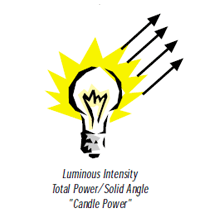
This expresses the power of a light source. It is defined as the quantity of luminous flux emitted in a given direction per solid angle (in steradian).
The unit is candela (cd).
1 cd = 1 lumen per steradian. (For practical purposes, one candela power.)
2.3.3 ILLUMINANCE
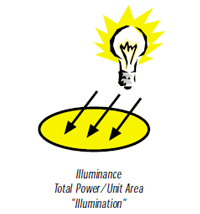
This is a measure of the concentration of luminous flux falling upon a surface. It is expressed in lumens per unit area.
The unit is lux (lx).
1 lx = 1 lumen per square meter (lm/m2)
The original non-metric British unit is the foot-candle.
1 foot-candle = 1 lumen per square foot (lm/ft2)
2.3.4 LUMINANCE
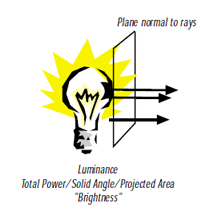
Also known as photometric brightness, luminance is a measure of the flux emitted from, or reflected by, a relatively flat and uniform surface. Luminance may be thought of as luminous intensity per unit area.
The unit is candelas per square meter (cd/m2), or nit.
The original non-metric British unit is the footlambert (fL)
1 fL = 1 candela/πft2
