

![]()
Measuring Instruments

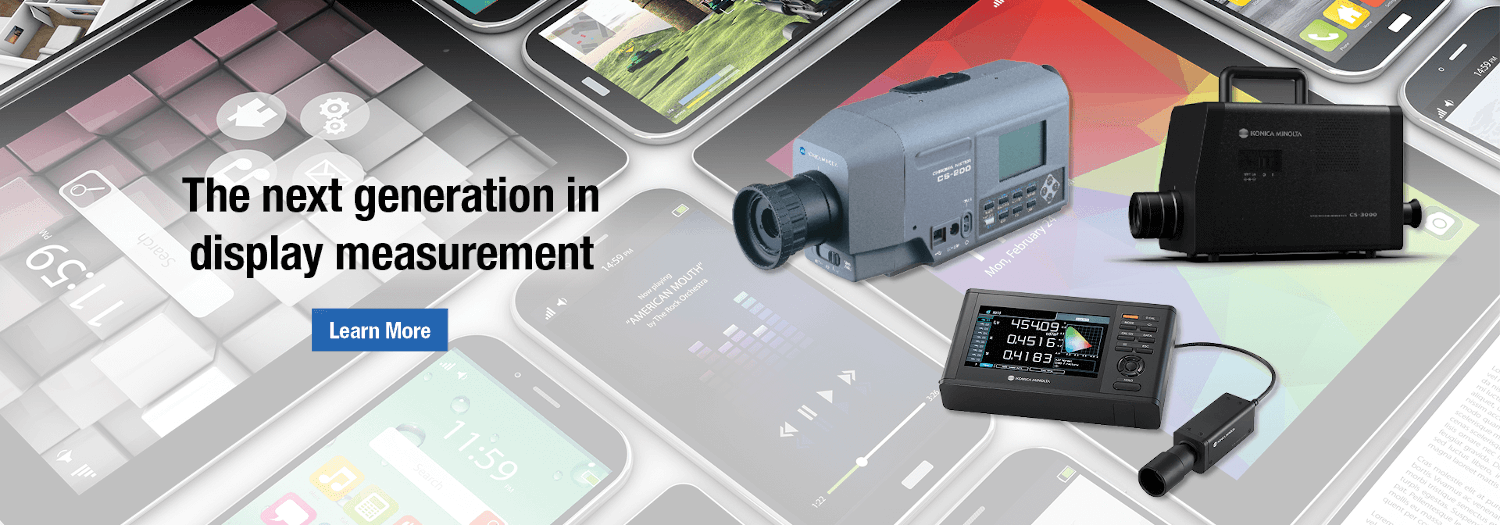
CS-200 ChromaMeter measures luminance and chromaticity of light emitting products as diverse as large plasma displays, compact LCDs and LEDs, outdoor screens, high pressure lamps, and instrument panels.
CS-200 is an instrument that enables highly accurate luminance and chromaticity measurements, comparable to those of the spectroscopic type of instrument while maintaining the simplicity, operability, and competitive price of the tristimulus type.
The CS-200 features 40 sensors and performs calculations using the spectral sensitivity characteristics (colour-matching functions) corresponding to the sensitivity of human eye. With this newly developed spectral fitting method, tristimulus values (XYZ for red, green, and blue) with a far higher accuracy than those of conventional tristimulus colorimeters can be obtained, providing excellent accuracy.
Measurements over a wide range of luminance levels from a low luminance of 0.01 cd/m2 through high luminance of 20,000,000cd/m2 (with measuring angle of 0.1°) can be done.
Three measuring angles can be selected: 1°, 0.2°, and 0.1°. The measuring angle can be switched according to the measurement target, ranging from display devices or other objects with large areas to measure through objects with tiny areas to measure, such as car audio control panels, vehicle instrument panels, and compact LCDs.

Light sources of all types can be measured with the CS-200, for example signal, traffic lights, airport lighting, lamps, LEDs, picture tubes, LCDs, PDPs, etc., simply anything that emits light. With the ever-growing demand for diversified media stimulated by the growth of information-technology business and full-scale service of digital broadcasting, research and development have been accelerated for various display devices, centering on plasma displays and LCDs. Innovations in LED technology have led to remarkable breakthroughs in the development of LED products including traffic lights, backlights for reflective LCDs, and large outdoor display screens.
There are two ways of determining luminance and chromaticity values for a light source.
A tristimulus type of instrument measures light sources with three sensors (red, green, blue) that have sensitivity similar to the sensitivity of human eyes to light. The filters used to reach this sensitivity have a limit in precision and thus the readings of tristimulus instruments can not be perfect on all kind of light sources. Best accuracy is reached when measuring light sources with a similar spectral distribution like that of the light source used for calibration of the instrument.
The second method, which is used by the CS-200, is to measure the spectral emittance of the light source and perform calculations using the spectral sensitivity characteristics (color-matching functions) corresponding to the sensitivity of human eye. By this method, the mis-matching of filters is avoided and thus the measurement results are much more precise.