
 Search within the site
Risk Management
Basic Concept
Creating a Group-wide risk management system
Along with the globalization of economies and the transformation of societies, the risks faced by companies have become more diverse. Konica Minolta has created a Group-wide risk management system in order to clarify various corporate risks and to minimize their impact on its businesses. The Group also conducts business continuity management, taking measures to ensure that businesses are able to continue uninterrupted in the case of a natural disaster or other unforeseen circumstances.
Risk Management System
Konica Minolta has established the Risk Management Committee to be responsible for managing diverse types of risks related to the Konica Minolta Group’s business activities. Executive Officers and Corporate Vice Presidents appointed by the Board of Directors are responsible for establishing and operating the risk management system described below in accordance with the Risk Management Committee Rules.
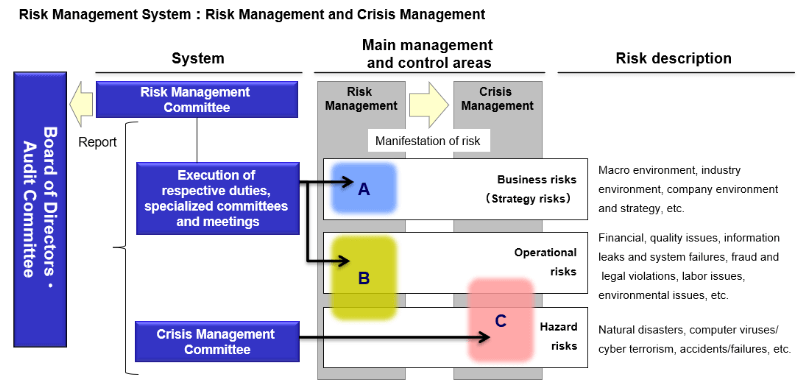
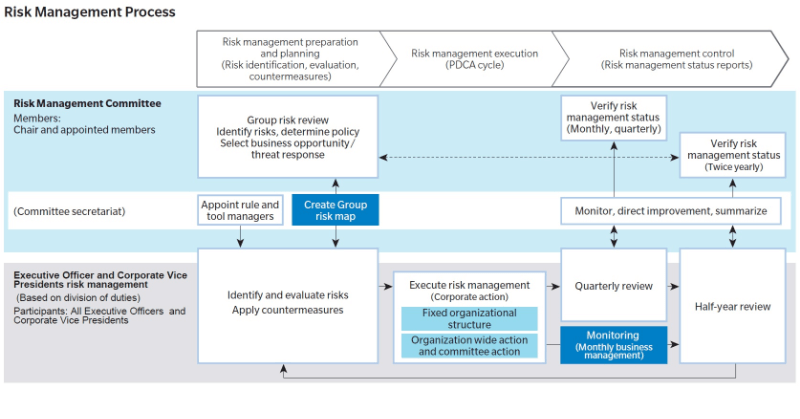
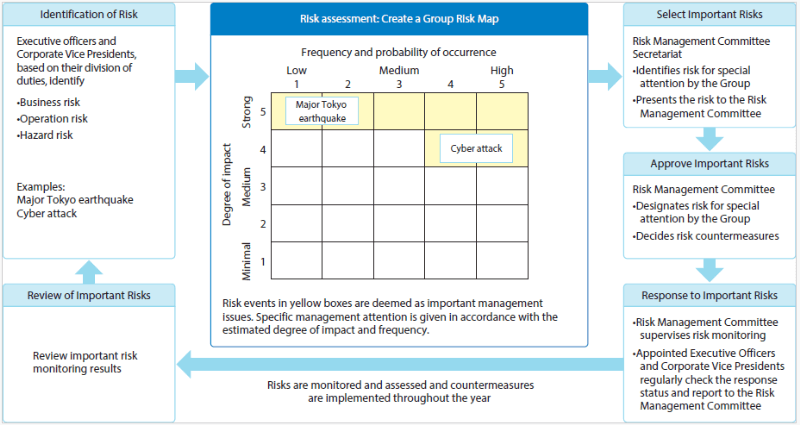
Business and operational risks related to the Konica Minolta Group’s business activities are managed by each executive officer and corporate vice president based on the division of duties and supported by the Risk Management Committee. The Risk Management Committee also identifies, evaluates, and reviews risks that are important to Group management, draws up countermeasures, and routinely checks on the management status.
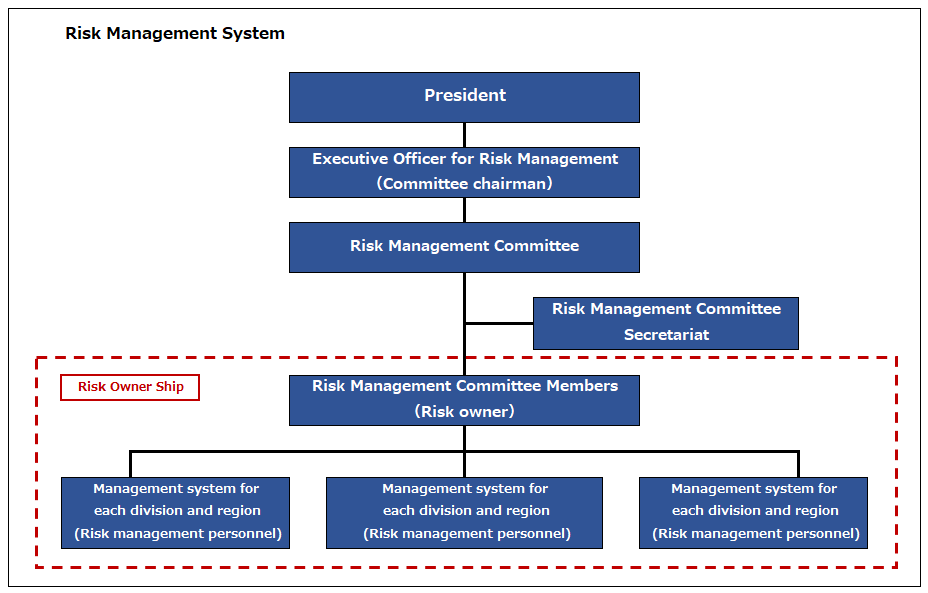
The Risk Management Committee’s discussions are routinely reported to the Audit Committee, reported to the Board of Directors as necessary, and reported monthly to the Board’s members.
Konica Minolta defines a “crisis” as a situation wherein a risk that has a significant impact on corporate value materializes. When a crisis occurs, it is reported to the officer in charge as well as to the officer in charge of crisis management via their superiors, and the officer in charge and the officer responsible for crisis management report to the Representative Executive Officer. To respond quickly and appropriately to crises caused by various risks, Konica Minolta has set rules for reporting crises and has informed executive officers, corporate vice presidents, and the officers of Konica Minolta’s subsidiaries of these rules. In accordance with these reporting rules, the officer in charge of crisis management provides centralized control of information on disasters, accidents, and other crises that have occurred around the world.
Risk Management Process
Konica Minolta’s Risk Management Committee meets routinely twice a year and on an as-needed basis. The committee formulates countermeasures to risks identified in its business activities and also verifies and evaluates whether the risk management system is functioning effectively. During the fiscal year under review, the Committee met twice to routinely monitor sanctions and new laws and regulations applicable to regions and countries with significant impact on Konica Minolta’s business, particularly with regard to risks that could have a significant impact on our global supply chain, such as the international logistics situation resulting from geopolitical risks, regulations related to the U.S.-China trade friction, and economic security and human rights issues.
Business and Other Risks
Described below are the major risks that could materially impact the financial position, business performance, and cash flow of the Konica Minolta Group. However, these risks are not all-encompassing and could be affected in the future by other unanticipated risks or risks currently considered immaterial.
Konica Minolta views risk as “uncertainty with the potential to impact the organization’s profits or losses.” Risk management encompasses not only the negative side of risk but also the positive side as an “opportunity.” Therefore, it recognizes risk management as activities that mitigate potential negative impacts and pursue maximum returns from opportunities. In order to manage risk as a source of profits, we are taking measures that take into account our risk appetite, which places emphasis on the balance between negative and positive aspects.
Our approach to risk responses and opportunities is described below in the individual risk sections.
Forward-looking statements in this document are based on the judgment of the Konica Minolta Group using currently available information as of the end of the current fiscal year.
First, a diagram of each risk item plotted on a risk map is shown. The “probability of occurrence” is evaluated based on the frequency and probability of occurrence within three years, and the “impact” is evaluated based on its impact on operating income when it occurs.
Risks for which “probability of occurrence” and “degree of impact,” have changed from the previous fiscal year (“previous period”) are indicated by arrow marks in the “assessment” column, and the assessments for the previous and current periods are shown.
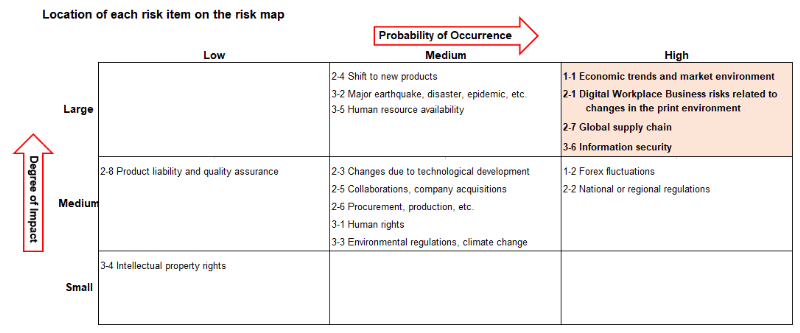
| Category | Risk Item | Probability of Occurrence | Probable Time of Occurrence | Degree of Impact |
|---|---|---|---|---|
| Economy/ Environment |
1-1 Economic trends and market environment | High | Within 1 year | Large |
| 1-2 Forex fluctuations | High | Within 1 year | Medium | |
| Business activity |
2-1 Digital Workplace Business risks related to changes in the print environment | Medium | Within 3 year | Large |
| 2-2 National or regional regulations | High | Within 1 year | Medium | |
| 2-3 Changes due to technological development | Medium | Within 3 years | Medium | |
| 2-4 Shift to new products | Medium | Within 3 years | Large | |
| 2-5 Collaborations, company acquisitions | Medium | Any time | Medium | |
| 2-6 Procurement, production, etc. | High | Within 1 year | Large | |
| 2-7 Global supply chain | High | Within 1 year | Large | |
| 2-8 Product liability and quality assurance | Low | Any time | Medium | |
| Other | 3-1 Human rights | High | Any time | Medium |
| 3-2 Major earthquake, disaster, epidemic, etc. | Medium | Any time | Large | |
| 3-3 Environmental regulations, climate change | Medium | Any time | Medium | |
| 3-4 Intellectual property rights | Low | Any time | Small | |
| 3-5 Human resource availability | Medium | Within 3 years | Large | |
| 3-6 Information security | High | Any time | Large |
For information on each risk, click on the links below.
Risk Information
Building a Crisis Management System
Establishing a system for minimizing the business and social impact of crises
Konica Minolta has established a system for minimizing the business and social impact of crises that may arise from a range of risks by taking prompt and appropriate action and by releasing information. The Crisis Management Committee, chaired by a director or an executive officer for crisis management appointed by the Board of Directors, discusses and formulates crisis countermeasures and procedures for action. Furthermore, the emergency contact system has been enhanced to enable the President and CEO, in addition to the director and executive officer for crisis management, to assess the situation and make decisions quickly. A system has also been established to enable the President and CEO to take leadership in critical areas in a crisis.
| Factors | Examples | |
|---|---|---|
| 1 | Defective products, recalls, product liability lawsuits | Design errors (faulty products, health hazards), errors in manufacturing processes (faulty products, foreign substances contained in products), etc. |
| 2 | Defective services | Inappropriate explanations, discriminatory attitudes toward customers, etc. |
| 3 | Personnel-related problems | Ambiguous performance evaluation standards, unfair transfers, human rights infringements such as employment discrimination and harassment, crimes/scandals involving employees, etc. |
| 4 | Labor-related problems | Labor disputes, unfair labor practices, child labor, forced labor, occupational health hazards, employee deaths or suicides caused by overwork, etc. |
| 5 | Corporate negligence | Pollution (soil, wastewater, odors), industrial accidents (health and safety hazards, accidents), etc. |
| 6 | Company's unethical conduct | Contacts with anti-social forces, scandals, internal disputes, insider trading, etc. |
| 7 | Inappropriate decision-making on management and marketing | Risks involved in investments, loans, bonds, M&A, and transactions; excessive competition, etc. |
| 8 | Corporate crimes | Illegal acts (violations of Antimonopoly Act, Premiums and Representation Act, Subcontract Act, Tax and Commercial Laws, etc.) |
| 9 | Intimidation and other crimes committed against the company | Obstruction of business (inserting foreign substances in products, etc.), robbery, subversive activities, etc. |
| 10 | Economic and social disturbances | Oil crises, major power failures, sharp declines in stock prices, etc. |
| 11 | International/political upheavals | War, coups, trade conflicts, etc. |
| 12 | Disasters and epidemics | Earthquakes, storms and floods, fires, epidemics (SARS, avian influenza, and new type of influenza, etc.) |
| 13 | Rumors concerning management instability | Incorrect information in mass media, spreading rumors through various channels, including the Internet, etc. |
Business Continuity Management (BCM)
Establishing measures for business continuity in the event of a major natural disaster
One of the most important responsibilities of an enterprise is to maintain or rapidly resume its essential business operations in the event of a major disaster or accident. Konica Minolta is working toward this goal at Group companies worldwide, as well as in its supply chains.*
At Konica Minolta, each business division and subsidiary, including the Business Technologies Business, which is Konica Minolta's core business, and Medical Devices, for which there is a high need during disasters, formulates a business continuity plan (BCP), laying out a specific plan of action for such an event. The Group has also established an initial response system to decide the necessity of putting the BCP into action by gathering information such as the damage situation immediately after a disaster.
Specifically, in the event of a major earthquake in Japan, the basic policy is to keep supplying consumables and products as much as possible so as to not inconvenience customers, while continuing to provide support services to existing customers. Toward that end, the Group is striving to increase the level of its business continuity system by decentralizing production sites for primary consumables, conducting risk assessments on suppliers, and securing alternatives and inventory for key parts with big risk. In addition, a backup structure has been established for call centers in Eastern and Western Japan so that they can provide backup to each other. This enables the company to continue to provide customer support even if one center were affected by a disaster. Further, various drills are conducted to increase the quality of these kinds of BCM.
*Supply chain: The series of activities involved in delivering a product or service to a customer, ranging from procurement and production to distribution and sales.
Reinforcing Crisis Response and BCM
The Group's major sites escaped severe damage in the Great East Japan Earthquake that struck on 2011, and the BCP did not have to be implemented. However, for the first month after the disaster, the president of Konica Minolta, Inc. held an Earthquake Response Meeting every morning to gather information, give appropriate instructions, and ensure consistent information disclosure. Since then, the Group has taken measures to improve its preparedness for front-line action in the event of a major disaster that occurs without warning.
Specifically, the initial response manual at all Group sites was revised so that operations would reliably continue during periods of chaos, at night and on holidays. The effectiveness of the manual was tested with actual drills, and the PDCA cycle is being used to improve it further.
In the event of a large-scale earthquake, the headquarters in the Marunouchi area of Chiyoda, Tokyo would serve as the Disaster Response Headquarters. Seven teams, headed by the President and CEO, would promptly respond. This system is reviewed in Group disaster preparedness training held once a year. In this training, the Disaster Response Headquarters, including top management, works with a site chosen as the hypothetical epicenter to quickly ascertain the extent of the damage, decide on a response and make decisions. In November 2021, training was carried out for a scenario involving the occurrence of a quake off the coast of Awaji Island, near Kobe, requiring a disaster control headquarters to be set up. Many headquarters employees participated remotely.
Konica Minolta has its own information-sharing tools for use in disasters. Its Emergency Information Data Base System is able to map the extent of damage at sites in the Konica Minolta Group in Japan, thereby providing an overall picture of the damage. The Safety Confirmation System prompts employees to report on their safety and the safety of their family members in the event of an earthquake. Konica Minolta also uses internal social media as an information-sharing tool for use in emergencies that occur at night or on holidays. Employing disaster prevention ICT, these tools support a smooth response from the initial response stage through the BCP stage. When the earthquake occurred in northern Osaka in June 2018, the Group used these ICT tools and confirmed that they were effective for information- sharing in the initial stage.
In January 2020, as the novel coronavirus began to spread, Konica Minolta established a crisis management system focused on production sites in China and initiated a group-wide response. After that, it expanded the scope of the system to European and North American sales and production companies in March, and to sites in Japan in April. Measures have been implemented to provide employee and business continuity support.
When the explosions occurred in July and August 2021 at Konica Minolta Supplies Manufacturing Tatsuno Factory, a Crisis Management Committee consisting of employees at the factory and Konica Minolta (headquarters and production departments) was formed to share information and determine countermeasures to be taken. The committee's work has initiated a neighborhood and public relations response, as well as measures to ensure safety and prevent recurrence.
With regard to the crisis in Ukraine that erupted in February 2022, a Crisis Management Committee consisting of representatives from Konica Minolta (headquarters and sales departments) and Ukraine was formed to share information and formulate a response to the crisis.
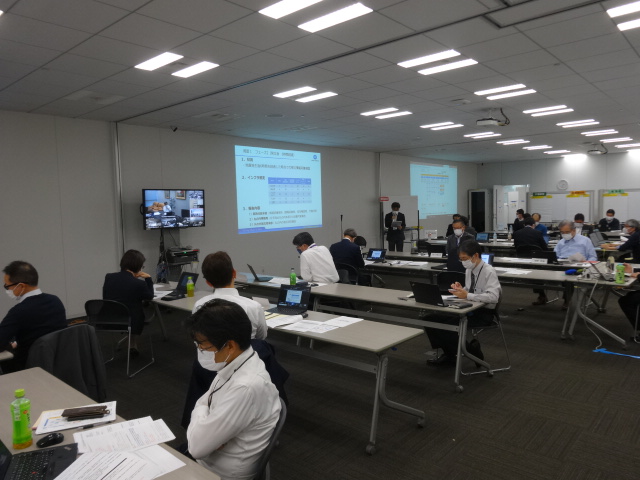
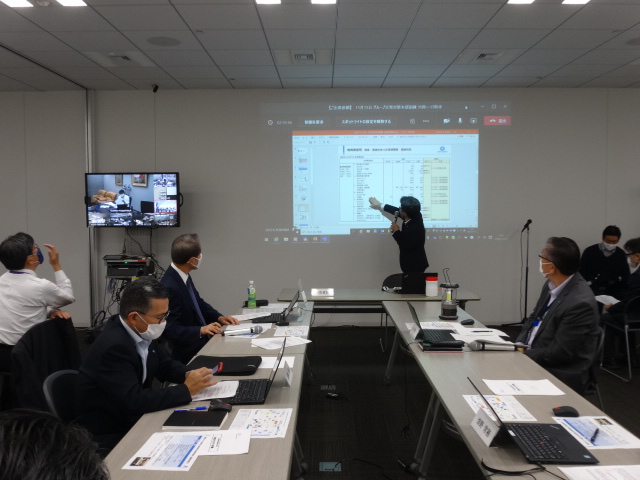
Group disaster preparedness training
IR Newsletter

※Clicking the link above will take you to the“Mitsubishi UFJ Trust and Banking Corporation”website.
Most Viewed
- Financial Results / Presentation Materials FY2026
- Integrated Report (Annual Report)
- Integrated Report (Annual Report) 2025
- IR Materials
- IR Events
Period : 01/08/2026 to 31/08/2026




About Konica Minolta


