Search within the site
CEO Interview
From management reform to building a foundation for long-term growth—strengthening business portfolio management with ROIC-based management at the core
Toshimitsu Taiko
Director, President and CEO,
Representative Executive Officer
Review of the previous Medium-term Business Plan (2023-2025)
QHow would you summarize the four years since you took office as President?
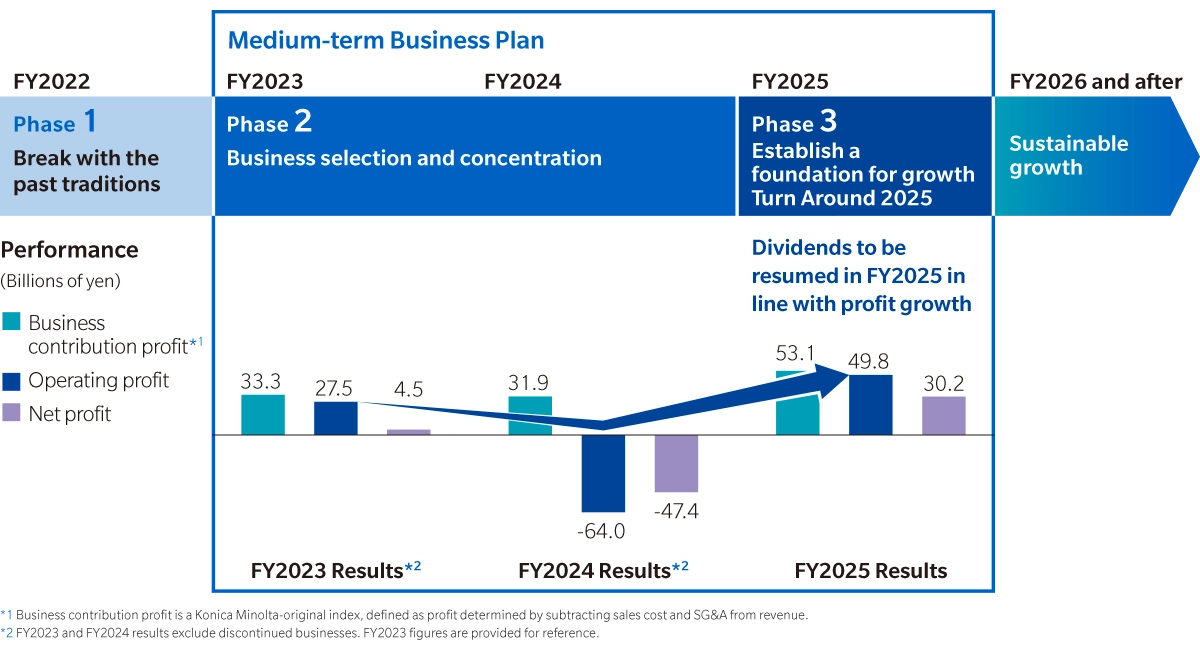
When I became President in April 2022, Konica Minolta was in a difficult financial position,having posted net losses for three consecutive fiscal years. Under these circumstances, our highest priority was to return to profitability, and I had no hesitation in deciding to undertake the management reforms needed to achieve this.
Under our previous Medium-term Business Plan (2023-2025) (hereinafter, previous Medium-term Business Plan), we classified all business units into four categories—strengthening businesses, maintaining profit businesses, direction-changing businesses, and non-focused businesses—and pursued business selection and concentration from a best-owner perspective. For non-focused businesses, we utilized third-party capital, including through the transfer of the precision medicine and marketing print management (MPM) services businesses. For direction-changing businesses, the DW-DX unit reviewed its geographic coverage and service areas, while the imaging-IoT solutions unit transferred its shares in MOBOTIX. In the Business Technologies Business, a maintaining profit business centered on the office unit, we terminated production at the Wuxi plant in China to improve future production efficiency and consolidated production at sites in Malaysia, Japan, and China (Dongguan). In addition, we established a joint venture with FUJIFILM Business Innovation Corp. to develop a procurement system for raw materials and components. We also implemented global structural reforms, which had not been planned when the previous Medium-term Business Plan was formulated, as an additional forward-looking measure to reinforce our earnings base.
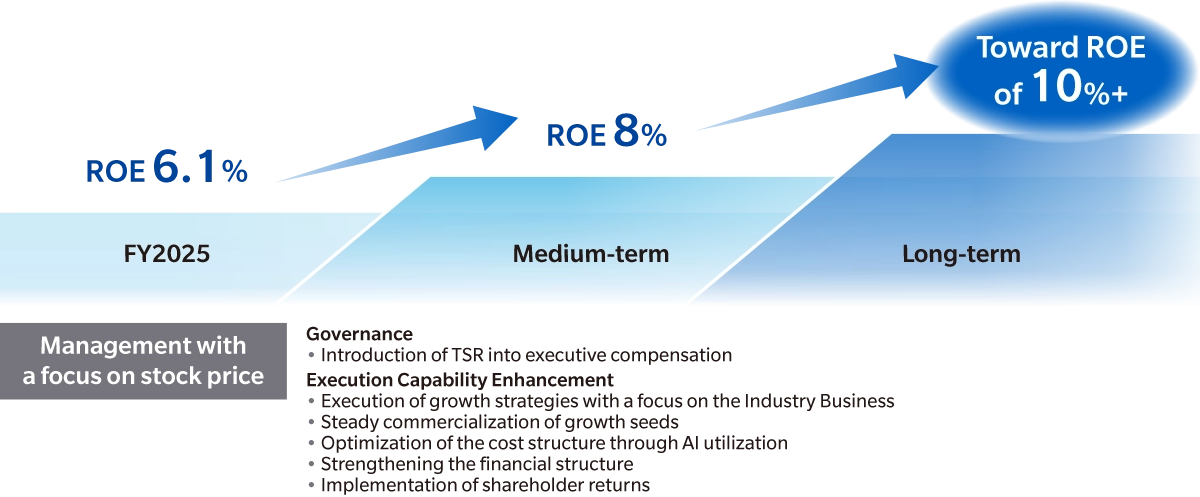
Alongside these management reforms, we also worked to strengthen the growth foundation of the Industry Business, a strengthening business. Although revenue growth fell short of our initial expectations, mainly due to customers curbing capital investment in the sensing unit, signs of a recovery in demand have emerged, and the business as a whole is on a recovery trend. We also steadily laid the groundwork for future growth seeds, including optical components for semiconductor inspection equipment, barrier films for perovskite solar cells and intelligent recycled materials. As a result, we were able to restore our profitability in fiscal 2025, the final year of the plan, and ROE also improved to 6.1%, exceeding our initial target of 5.0%.
In summary, the three years of the previous Medium-term Business Plan were a period in which, despite difficult management decisions, we clarified the direction we needed to take and steadily implemented measures across the Group with the understanding and cooperation of employees.
Phases of the Medium-term Business Plan (2023-2025)
QWhat issues remain from the previous Medium-term Business Plan, and what issues must continue to be addressed?
Although our profitability is steadily recovering and expanding as a result of management reforms, it has yet to reach the level expected by capital markets, and accelerating growth remains an issue. In addition, the industrial print unit experienced a decline in profitability due to a deterioration in the market environment caused partly by U.S. tariffs. With medium- to longterm market growth in view, we recognize that further accelerating the expansion of these growth businesses and strengthening our profitability are important management issues.
From an organizational perspective, I also feel that we sometimes impose limits on ourselves, constraining our growth. Rather than judging ourselves solely by internal standards such as that we are doing our best or that we have improved versus past performance, it is important to change our actions by always starting from an external perspective, such as where we stand relative to competitors and what customers, society, and capital markets expect from us. To continuously enhance corporate value, it is essential that I take the lead and that the senior management team itself remain determined to spearhead ongoing transformation. I also recognize that thoroughly instilling this change in mindset and transforming our corporate culture throughout the Group to evolve into an organization that continues to take on challenges and transform itself are important management issues going forward.
Objectives of Corporate Plan 2026–2028
QWhy did you position the Corporate Plan 2026–2028 (hereinafter, new Mediumterm Business Plan) as a plan for “building the foundation for long-term growth”?
Under the previous Medium-term Business Plan, we achieved our ROE target by advancing management reforms through business selection and concentration and global structural reforms. However, we need to further strengthen our profitability to sustainably enhance corporate value. We therefore positioned the three years of the Corporate Plan 2026–2028 (hereinafter, new Medium-term Business Plan) as a period for building a foundation for longterm growth. We will thoroughly apply ROIC-based decision-making and further strengthen business portfolio management, seeking to achieve both improved capital efficiency and growth. For sustainable growth over the medium to long term, we will also commercialize new businesses positioned as growth seeds while steadily validating their technologies and customer value, developing them into future pillars of earnings.
ROIC-based business portfolio management
QPlease explain your policy on business portfolio management.
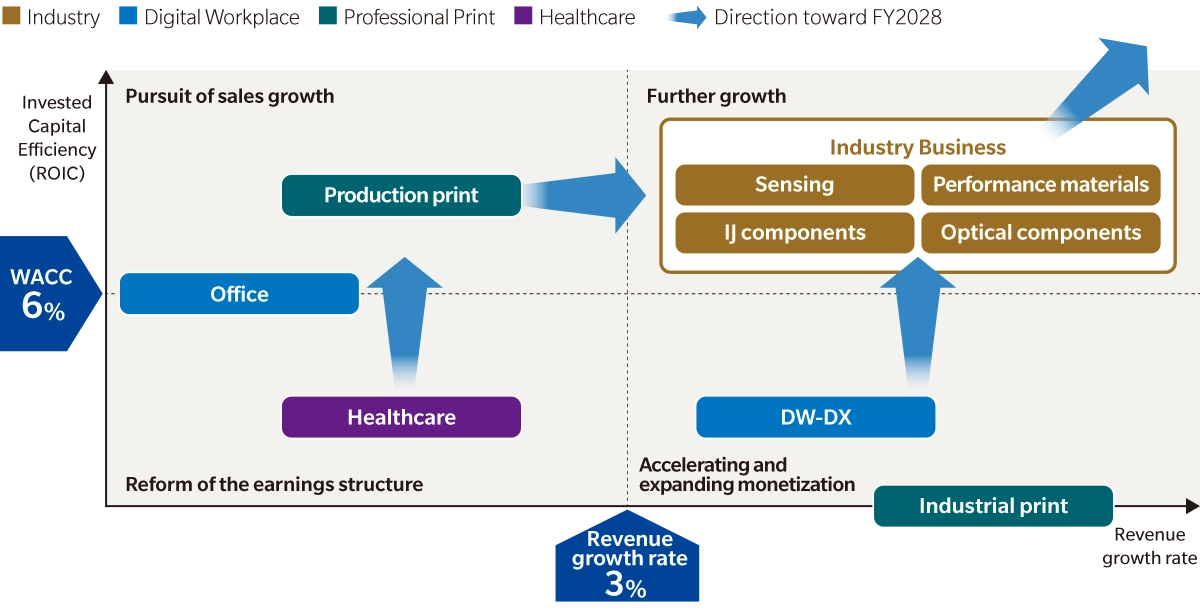
The new Medium-term Business Plan establishes target levels and directions for each business’s ROIC and revenue growth rate. As evaluation criteria, we use our assumed weighted average cost of capital (WACC) of 6% for fiscal 2028 as the hurdle rate and the Group-wide average revenue growth rate of 3% as the benchmark.
The office unit’s plan factors in market contraction, while the Industry Business and Professional Print Business are expected to grow faster than the Group-wide average. Of these, we will prioritize strengthening the Industry Business, which exceeds both the ROIC and revenue growth benchmarks, as a core business that will drive Group-wide growth. The production print unit of the Professional Print Business also maintains a high ROIC and has growth opportunities arising from the digitalization of commercial printing. We will pursue revenue expansion and earnings growth while further strengthening our competitive advantage.
We have already been evaluating businesses using ROIC and reviewing the appropriate direction of each business every three years, in addition to conducting annual business reviews. Under the new Medium-term Business Plan, we will now manage progress quarterly to enhance our responsiveness to environmental changes and promptly implement improvement measures for businesses falling behind the plan. Although decisions must also take medium- to long-term market trends and the competitive environment into account, if no improvement can be expected, we will review our business strategy, including potentially narrowing the scope of the business, such as by focusing on specific products or regions.
In fact, in the first quarter of fiscal 2026, we reviewed each product and service in the imaging-IoT solutions unit, transferring some to businesses where synergies could be expected and sequentially withdrawing from others. To instill this approach to ROIC-based management throughout the Group, we use the ROIC tree to clarify the measures and KPIs each division should address. Field operations and management will work together to improve capital efficiency and growth potential, leading to sustained growth in corporate value.
QThere were periods of weak share-price performance following the announcement of the new Medium-term Business Plan. How do you view capital markets’ assessment of and expectations for the management targets set for fiscal 2028?
Under the new Medium-term Business Plan, amid rising capital costs due to higher interest rates, we have positioned ROE of 8% as our most important financial target for enhancing corporate value. We also established management targets for fiscal 2028 of 3% revenue CAGR, a business contribution profit ratio of 6.5%, a net profit ratio of 3.8%, and Group-wide ROIC of 6%. We set these at levels Konica Minolta must achieve without fail. However, capital markets have particularly expressed the critical view that the profit level of the Digital Workplace Business, a core business of ours, has been insufficient.
In the past, the Company set ambitious targets but failed to achieve its plans, damaging trust from capital markets and placing a heavy burden on employees. Reflecting on that experience, we prioritized steadily delivering results first. Going forward, beyond merely achieving our targets, we will seek to achieve them ahead of schedule and deliver results exceeding expectations, thereby increasing trust from capital markets and improving their assessment of Konica Minolta. We believe that consistently building a track record is precisely what will heighten expectations for enhanced corporate value.
QSome capital market participants have concerns about the office unit’s future
prospects and sustainable profitability. What is your view?
prospects and sustainable profitability. What is your view?
In considering the future of the office unit, it is important to anticipate how working styles and office environments will change. The use of AI is currently expected to further expand the digitalization of business processes, potentially accelerating the decline in print demand. Although it is not easy to forecast the impact, waiting until the changes become clear before acting would be too late.
Assuming that AI adoption will advance faster than expected and significantly transform business processes, we will take appropriate measures and determine the optimal strategy for the business’s future.
We will consider every option, including whether to continue operating the business independently or improve competitiveness and capital efficiency through collaboration with partners. What matters is not responding passively to environmental changes, but anticipating them ourselves and devising the optimal strategy. With this in mind, we will first thoroughly enhance the office unit’s earning power and build a business foundation capable of generating stable cash flow even amid structural market changes. In addition, we will accelerate the implementation of measures aimed at improving profitability while taking advantage of positive factors, such as U.S. tariff refunds, that were not factored into the new Medium-term Business Plan at the time of its formulation.
QWhat initiatives are planned to improve profitability?
We aim to enhance added value through the use of AI across all our business segments. To provide an example in the Business Technologies Business, we will also further advance our use of AI, promote business process innovation through AI transformation, and achieve industryleading productivity by enhancing and streamlining our operations.
To enhance Group-wide earning power, we will also optimize cross-business functions on a regional basis. While Konica Minolta has traditionally focused on governance at the business level, we will improve management efficiency and streamline our cost structure by standardizing business processes and functions and consolidating indirect operations within each region. Through these initiatives, we will build a more robust earnings base capable of continuously generating earnings.
Medium- to long-term growth strategy
QPlease explain your policy for strengthening the Industry Business.
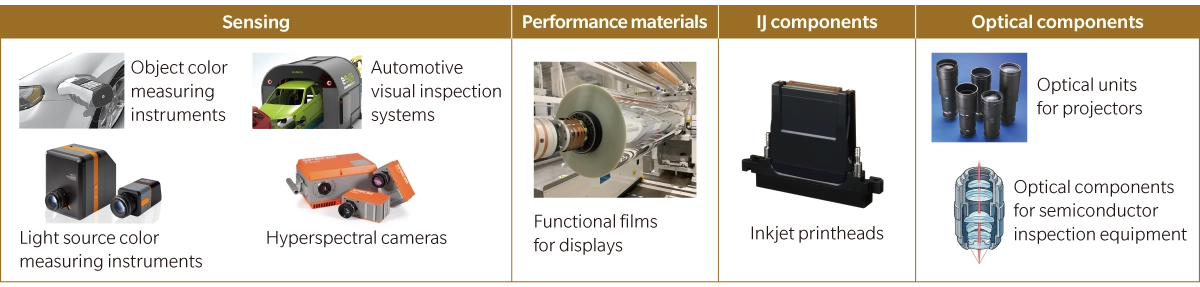
Konica Minolta positions the Industry Business as a core business that will drive medium- to long-term growth. Under the new Medium-term Business Plan, we will increase investment beyond previous levels and prioritize the allocation of management resources to areas that will become future growth drivers, including optical components for semiconductor inspection equipment, the new SANUQI and SAZMA films for displays, and automotive visual inspection systems.
We believe that the sensing unit, in particular, has substantial room for growth. For example, sensing’s hyperspectral imaging (HSI) technology is used in many areas the Company positions as growth seeds, including barrier films for perovskite solar cells, intelligent recycled materials, and biomanufacturing. As manufacturing becomes more advanced, we believe the range of applications for sensing technologies will expand further.
The sensing unit has traditionally focused on developing, manufacturing, and selling measuring instruments. Looking ahead, we will accelerate its transformation into a solutions business that contributes to customers’ quality and productivity improvements by combining measurement technology with AI, rather than merely providing hardware. Ultimately, we aim to truly evolve this from a measuring instruments business into a measurement business. To achieve this, we will establish the Advanced Sensing Promotion Office within the Technology Development Headquarters in fiscal 2026 to enhance our technology development.
We will also accelerate new value creation and business growth by bringing together technologies, human capital, and customer touchpoints across organizational, regional, and business boundaries.
Products driving growth in the Industry Business
QHow will you cultivate growth seeds?
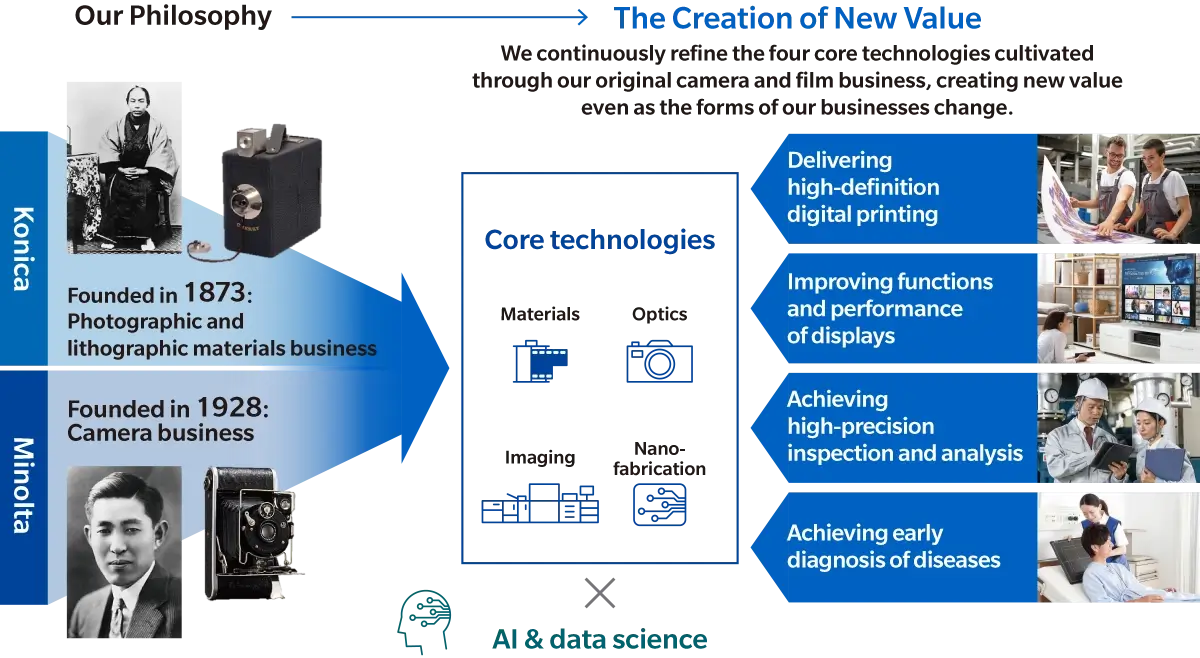
By combining our four core technologies—materials, optics, imaging, and nano-fabrication—with AI and data science, we will expand our businesses into growth areas such as the circular economy, decarbonization, and green transformation (GX).
In particular, we position optical components for semiconductor inspection equipment as a driver of future profit growth. Applications in the semiconductor inspection equipment market continue to expand, encompassing not only AI-related demand but also legacy fields, and medium- to long-term growth is expected even after the current surge in semiconductor demand led by AI data centers has run its course. We also plan to begin mass production in fiscal 2027 of products for the deep ultraviolet (DUV) field, where high growth is expected.
In the GX field, amid growing interest in a stable energy supply, attention is increasingly focused on perovskite solar cells, and demand is expected for barrier films, a key component. In addition to the high-barrier film technology cultivated through OLED lighting, we will utilize technologies such as inkjet printheads and HSI to help bring them into real-world application.
Our intelligent recycled materials solution uses advanced material sorting technology, proprietary sensing technology, and AI to stabilize the quality of recycled plastics and optimize manufacturing and molding conditions. In collaboration with MJ MATERIAL TECHNOLOGY, which has strengths in manufacturing and supplying recycled materials, we are currently studying plans for mass production at its new plant in Malaysia.
We will invest in these growth seeds in stages according to their growth stage, and we anticipate full-scale profit contributions from fiscal 2029 onward. We will steadily develop them into businesses that enhance future corporate value.
Our Philosophy and Core Technologies
Toward further enhancement of corporate value
QHow will you embody the corporate philosophy of “The Creation of New Value”?
“The Creation of New Value” has unwaveringly been defined as Our Philosophy since Konica Minolta was established in 2003. We have created new value to meet the needs of each era, including the digitalization and colorization of office printing and functional films for displays that utilize technologies cultivated through our photo and camera businesses. From 2015, we pursued major acquisitions in areas such as precision medicine, seeking to create new business pillars. As we reviewed our business portfolio, however, we decided to divest these businesses and determine that Konica Minolta was no longer the best owner. In recent years, we have developed highly distinctive technologies, including Dynamic Digital Radiography systems and the IQ-501 intelligent quality optimizer for digital printing systems, but compared with the past, it is taking longer for them to scale substantially as businesses. Looking ahead 10 to 15 years, creating new value that contributes to solving social issues while achieving sustainable growth is one of my highest management priorities.
To achieve this, the ability to anticipate changes in society and identify new business opportunities is essential. Konica Minolta selects talent with a keen awareness of technology and business to explore new business themes through unconstrained thinking that transcends existing organizational boundaries and brings fresh perspectives. Since April 2025, we have also operated a framework under which executives, including myself, review new business themes monthly with the personnel responsible. By discussing themes directly with those responsible, we have established a system enabling prompt support for promising themes and agile withdrawal decisions. Looking ahead, we will develop this into a framework capable of evaluating business viability and future potential more objectively by incorporating external expertise.
Since becoming President, I have also visited many business sites and gained new insights through repeated dialogue with employees. The aforementioned optical components for semiconductor inspection equipment serve as one example in which dialogue at the frontlines renewed my recognition of the importance of commercialization.
While taking on the challenge of creating new value, we will rigorously apply disciplined investment decisions focused on capital efficiency under quantitative criteria, thereby enhancing both social and corporate value.
QPlease explain your approach to sustainability management and business growth.
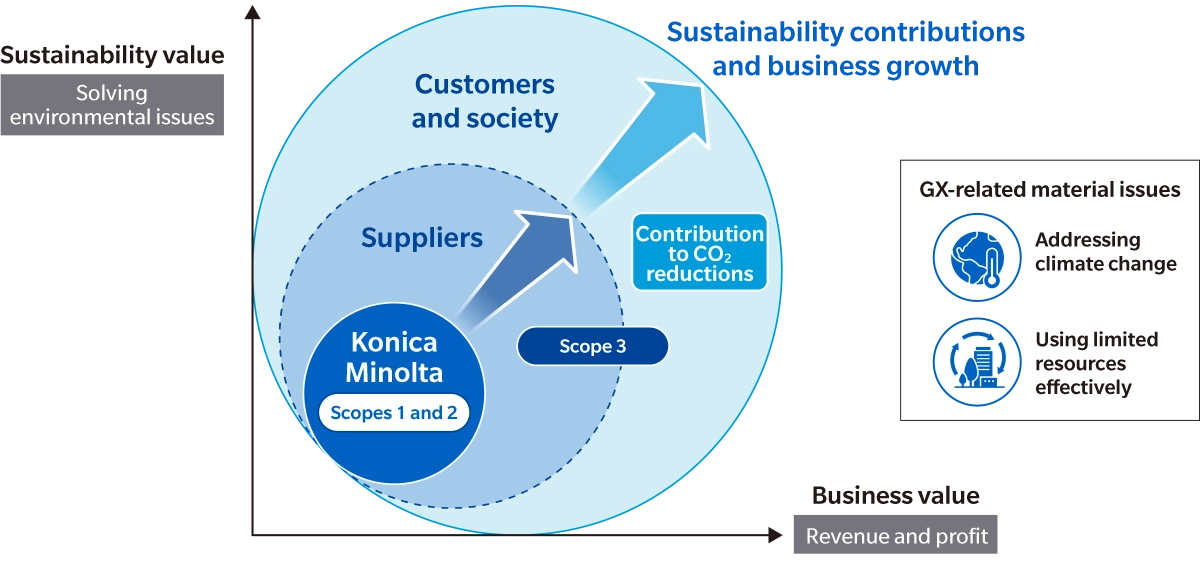
For Konica Minolta, which creates value by solving issues faced by customers and society, advancing our growth strategy is itself an embodiment of sustainability management. The growth seeds mentioned earlier are also business themes deeply related to our material issues, including addressing climate change and using limited resources effectively.
We have strengthened Group-wide initiatives to address climate change, and in 2025, our contribution to CO2 reductions exceeded CO2 emissions across the entire product lifecycle, achieving what we define as Carbon Minus. By further advancing these initiatives, we aim to achieve Net zero CO2 emissions across the entire Konica Minolta product lifecycle by 2050.
We are also continuing to discuss material issues and reaffirming their alignment with our new Medium-term Business Plan and links to the priority areas of each business. Going forward, we will further examine the nature of the material issues we should address, taking into account changes in the social and business environments.
Balancing sustainability contributions and business growth through co-creation
QCapital markets are taking a critical view of Konica Minolta’s current PBR, which is below 1x. How will you improve PBR going forward?
A PBR below 1x reflects the capital markets’ assessment of the Company’s capital efficiency and growth potential, and as the CEO, I take this assessment very seriously.
Although we target ROE of 8%, this is merely a milestone, and we must aim for ROE of 10% or higher over the medium to long term. To achieve this, in addition to improving profitability, it is essential to use total assets efficiently by optimizing working capital and improving asset efficiency. We also introduced an executive compensation system linked with total shareholder return (TSR) to align the interests of management and shareholders, further strengthening our commitment to enhancing shareholder value. Through these initiatives, we aim to quickly reach a PBR above 1x and realize corporate value that is appropriately recognized by the market.
We position the next three years as a critical period for enhancing corporate value and will deliver results meeting capital markets’ expectations. On behalf of Konica Minolta, I sincerely appreciate your continued support of our endeavors.
Toward enhancing corporate value over the medium to long term