
 Search within the site
Sustainability Strategy
Approach to Sustainability
At Konica Minolta, sustainability means "contributing to the realization of a sustainable society and driving corporate growth by resolving environmental and social challenges through our business operations." In short, we believe that tackling environmental and social issues as economically viable business endeavors is the key to achieving sustainable growth for our company.
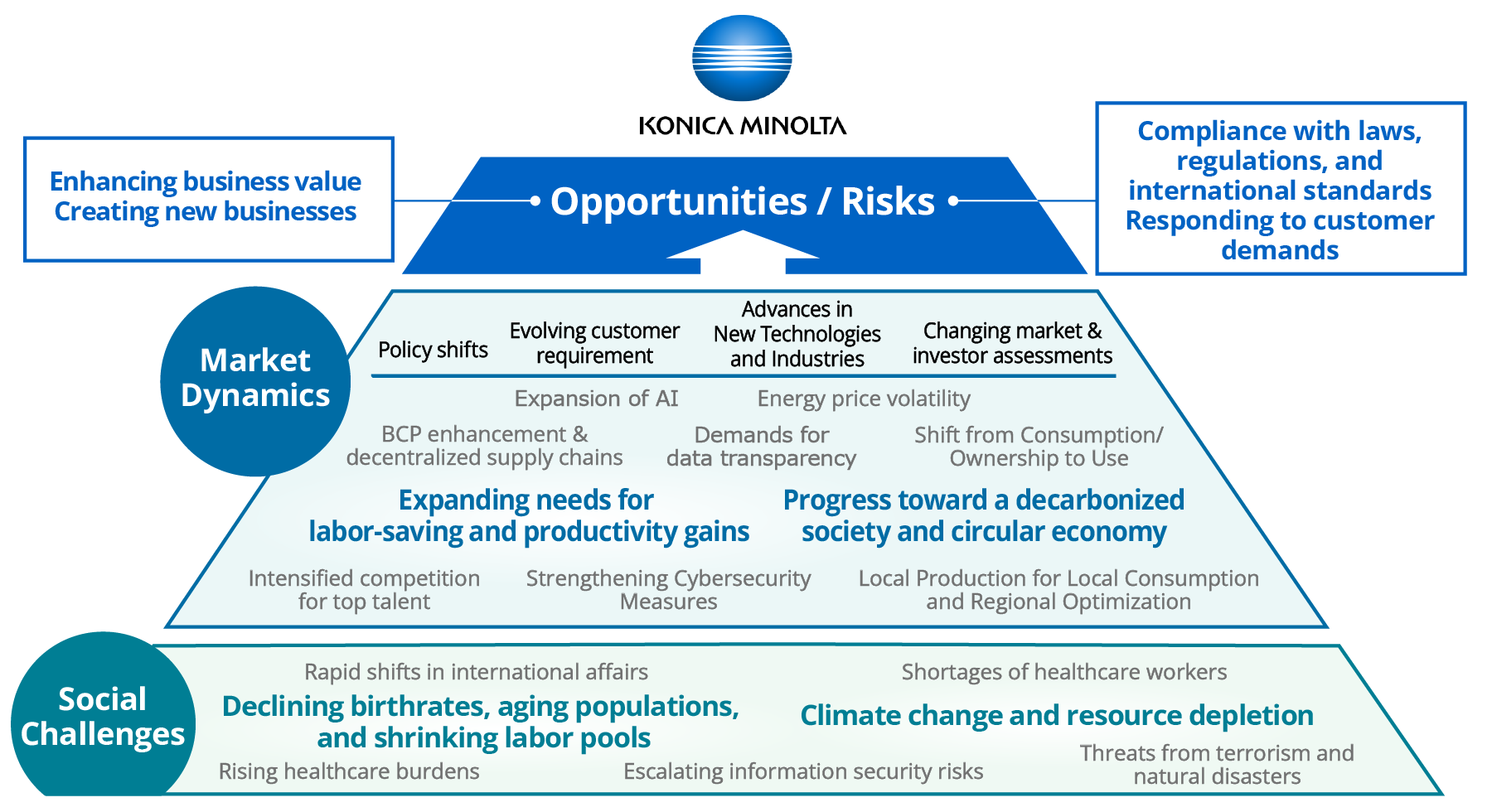
As environmental and social challenges such as climate change, resource constraints, labor shortages, and disparities in employment, education, and opportunities for creativity become increasingly apparent and severe, policies and regulations, customer requirements, technologies and industries, and market and investor assessments are changing significantly. These changes in the external environment pose risks to the business through changes in laws and regulations, international standards, and customer requirements. At the same time, by helping customers and their supply chains address the challenges they face, these changes also present opportunities to provide new value, such as enhancing the value of existing businesses and creating new businesses.
Konica Minolta appropriately identifies these risks and opportunities and assesses their impact on the business and their importance. By leveraging the strengths it has cultivated—“Customer Relationships,” “Technology Integration,” and “Diverse Talent”—Konica Minolta promotes co-creation with customers through its businesses. The basic approach of its sustainability strategy is to pursue both contributing to the realization of a sustainable society through this co-creation and achieving sustainable business growth for Konica Minolta.
To put this vision into practice, we established the "Konica Minolta Group Charter of Corporate Behavior" and created the accompanying "Guidance for the Konica Minolta Group Charter of Corporate Behavior" to foster a consistent global understanding and application across all group entities. These documents respect international norms and principles, including the UN Global Compact.
Materiality
Approach to Materiality
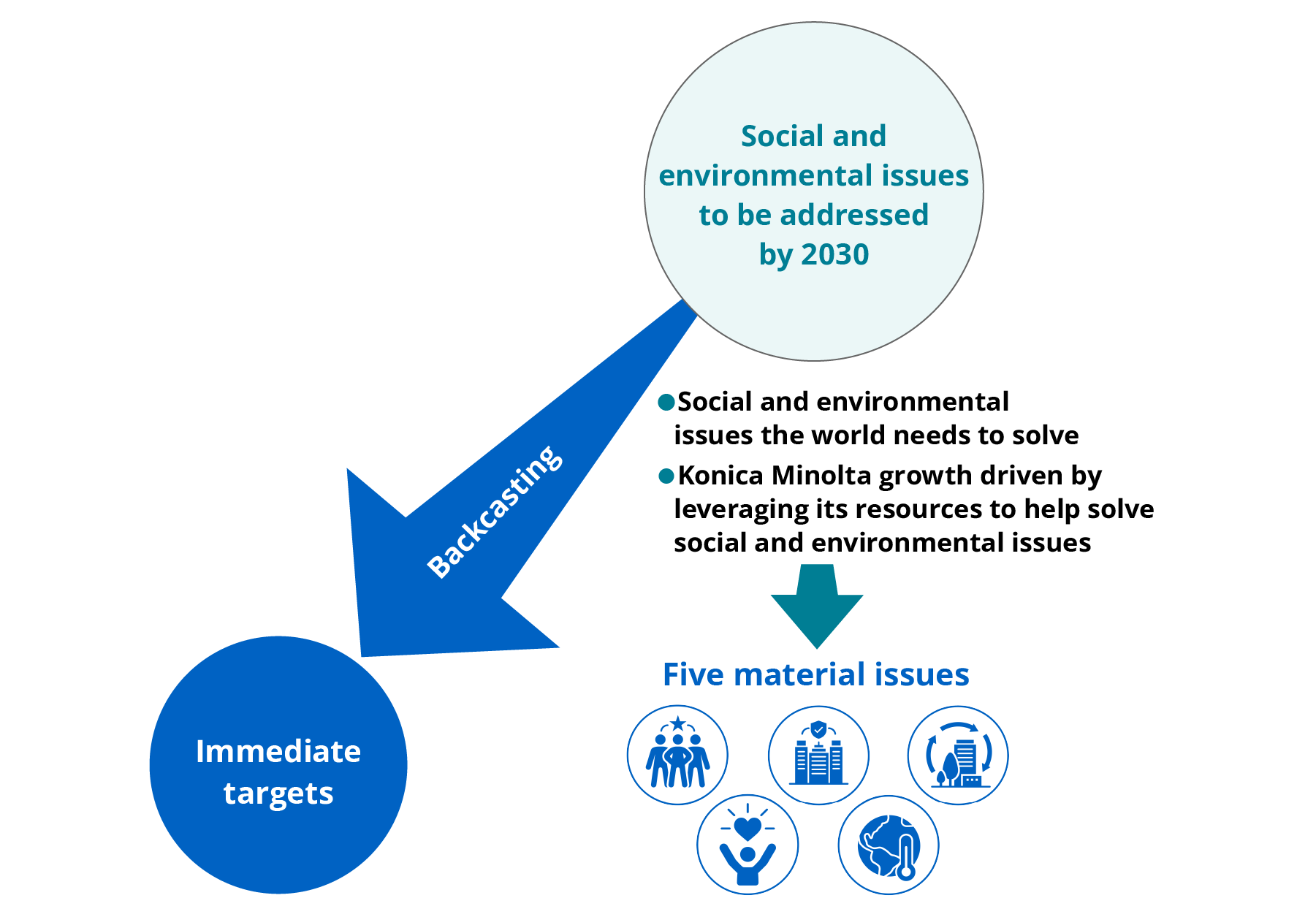
In 2020, envisioning what a “sustainable society” should look like a decade later in 2030, Konica Minolta identified five material issues as environmental and social issues that it should address. Backcasting from that vision, we defined “what we should do now.” For each materiality, we set a “Vision for 2030” that indicates the direction of medium- to long-term value creation.
Materiality Assessment and Identification Process
STEP 1
Listing Potential Issues
We compiled a broad list of environmental, social, and economic issues by referring to international frameworks and guidelines such as the GRI Standards, the SDGs, and SASB, as well as macro trends in various specialized fields.
In compiling the list, we identified issues based on the Stockholm Resilience Centre’s “SDGs Wedding Cake Model,” while keeping in mind the relationships among “ECONOMY,” “SOCIETY,” and “BIOSPHERE.”
The scope of this process covered business areas with which Konica Minolta is or may potentially be associated, as well as their supply chains and value chains. Issues were identified taking into account environmental and social changes, regulatory and policy trends, and requests from stakeholders.
For more information on the SDGs Wedding Cake Model, please visit:
Referenced Frameworks, Guidelines, and Standards
- GRI Standards
- SASB Standards
- ISO 26000
- Sustainable Development Goals (SDGs)
- Ten Principles of the United Nations Global Compact
- OECD Guidelines for Multinational Enterprises
- Recommendations of the Task Force on Climate-related Financial Disclosures (TCFD) (Final Report)
- Macro trends in various specialized fields, including climate change (Paris Agreement, European circular economy, etc.)
- IFRS Foundation "International Integrated Reporting Framework"
- Stockholm Resilience Centre "SDGs Wedding Cake Model"
Stakeholder Dialogue, Feedback, and Requests
- Investors: Presentations and direct dialogue at IR briefings, business briefings, etc., and requests made through various ESG surveys
- Customers: Engagement through bidding requests and the provision of solutions
- Business Partners: Dialogues with companies participating in the "Environmental Digital Platform"
- International NGOs/NPOs: Dialogue with CDP and other organizations
STEP 2
Issue Identification and Materiality Assessment
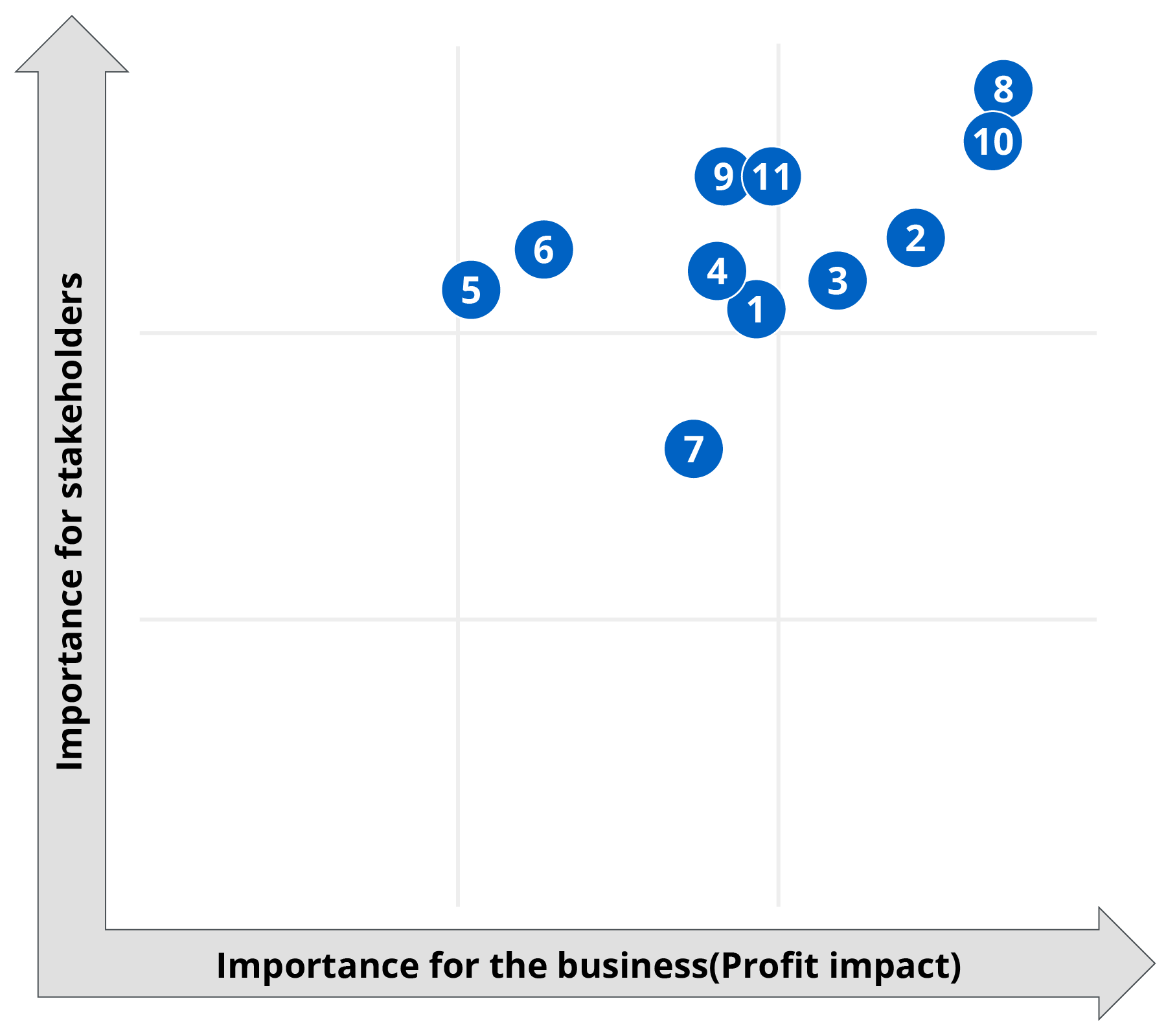
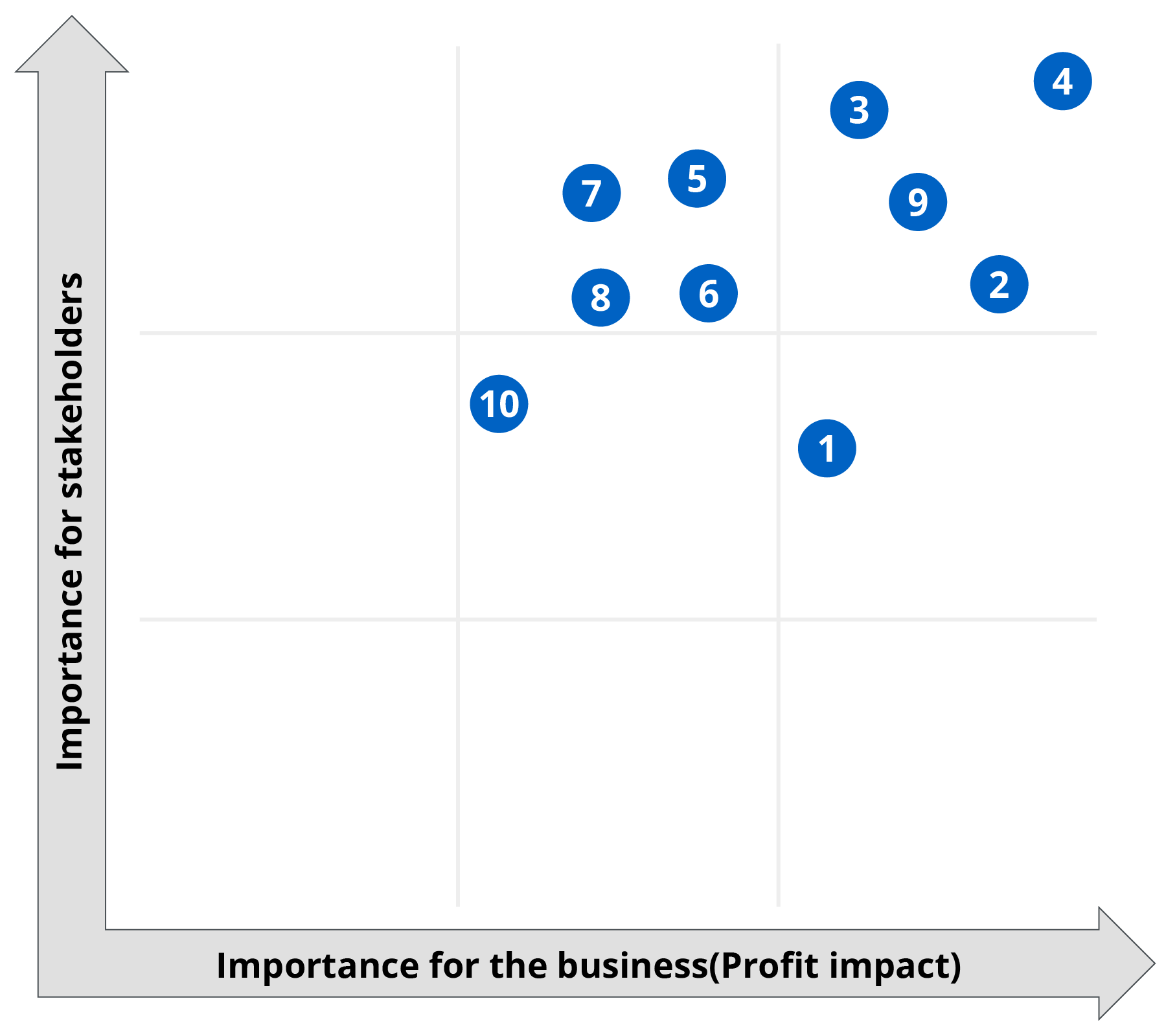
From the issues listed, we identified areas particularly relevant to Konica Minolta and conducted a materiality analysis (Materiality Assessment). A characteristic of Konica Minolta’s materiality analysis is that risks and opportunities are assessed separately. By assessing both risks and opportunities, we put into practice what companies are expected to do in addressing environmental and social issues: view social issues as opportunities and achieve business growth by solving them through business. In the materiality analysis, each issue was evaluated on a five-point scale along two axes—“Importance to Stakeholders (customers, business partners, shareholders and investors, employees, etc.)” and “Importance to Business (financial impact)”—and prioritized accordingly.
Opportunities Matrix
| Materiality | No. | Content |
|---|---|---|
| Improving Fulfillment in Work and Corporate Dynamism | 1 | Improving customers’ productivity and creating time for creative activities by providing “work style” solutions using digital technologies |
| 2 | Supporting improvements in customers’ productivity and a shift toward creative work through workflow and supply chain transformation | |
| 3 | Providing innovative services by unlocking the potential of “talent,” the source of new value creation, and becoming an organization where “individuals thrive” | |
| 4 | Supporting the establishment of a new industrial foundation that expands and carries forward the human capabilities of “seeing, judging, and adjusting” | |
| Supporting Healthy, High-Quality Living | 5 | Transforming nursing care workflows and creating a workforce for the nursing care industry |
| 6 | Contributing to early diagnosis, reduced healthcare costs, and improved Quality of Life (QOL) through imaging and healthcare IT services | |
| Ensuring Social Safety and Security | 7 | Ensuring the quality of customers’ products and services through advanced measurement and inspection |
| Addressing Climate Change | 8 | Reducing energy consumption and CO2 impacts at customer companies and in society through workflow and supply chain transformation |
| 9 | Providing measurement and inspection technologies and materials that support the commercialization of new materials, new energy, and new processes | |
| Using Limited Resources Effectively | 10 | Reducing resource consumption and promoting the effective use of resources at customer companies and in society through workflow and supply chain transformation |
| 11 | Providing measurement and inspection technologies and materials that support the commercialization of new materials, new energy, and new processes |
Risk Matrix
| Materiality | No. | Content |
|---|---|---|
| Improving Fulfillment in Work and Corporate Dynamism | 1 | Mismatches between internal skills and work resulting from rapid changes in digital technologies such as AI and the surrounding environment |
| 2 | Declining employee autonomy and capacity for innovation due to delays in creating an environment that emphasizes engagement | |
| Ensuring Social Safety and Security | 3 | Loss of public trust in the event of an accident involving a product or service that causes serious harm to the life or physical well-being of a user |
| 4 | Loss of public trust in the event of a serious security incident leading to information leakage or privacy violations | |
| 5 | Impact on operations and product shipments due to the use of substances that could cause ecosystem contamination or harm to human health | |
| Addressing Climate Change | 6 | Loss of competitiveness due to delays in transitioning to sustainable energy |
| 7 | Delays in transitioning to a revenue model that does not depend on print charges as forest resources decline | |
| 8 | Supply chain disruptions caused by extreme weather | |
| Using Limited Resources Effectively | 9 | Loss of competitiveness due to delays in transitioning to sustainable raw materials |
| 10 | Increased costs of materials and components and supply instability due to resource shortages |
STEP 3
Review, Validation, and Formal Identification
The officer responsible for Corporate Planning reviews the validity of the materiality assessment process and its results and identifies the material issues that should be addressed as priorities. The identified material issues are approved by the Board of Directors following deliberation by senior management. Their validity is ensured through regular reviews and revisions as necessary.
Five Material Issues
In 2020, Konica Minolta identified the following five material issues that it should address: “Improving Fulfillment in Work and Corporate Dynamism,” “Supporting Healthy, High-Quality Living,” “Ensuring Social Safety and Security,” “Addressing Climate Change,” and “Using Limited Resources Effectively.”
Improving Fulfillment in Work and Corporate Dynamism
Vision for 2030
Increase productivity and create time for creative activities within Konica Minolta and among customers and society, while advancing human perception and judgment to support innovation in customers’ industries.
Recognition of Environmental and Social Issues (2030 Horizon)
Labor shortages are expected in Japan and many other economies around the world. Changes in industrial structures are expected to create imbalances in the labor required, leading to wider “skill mismatches.” Advances in technologies such as AI, robotics, and automation will improve productivity and alleviate labor shortages. At the same time, however, new jobs will be created, requiring more creative skills suited to those jobs. It will therefore be necessary to address the global labor shortage by increasing productivity while also enhancing human creativity.
Opportunities and Risks
Opportunities
- Improving customers’ productivity and creating time for creative activities by providing “work style” solutions using digital technologies
- Supporting improvements in customers’ productivity and a shift toward creative work through workflow and supply chain transformation
- Providing innovative services by unlocking the potential of “talent,” the source of new value creation, and becoming an organization where “individuals thrive”
- Supporting the establishment of a new industrial foundation that expands and carries forward the human capabilities of “seeing, judging, and adjusting”
Risks
- Mismatches between internal skills and work resulting from rapid changes in digital technologies such as AI and the surrounding environment
- Declining employee autonomy and capacity for innovation due to delays in creating an environment that emphasizes engagement
Key KPI Targets and Results
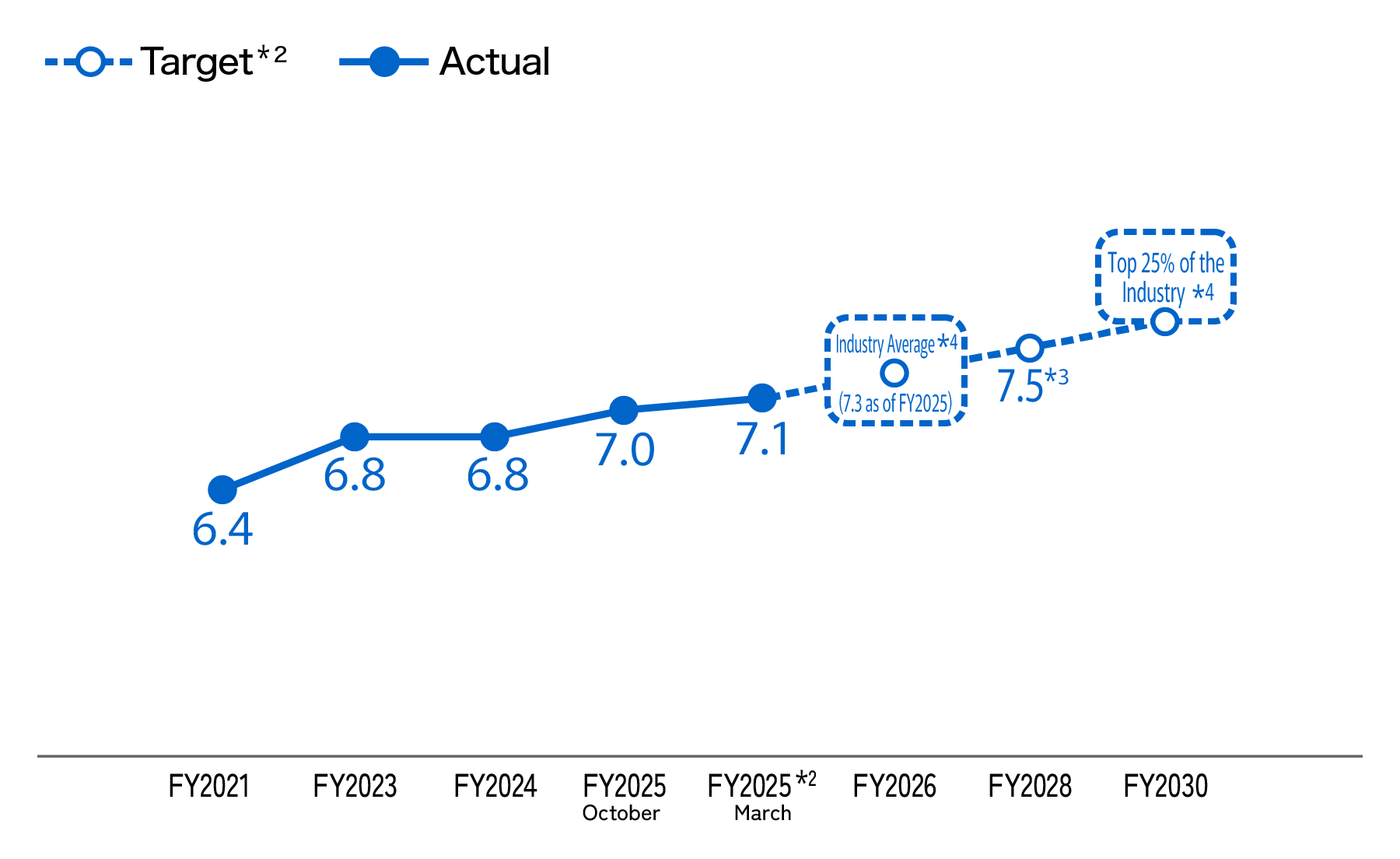
*1Uses the survey platform provided by Workday. The score represents the average response to the “engagement” question in the Global Employee Survey, which is answered on a scale of 0 to 10.
*2Industry: The target is reviewed annually because it is set in line with the global average score for technology companies overall (industry average). The FY2025 target was initially set at 7.7 in FY2023, but was revised to 7.3, the industry average for FY2025.
*3Refers to the top 25% level for the industry overall; therefore, no specific numerical value has been determined at this time. For reference, the top 25% value for the industry in FY2025 was 7.7.
For detailed KPI breakdowns, please see:
Supporting Healthy, High-Quality Living
Vision for 2030
Foster healthy, enriched lifestyles across our workforce, client base, and broader society, helping individuals lead more fulfilling lives.
Environmental and Social Context (2030 Horizon)
In developed countries, aging populations are expected to increase the number of patients with various diseases, resulting in greater demand for medical and nursing care and increased social security costs. In Japan, the gap between supply and demand for nursing care workers is expected to reach approximately 250,000* in FY2026 and widen further in the 2030s. Similar challenges are expected to arise in other developed countries in the future.
It is necessary to improve productivity and safety in medical and nursing care settings while improving the quality and accessibility of medical services and curbing social security costs through disease prevention and early detection.
Opportunities and Risks
Opportunities
- Transforming nursing care workflows and creating a workforce for the nursing care industry
- Contributing to early diagnosis, reduced healthcare costs, and improved QOL through imaging and healthcare IT services
Ensuring Social Safety and Security
Vision for 2030
Elevate safety and peace of mind in work and daily life for our customers and communities, while proactively minimizing operational and product risks.
Environmental and Social Context (2030 Horizon)
Aging factories and equipment, labor shortages, and the retirement of experienced workers are expected to increase the risk of accidents at manufacturing sites and occupational accidents. Safer working environments are also required from the perspective of securing talent. In cyberspace, cyberattacks are becoming increasingly severe and sophisticated, and according to a WEF survey, 72% of respondents reported an increase in cyber risks*.
It is necessary to realize a safe and secure society by visualizing hazards at workplaces, including social infrastructure, and information security risks, and by advancing products and services that contribute to people’s work and daily lives.
*Source: World Economic Forum, Global Cybersecurity Outlook 2025.opens in a new window
Opportunities and Risks
Opportunities
- Ensuring the quality of customers’ products and services through advanced measurement and inspection
Risks
- Loss of public trust in the event of an accident involving a product or service that causes serious harm to the life or physical well-being of a user
- Loss of public trust in the event of a serious security incident leading to information leakage or privacy violations
- Impact on operations and product shipments due to the use of substances that could cause ecosystem contamination or harm to human health
Addressing Climate Change
Vision for 2030
Reduce Konica Minolta’s own CO2 emissions while expanding CO2 reductions among customers and across society.
Environmental and Social Context (2030 Horizon)
Under the Paris Agreement, the world may transition toward a decarbonized society at an accelerating and ambitious pace. Such a transition would bring major changes to the energy structure of industry as a whole, including the increased use of renewable energy. On the other hand, if the transition does not progress as expected and the impacts of climate change become apparent around the world, consequences such as land submergence, loss of biodiversity, and more frequent extreme weather events could have a major impact not only on industry but also on human life itself.
To transition to a decarbonized society, it is necessary to transform workflows and supply chains and fundamentally rethink how energy is used, while establishing new materials, new energy, and new processes for decarbonization as viable industries. It is also necessary to build industrial structures capable of withstanding extreme weather events in preparation for the impacts of climate change becoming apparent.
Opportunities and Risks
Opportunities
- Reducing energy consumption and CO2 impacts at customer companies and in society through workflow and supply chain transformation
- Providing measurement and inspection technologies and materials that support the commercialization of new materials, new energy, and new processes
Risks
- Loss of competitiveness due to delays in transitioning to sustainable energy
- Delays in transitioning to a revenue model that does not depend on print charges as forest resources decline
- Supply chain disruptions caused by extreme weather
Key KPI Targets and Results
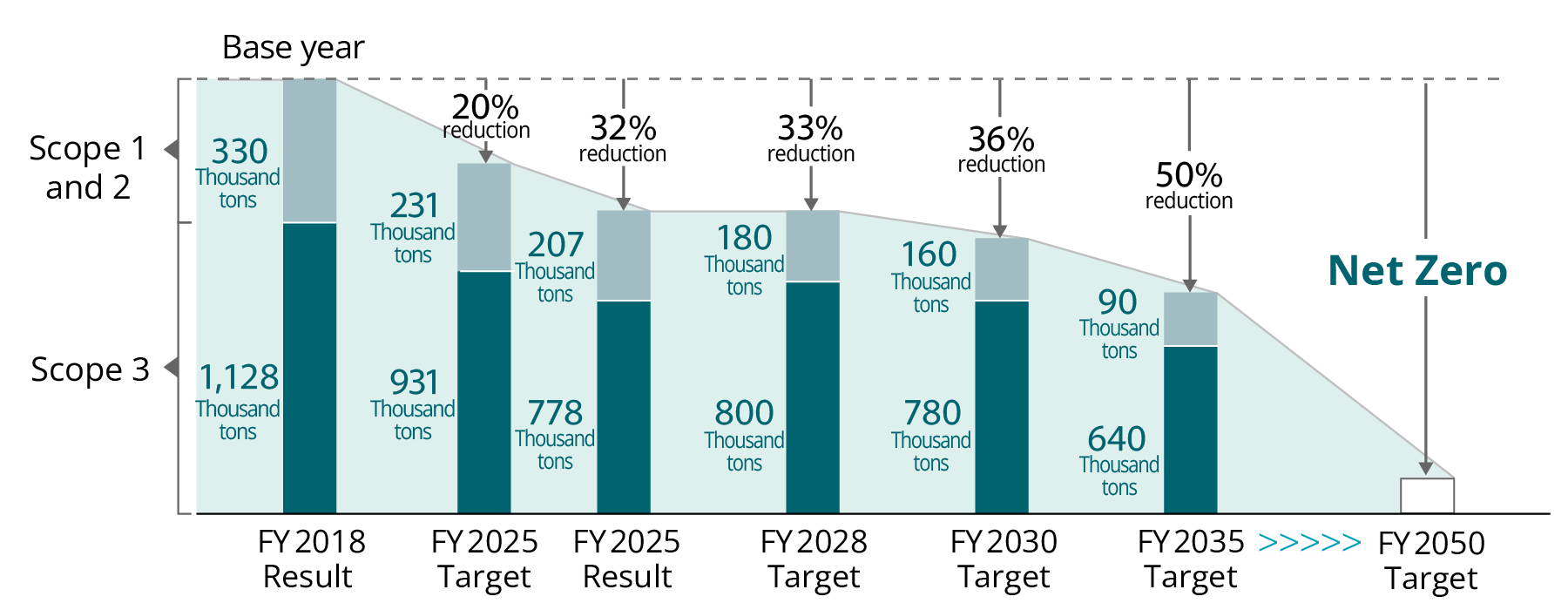
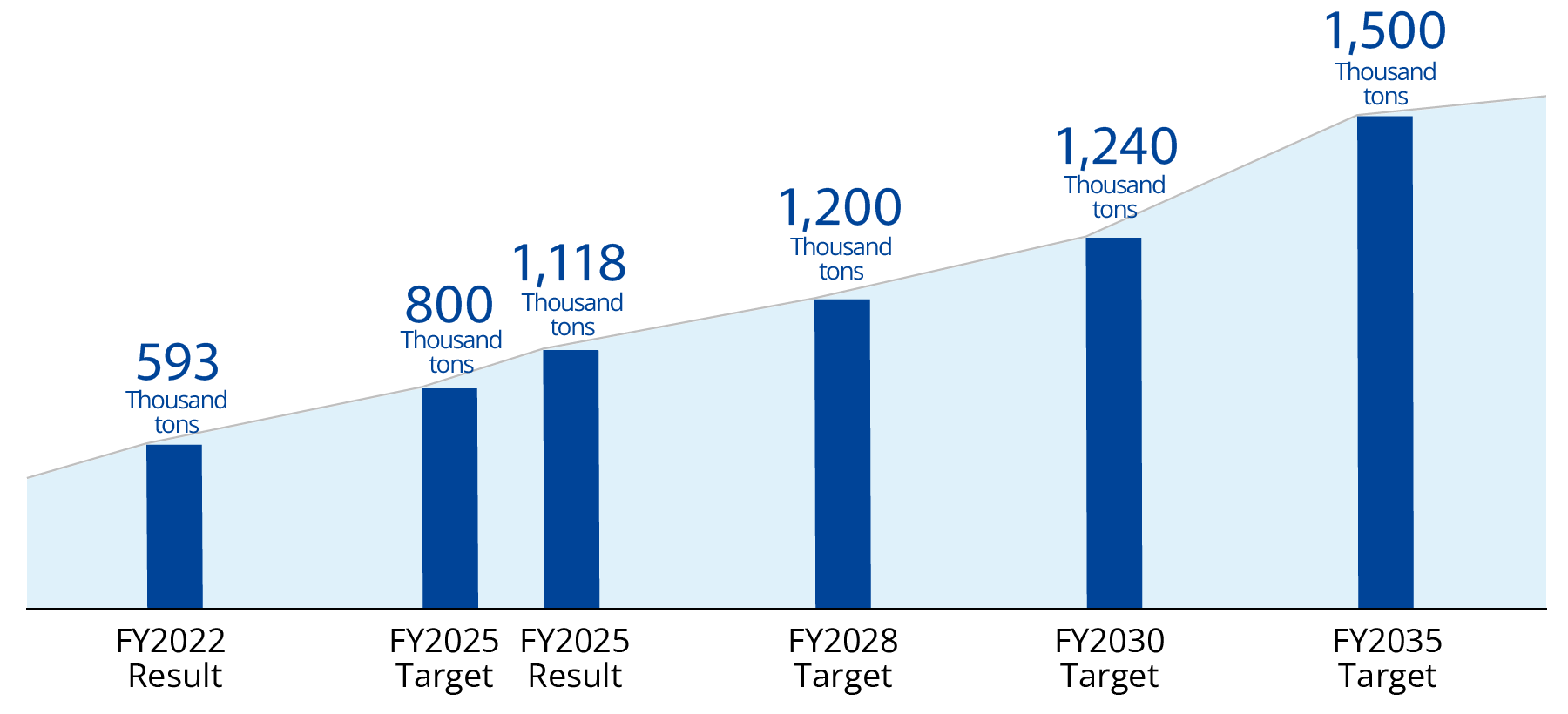
*Avoided CO2 Emissions: The amount of CO2 emissions avoided in society through the provision of Konica Minolta’s products and solutions (Avoided Emissions).
For detailed KPI breakdowns, please see:
Using Limited Resources Effectively
Vision for 2030
Promote the effective use of resources within Konica Minolta while contributing to the effective use of resources by customers and society.
Environmental and Social Context (2030 Horizon)
As the global population increases, it is estimated that by 2030, human resource consumption will reach a level equivalent to approximately two Earths. To make effective use of finite resources, it is important not only to collect waste and recycle and reuse resources, but also to reduce unnecessary resource use.
Fundamental workflow transformation, such as reducing resource waste across supply chains, is required, along with the development of materials technologies and collection networks that contribute to resource circulation. It is also necessary to respond to the circular economy by enabling new materials, new energy, and new processes to become commercially viable under resource constraints.
Opportunities and Risks
Opportunities
- Reducing resource consumption and promoting the effective use of resources at customer companies and in society through workflow and supply chain transformation
- Providing measurement and inspection technologies and materials that support the commercialization of new materials, new energy, and new processes
Risks
- Loss of competitiveness due to delays in transitioning to sustainable raw materials
- Increased costs of materials and components and supply instability due to resource shortages
Key KPI Targets and Results
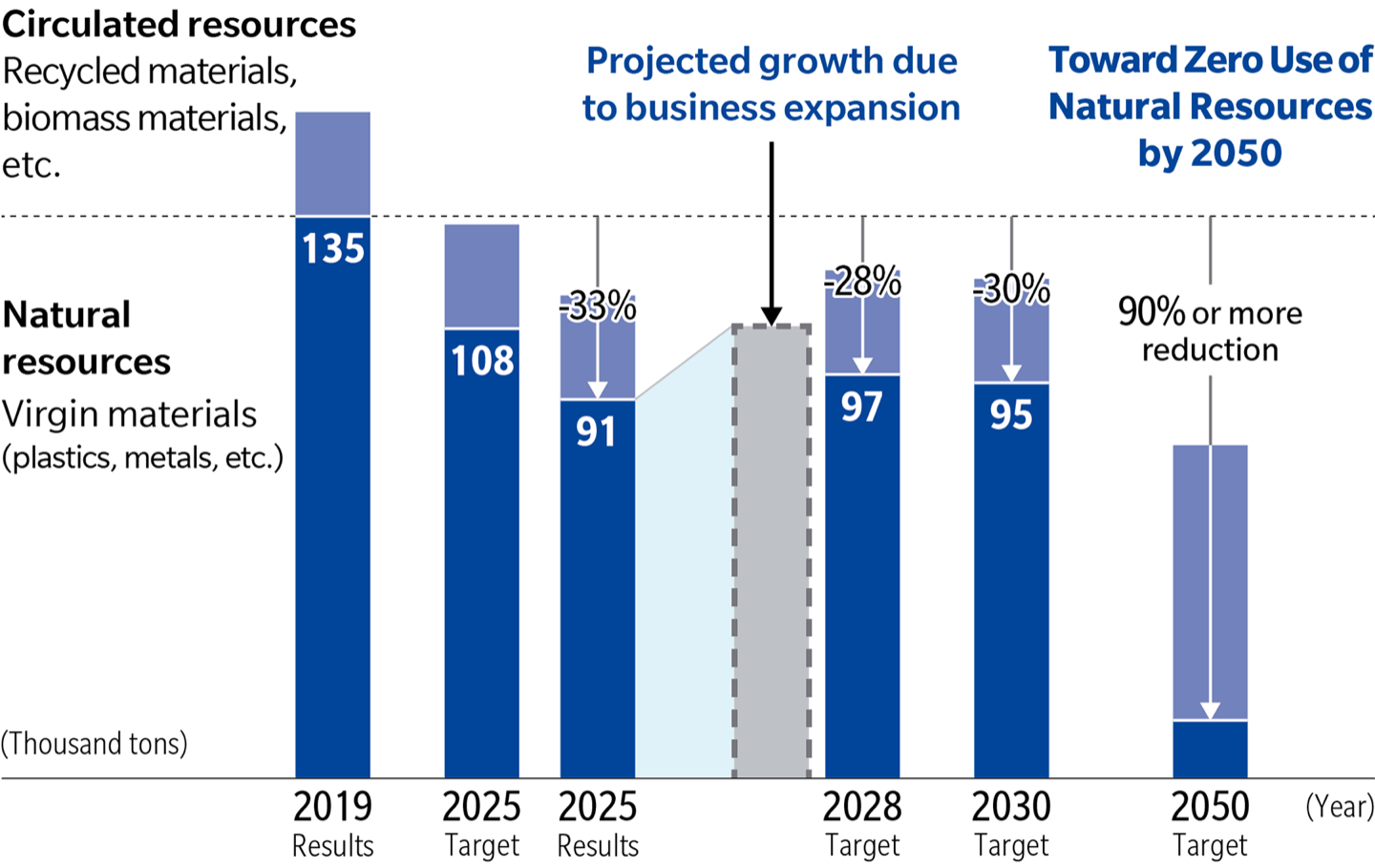
*Natural Resources: Resources that require new extraction, such as crude oil and mineral resources, and are generally synonymous with depletable resources.
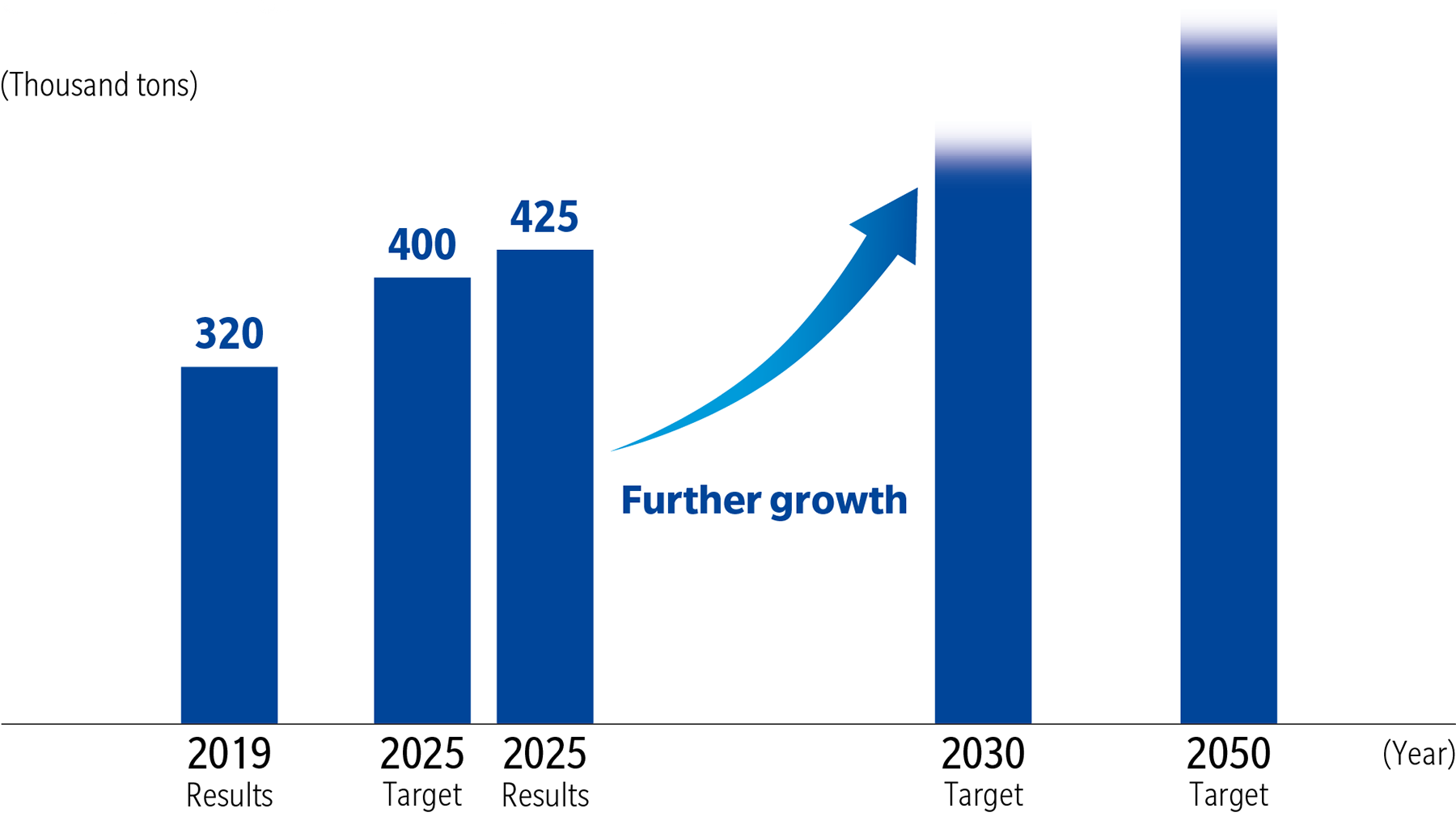
*Contribution to Reducing Natural Resource Usage: The amount by which Konica Minolta products contribute to reducing natural resource usage by customers and society compared with the case in which those products were not introduced.
For detailed KPI breakdowns, please see:
Value Creation Process
Konica Minolta creates customer value through co-creation with customers across its four business groups, combining its strengths in intangible assets—Customer Relationships, Technology Integration, and Diverse Talent—to address the five Material Issues. The resulting economic value (cash flow) is reinvested to further expand the impact of efforts to address environmental and social issues. Continuing this cycle is the Konica Minolta Group’s approach to value creation.
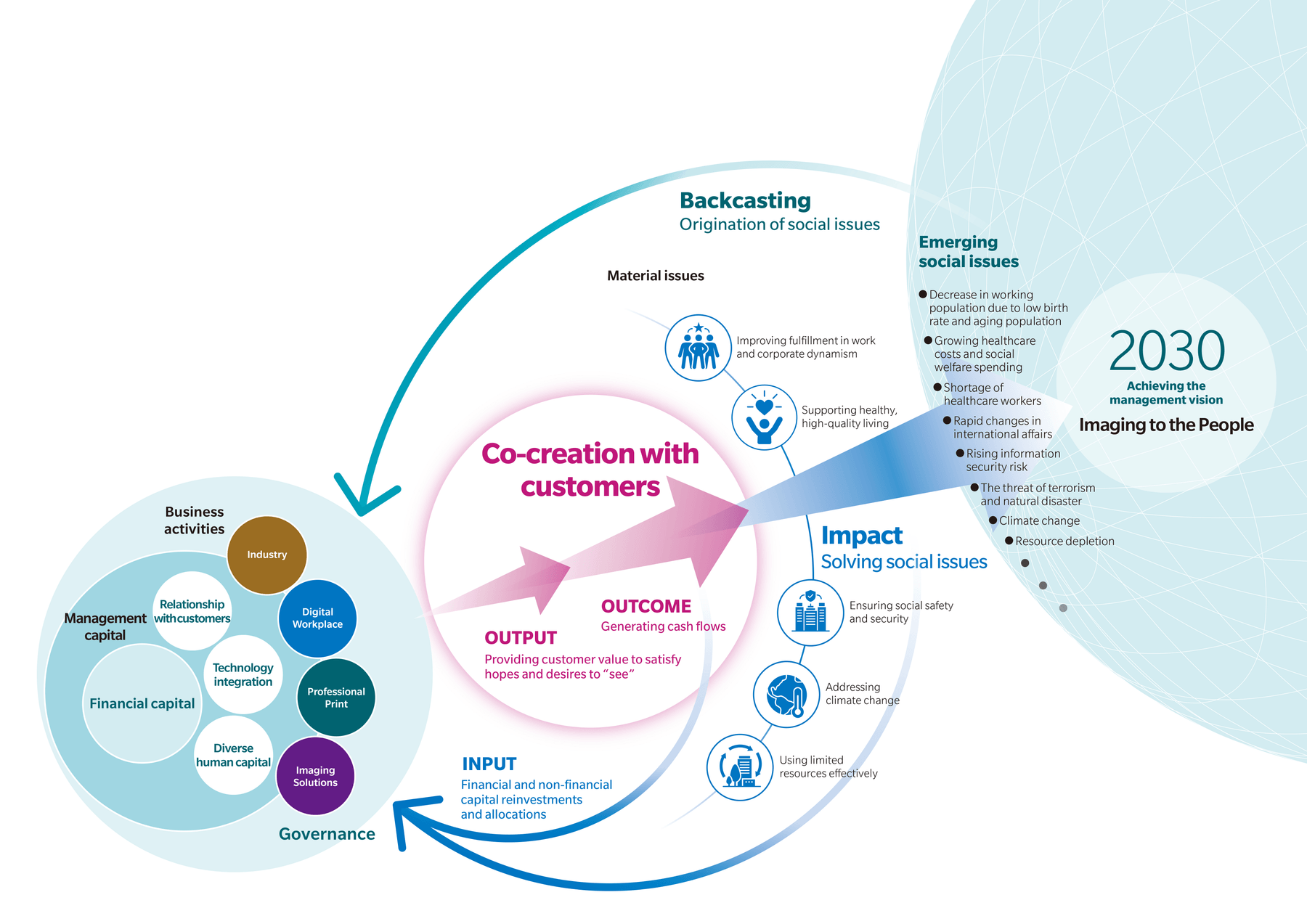
Technology and Business Initiatives Related to Material Issues
Konica Minolta works to create value based on the risks and opportunities associated with its five Material Issues. By identifying the needs of customers and society in relation to environmental and social issues and providing value through its technologies and businesses, the Company aims to both address these issues and achieve sustainable business growth.
Amid growing labor and skilled worker shortages and skill mismatches, Konica Minolta will provide solutions that enable automation, labor-saving, and skill-independent operations. By enhancing productivity while also fostering human creativity, the Company will help improve fulfillment in work, support corporate growth, and establish new industrial foundations.
Case 1: Reducing Dependence on Human Labor, Automation, and Labor-Saving through Sensing Technologies
Against the backdrop of persistent labor shortages, automating exterior inspections and reducing the labor required to check vehicle body paint and fit have become important challenges on automotive manufacturing lines. The Konica Minolta Group combines its long-established technologies for measuring and managing exterior colors with automated inspection technologies to provide systems that inspect paint defects, gaps, and level differences in a non-contact, inline process. In addition to detecting minute defects, the tunnel-type automated paint defect inspection system uses AI to classify and analyze defects and improve the efficiency of repair processes. The system helps stabilize inspection quality and reduce reliance on skilled workers. The defect data obtained can also be used to analyze causes and make improvements, thereby helping to reduce quality losses and advance factory DX (digital transformation). Going forward, Konica Minolta will continue to support improvements in customer productivity and quality by expanding the adoption of these solutions for exterior inspections at automotive manufacturing sites.
For more information, please refer to the following IR-related information:
Case 2: Reducing Reliance on Individual Workers through Digitalization and Standardization and Contributing to a Reproducible Production System Less Dependent on Human Skills.
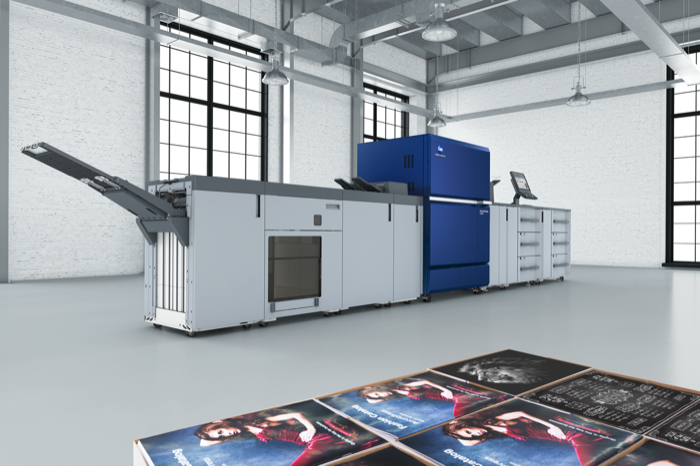
Against the backdrop of a shrinking workforce due to declining birthrates and an aging population, reducing labor requirements and reliance on skilled workers while improving productivity have become urgent priorities at printing sites. Building on its printing technologies centered on optics and image processing, Konica Minolta provides solutions that combine print quality with process automation. The compact AccurioPress series, which combines high quality and reliability, features real-time color correction technology using the Intelligent Quality Optimizer. By reducing reliance on specialized knowledge and experience for adjustments to color, image quality, registration, and other parameters, the series helps prevent human error and rework while supporting consistently high-quality printing. The AccurioPro Flux workflow solution centrally manages the entire process from job submission through shipment, contributing to the establishment of a production system capable of stable operation even under workforce constraints. By reducing reliance on skilled workers at printing sites, these solutions help create a production environment that can maintain stable quality and productivity even under workforce constraints.
For more information, please refer to the following product pages:
- AccurioPress – Digital Color Printing Systems Promoting Automation and Labor-Saving in Printing Processes(Japanese only)opens in a new window
- IQ-601 – Improving Printing Process Efficiency and Print Quality through a Wide Range of Automated Adjustment Functions(Japanese only)opens in a new window
- AccurioPro Flux – Streamlining Job Management and Editing Operations and Optimizing Print Workflows(Japanese only)opens in a new window
To improve access to healthcare services and enhance the quality and efficiency of medical care, Konica Minolta will combine diagnostic imaging technologies with healthcare ICT services to provide information that supports diagnosis and help improve operational efficiency at healthcare facilities.
Case 1: Early Detection and Early Diagnosis of Disease
Chronic thromboembolic pulmonary hypertension (CTEPH) is a rare disease for which early diagnosis can significantly improve treatment outcomes, and evaluation of pulmonary blood flow is considered important for early diagnosis. Pulmonary scintigraphy has traditionally been recommended, but challenges include the burden of the examination on patients due to the need to administer radiopharmaceuticals and the need for expensive equipment. Konica Minolta’s pulmonary blood flow imaging technology using Dynamic Digital Radiography (DDR) uses equipment similar to that used for conventional X-ray imaging. Images can be acquired with a breath-hold of only a few seconds, and changes in density within the lung fields can be visualized to provide reference information for evaluating pulmonary blood flow. In addition to involving lower radiation exposure than pulmonary scintigraphy, the technology does not require contrast media or radionuclides and is therefore expected to reduce the burden of examinations on patients.
In the 2025 Revised Guidelines for Pulmonary Thromboembolism, Deep Vein Thrombosis, and Pulmonary Hypertension published by the Japanese Circulation Society, DDR was recommended as one of the supplementary diagnostic methods to be considered when diagnosing CTEPH. Konica Minolta aims to contribute to the early diagnosis of CTEPH by promoting the wider adoption of this technology.
Case 2: Clinic digital transformation(DX) and AI-Based Diagnostic Imaging Support
Against the backdrop of an aging population and shortages of healthcare professionals, increasing workloads at healthcare facilities and regional disparities in access to healthcare have become significant challenges. There is therefore a need to establish systems that can provide high-quality healthcare efficiently.
Konica Minolta supports the DX of clinics through cloud services and healthcare information systems, including its “infomity” healthcare ICT service. Through solutions that support clinic DX, including image management, online medical consultations, and remote image interpretation support services, as well as operational support following implementation, Konica Minolta helps improve operational efficiency. In doing so, the Company aims to give healthcare professionals more time to interact with patients and contribute to sustainable community healthcare.
Konica Minolta also provides solutions that support diagnostic imaging, including chest X-ray diagnostic imaging support software developed using its long-established image processing technologies and AI, as well as Bone Suppression processing and Temporal Subtraction processing. AI-based diagnostic imaging support is not intended to replace diagnosis by physicians. Rather, it supports the prevention of oversights during image interpretation, improvements in diagnostic accuracy, and greater efficiency in image interpretation, and is expected to contribute to improving the quality of diagnosis.
For more information, please refer to the following:
In response to safety and quality risks associated with aging equipment and increasingly sophisticated products and services, Konica Minolta will support safety and quality control at customer sites by using imaging, optical, and measurement technologies to visualize risks and advance inspection capabilities.
Case 1: Contributing to Improved Reliability of Products that Support Social Infrastructure through Sensing Technologies
Across a wide range of industries, including automobiles and transportation equipment, electrical equipment and displays, lighting, food and agriculture, pharmaceuticals and cosmetics, paints and plastics, and printing and paper, quality control is becoming increasingly important in ensuring product safety and reliability. Objectively quantifying subtle differences in color, brightness, and optical characteristics that are difficult to distinguish through human vision and experience alone, and using this data in manufacturing processes and shipment inspections, are essential for stabilizing quality and reducing the risk of defective products reaching the market.
Leveraging its core technologies, Konica Minolta provides solutions for highly accurate measurement of the color and optical characteristics of objects through measurement instruments such as spectrophotometers, colorimeters, luminance meters, and illuminance meters. These instruments are used in a variety of quality control applications, including color management for automotive interiors and exteriors; evaluation of luminance and chromaticity for displays and lighting; color management for food, pharmaceuticals, and cosmetics; and color matching and shipment inspections for paints, plastics, and printed materials. Through its high-precision measurement and inspection technologies, Konica Minolta will support more advanced quality control and help prevent defective products from reaching the market, thereby contributing to improved product safety and reliability.
For more information, please refer to the following product page:
As the transition toward decarbonization progresses, Konica Minolta will address the low-carbon needs of customers and society by helping reduce environmental impacts through more efficient printing processes and by developing technologies related to next-generation energy.
Case 1: Contributing to CO2 Reductions across the Entire Supply Chain through Digitalization of Print Production Processes
Amid growing demand for reduced environmental impacts, the commercial printing industry is being called upon to reduce CO2 emissions from printing processes. Konica Minolta’s AccurioPress series of digital printing systems and AccurioJet series of inkjet digital printing systems use plate-free digital printing methods, reducing the processes and waste associated with plate making. Automated color and registration adjustments also help reduce paper waste generated during test printing and color adjustment. To raise awareness among printing companies, customers placing print orders, and consumers of how the use of digital printing can contribute to the realization of a low-carbon society, Konica Minolta publishes model calculations of avoided CO2 emissions from printing processes at customers using its systems.
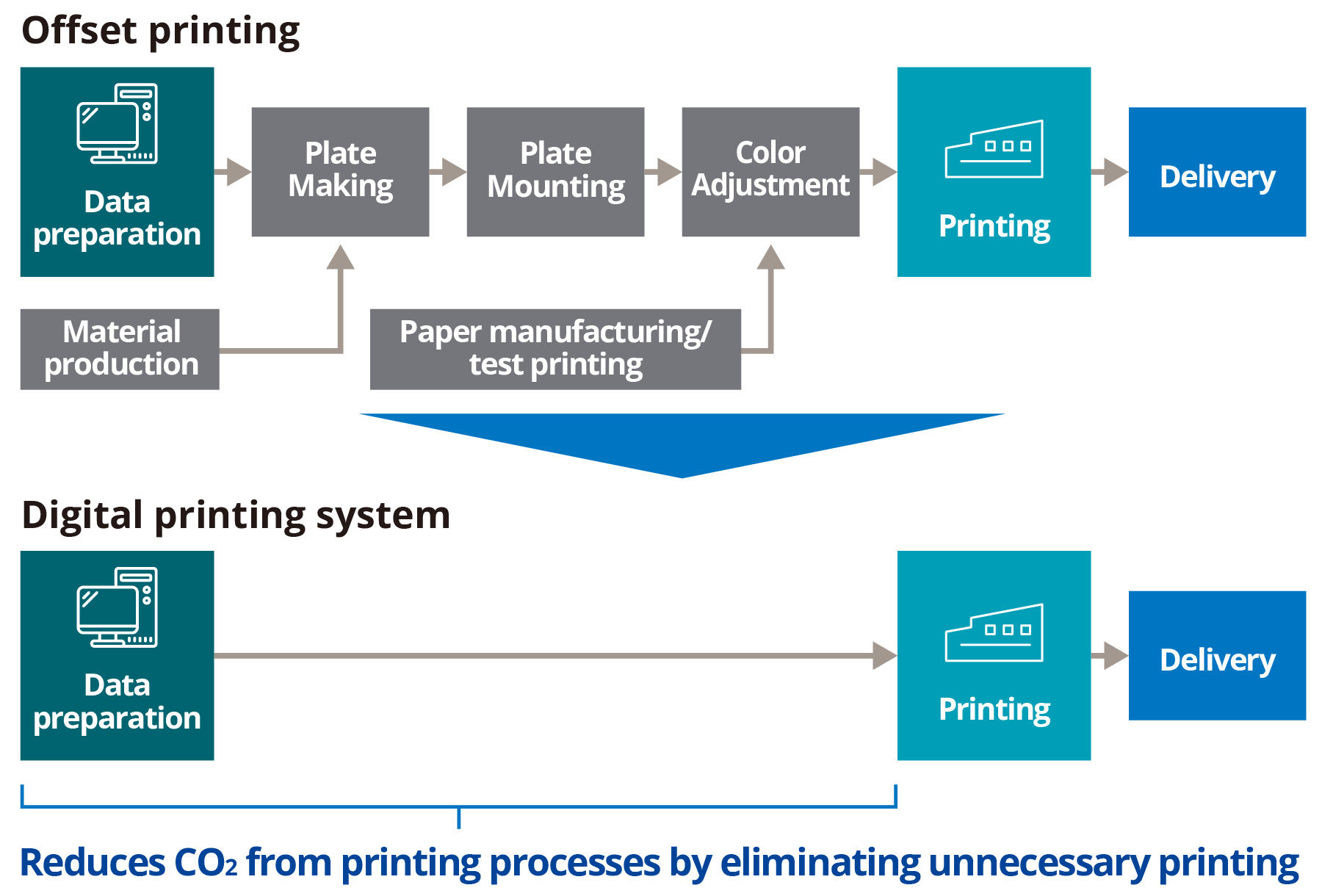
For more information, please refer to the following product pages:
- AccurioPress – Digital Color Printing Systems Promoting Automation and Labor-Saving in Printing Processes(Japanese only)opens in a new window
- AccurioJet KM-1 Series – Reducing the Environmental Impact of Commercial Printing through Digital Printing(Japanese only)opens in a new window
- AccurioJet 30000 – Product Information(Japanese only)opens in a new window
For details on avoided emissions, please refer to:
Case 2: Providing Essential Technology Foundations for a Decarbonized Society, Including Technologies Related to Perovskite Solar Cells
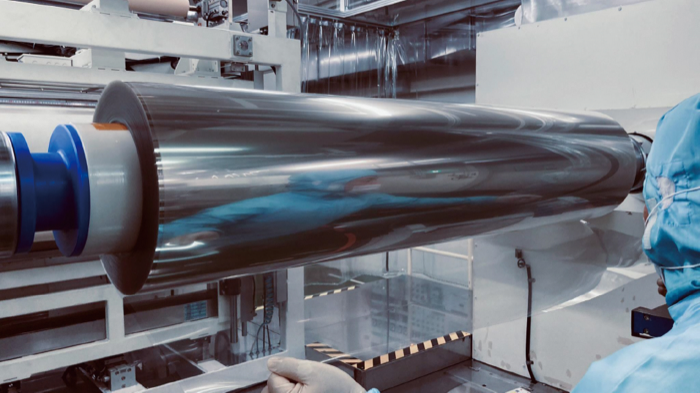
As the transition toward decarbonization progresses, lightweight and flexible perovskite solar cells are expected to be deployed in locations where conventional solar cells are difficult to install, such as factory roofs and building-integrated applications. However, degradation caused by moisture ingress remains one of the challenges to their practical application. Konica Minolta is applying film-forming technologies developed through its OLED lighting business to develop barrier films that contribute to improved water resistance and durability. Through evaluation and demonstration in collaboration with partners, Konica Minolta aims to establish technologies that contribute to improving the durability of perovskite solar cells and to create future business opportunities.
For more information, please refer to the following IR-related information:
To support the transition to a circular economy, Konica Minolta will address customer and societal challenges related to the efficient and circular use of resources by supporting on-demand production through digital printing; developing technologies that enable advanced sorting of waste plastics and help stabilize the quality and expand the use of recycled materials based on predictions of the physical properties of waste plastics; and developing technologies that support greater efficiency and stable quality in biomanufacturing.
Case 1: Promoting a Shift to a Production Model that Does Not Presuppose Overproduction and Disposal through Digitalization of Production
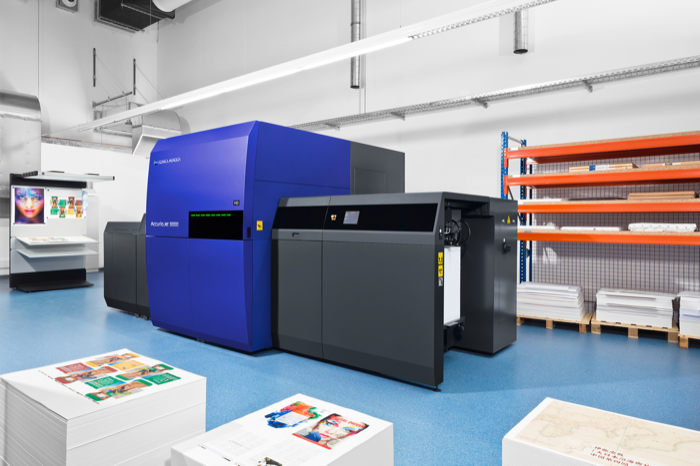
In commercial printing, there is a need to shift from the conventional model based on mass production and inventory holdings to a model in which only the required quantity is produced when needed. At the same time, printing companies’ commitment to maintaining the quality of conventional offset printing has presented an unseen barrier to this transition. The AccurioJet KM-1 series of inkjet digital printing systems uses a plate-free digital printing method and delivers consistently high quality and high registration accuracy even over repeated reprint runs, making it possible to maintain a commitment to quality while transitioning to a new production model. While ensuring high image quality and color stability comparable to offset printing to meet the expectations of printing companies and customers placing print orders, the system helps reduce paper waste generated during printing. It also makes it possible to reduce the overproduction, excess inventory, and disposal of printed materials that have been challenges associated with offset printing. The system also supports printing on a wide variety of media, including plastic materials, helping customers expand their digital printing applications and businesses.
For more information, please refer to the following product pages:
Case 2: Promoting High-Purity Sorting and Material Recycling of Waste Plastics through Sensing Technology
In the recycling industry, which collects, sorts, and recycles waste plastics and textiles, ensuring a stable supply of high-quality recycled materials has become an important challenge amid tighter regulations, particularly in Europe, and growing environmental awareness. At the same time, differences between materials that cannot be distinguished by appearance and the presence of black plastics that are difficult to identify using conventional technologies are obstacles to high-purity sorting.
Konica Minolta provides solutions that use hyperspectral imaging technology to identify various types of plastic materials in a non-contact, non-destructive manner by distinguishing differences between materials based on precise spectral information. The technology captures differences between materials that are difficult to distinguish with the human eye or conventional cameras as spectral information and sorts them by material type with high accuracy, thereby contributing to improved quality of recycled materials. It can also be incorporated into inline sorting systems, promoting the material recycling of mixed waste that has traditionally been difficult to sort and has therefore been used for thermal recovery.
Through highly accurate material identification, Konica Minolta will contribute to expanding the range of materials that can be recycled, reducing CO2 emissions, and conserving resources, thereby supporting the transition to a circular society that makes effective use of limited resources.
For more information, please see:
Case 3: Accelerating the Stable Supply and Quality Assurance of Recycled Plastics Regardless of Raw Material Used

The market for recycled plastics is expanding amid tighter regulations in Europe and growing environmental awareness. However, the need to use high-quality waste plastics consisting of a single material with ensured traceability as raw materials presents a challenge to expanding supply. Konica Minolta has been promoting the use of recycled plastics in multi-functional peripherals (MFPs) since 2011 and, as a user of these materials, has accumulated extensive knowledge of how variations in raw materials affect product quality. Combining this knowledge with sensing technologies and AI, Konica Minolta has developed “Intelligent Recycled Materials,” comprising AI that predicts the physical properties of waste plastics and AI that optimizes manufacturing and molding conditions. By improving the stability of both the supply and quality of recycled materials while accommodating variations in raw material quality, Konica Minolta will support customers in their use of recycled plastics and help create new business opportunities in the circular economy.
Case 4: Process Management Technologies Supporting the Mass Production of Biomanufacturing
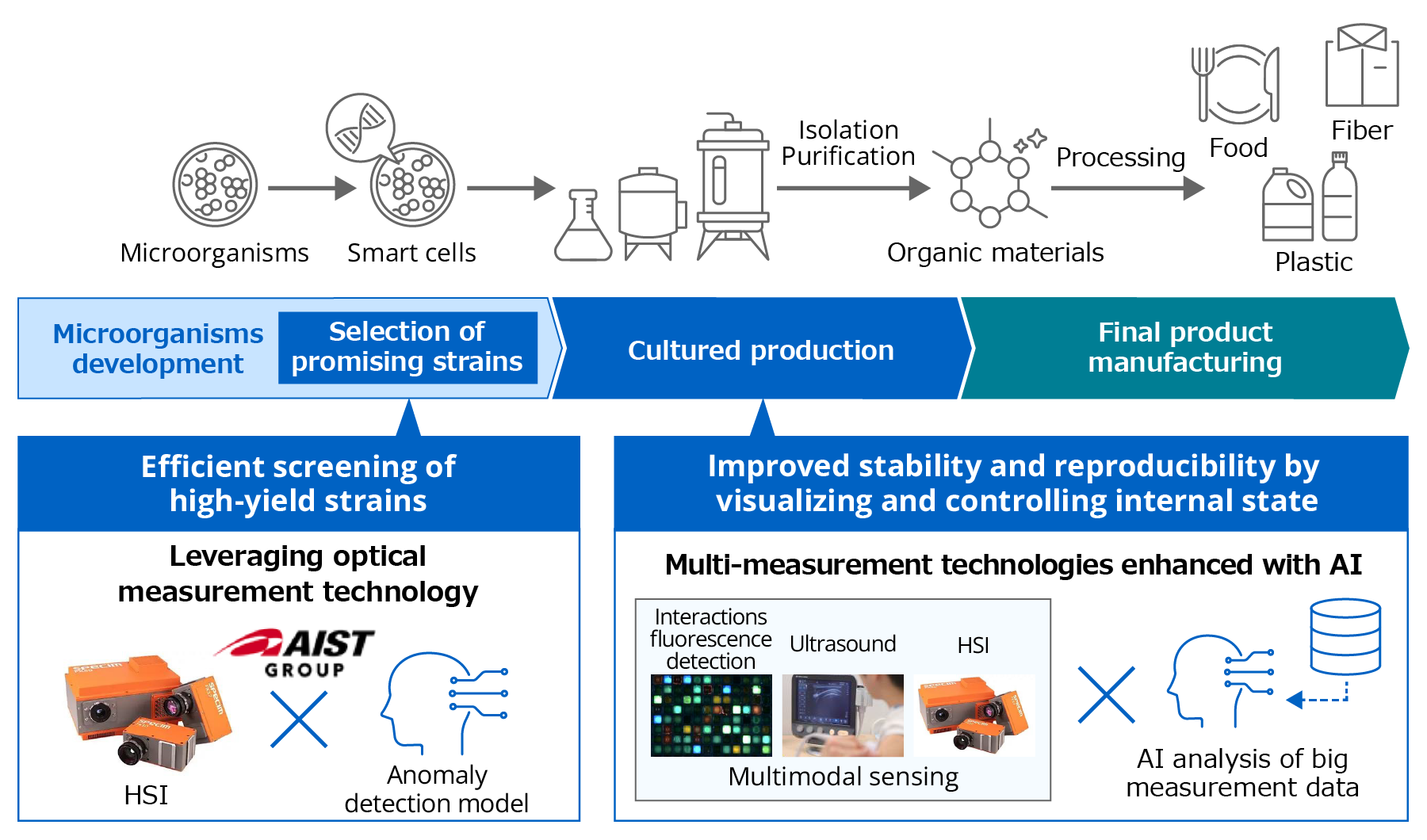
Amid growing demand for decarbonization and resource circulation, “biomanufacturing,” which uses microorganisms to produce high-performance materials and other products, is attracting attention as a technology that can reduce dependence on fossil resources. However, selecting highly productive microbial strains and managing and optimizing culture conditions remain major challenges to practical application and mass production. Konica Minolta is developing technologies that leverage hyperspectral imaging, which precisely analyzes wavelengths of light, together with AI-based analysis to support the early selection of highly productive strains and the visualization and advancement of culture processes. In 2023, Konica Minolta established a collaborative research laboratory with the National Institute of Advanced Industrial Science and Technology (AIST) and is developing a system for the early selection of highly productive strains. Through these technologies, Konica Minolta aims to contribute to advancing the production infrastructure needed for the practical application of bio-based materials in society and to create new business opportunities.
For more information, please see: