
 Search within the site
Use of AI
Basic Concept
Konica Minolta’s management vision is “Imaging to the People,” and the Company has been striving to achieve two goals: “Support people to achieve their own purpose” and “Realize a sustainable society.” To achieve its vision, the Company has been actively utilizing AI in the development of products and services, as well as in other business operations, including R&D, manufacturing, and sales.
Meanwhile, inappropriate use of AI can cause various problems, including violations of privacy or human rights and amplification of human biases, and these problems could negatively impact society and stakeholders.
Additionally, against the backdrop of the rapid spread of generative AI and the development of laws, regulations, and guidelines both in Japan and overseas, companies are required to manage risks and ensure transparency throughout the lifecycle of AI use.
Konica Minolta believes it is crucial to properly understand the potential and risks of AI, and to use AI appropriately and actively based on a common understanding shared throughout the Group worldwide.
Based on this approach, Konica Minolta has established the Konica Minolta Group Basic Policy on the Use of Artificial Intelligence.
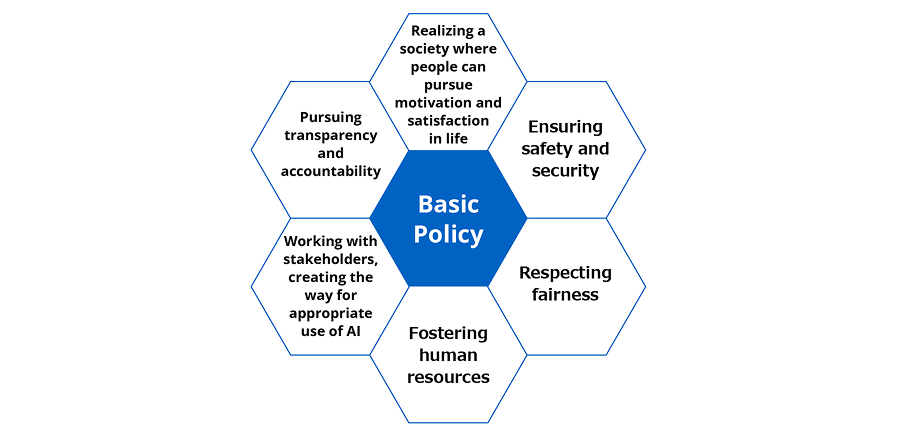
Konica Minolta Group Basic Policy on the Use of Artificial Intelligence
Basic Concept
Konica Minolta has created the concept of “Imaging to the People” -- a long-term management vision aimed at achieving a balance between “supporting people to achieve their own purpose” and “realization of a sustainable society” at the highest level. In an effort to realize this vision, we have embraced research and development of Al, and its practical implementation in society. At the same time, Konica Minolta recognizes that the inappropriate use of Al can cause legal and ethical problems, including privacy or human rights violations.
Konica Minolta hereby establishes the following basic Al Policy (“Policy”) to guide its officers and employees in order for a better use of Al in its efforts to build a better human-centric society.
Scope and Applicability of this Policy
This Policy applies to Konica Minolta, Inc. (“Konica Minolta”) and all of its affiliated companies (collectively with Konica Minolta, the “Konica Minolta Group”) and its officers and employees. “Affiliated” in this instance means a company that is controlled, directly or indirectly, by Konica Minolta. Further, this Policy will govern the use of Al in Konica Minolta Group's products and/or services, as well as in its research and development, manufacturing, sales and other internal business activities.
The Konica Minolta Group may establish and enforce additional internal rules or guidelines in accordance with this Policy.
Basic Policy
To realize a society where people can pursue motivation and satisfaction in life
Recognizing that Al is a tool enabling people to make proactive decisions and supporting them in utilizing their capacities to the fullest, Konica Minolta Group will use Al to contribute to the creation of new and diverse values and a society where people can pursue a meaningful existence.
To ensure safety and security
In using Al, Konica Minolta Group will prioritize safety, and apply and operate Al in continuous consideration of the related risks, so that the unintended effects of Al do not adversely affect society and/or people. In addition, the Konica Minolta Group will respect individual privacy and take responsibility for ensuring the security of personal information, so that it can avoid the unauthorized disclosure and/or misappropriation of personal information as a result of the use of Al.
To respect fairness
Konica Minolta Group recognizes that the algorithms used in Al may include an implicit or inherent bias, which may impair the fairness of its use.
Thus, we continually monitor the effects of Al decisions to identify and eliminate any unintended discriminatory effects from the use of Al.
To pursue transparency and accountability
Konica Minolta Group recognizes that the inner workings of Al are not visible from the outside. Thus, Konica Minolta will strive towards transparency in our use of Al, and to be accountable to society through open and honest communication.
To work with stakeholders, creating the way for appropriate use of Al
Konica Minolta Group recognizes that the environment and values surrounding Al, as well as the way it does business, such as expanding partnerships, continues to evolve.
Thus, in promoting the use of Al, Konica Minolta Group will communicate with various stakeholders including our customers and business partners to deepen mutual understanding and, as a global company, comply with the laws, regulations and governmental rules applicable in each country and region we operate and pursue fair and harmonious use of AI.
To foster human resources
Konica Minolta recruits and trains the employees who develop and implement Al, as well as the employees who widely share an awareness of the issues and values behind this Policy, to promote fair use of Al, and contribute to the realization of a better society.
April 1, 2022

Toshimitsu Taiko
President and CEO
Konica Minolta, Inc.
Strategy, Goals and Results
Under the Corporate Plan 2026-2028 launched in FY2026, Konica Minolta aims to strengthen its earnings base and contribute to sustainable growth by leveraging AI to enhance customer value and improve operational efficiency.
To expand the use of AI, it is essential to appropriately manage AI risks and establish an environment where employees can utilize AI with peace of mind. Konica Minolta is focused on promoting the development and operation of an AI governance structure, carrying out risk assessments and continuous monitoring of projects involving the use of AI, improving AI literacy among employees, collaborating with external parties, and complying with domestic and international laws, regulations, and guidelines. In addition to rolling out these initiatives globally, we will identify issues in each region and implement approaches tailored to specific circumstances. By making these efforts, we will strengthen cooperation across the entire Group and move forward with building a foundation that supports the safe, secure, and appropriate use of AI.
Since establishing the basic policy in FY2021, Konica Minolta has continually conducted risk assessments and reviews on the use of AI. With the widespread adoption of generative AI, the number of reviews has increased year by year, and approximately 150 internal reviews were conducted in FY2025. Following each review, regular monitoring is carried out to confirm the continued appropriateness of AI use, and no serious AI-related incidents have been identified to date.
Furthermore, we provide training designed to improve literacy in the use of AI for all employees of the Konica Minolta Group. In addition, we have enhanced our processes by categorizing projects involving the use of AI by type based on accumulated cases and conducting assessments tailored to their respective characteristics. We are also moving forward with our response to domestic and international laws, regulations, and guidelines — including the EU AI Act — in cooperation with relevant divisions and local subsidiaries.
Going forward, we will continue to flexibly and continuously review our AI governance initiatives to respond to changes in AI technology and the social environment, promoting the active use of AI across the entire Group.
Structure
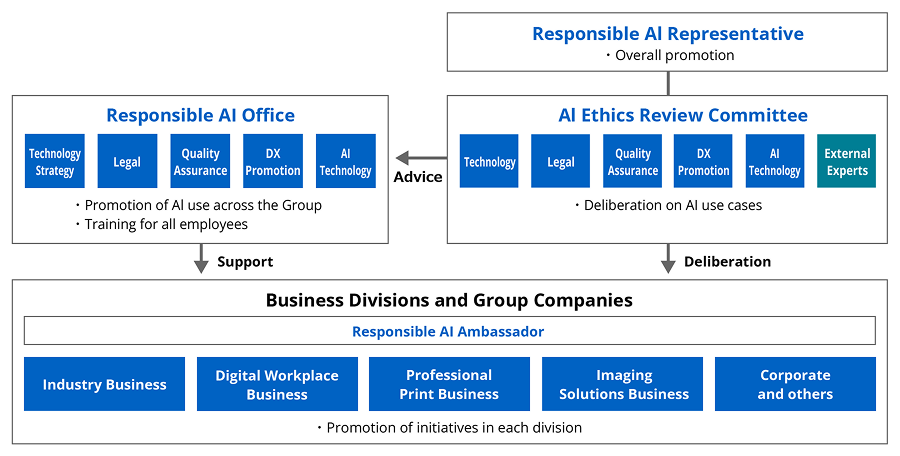
To ensure the appropriate use of AI throughout the Konica Minolta Group, we have established the Responsible AI Office, a cross-company organization consisting of relevant divisions.
In cooperation with the Responsible AI Ambassadors appointed for each business division, the Responsible AI Office supports developers in conducting appropriate risk assessments at the product planning stage, and carries out training and awareness activities for all employees.
The results of the risk assessments conducted by each division are deliberated by the AI Ethics Review Committee, which consists of the executive officer responsible for the division overseeing AI risk management and the promotion of AI use, internal AI technology experts, and external AI ethics experts. The AI Ethics Review Committee meets every other month to deliberate on individual cases and reviews its processes, internal rules, and organizational structure in light of changes in social trends and domestic and international regulations and guidelines related to AI use.
Furthermore, we evaluate our implementation of AI governance with reference to the AI Guidelines for Business jointly issued by Japan’s Ministry of Internal Affairs and Communications and the Ministry of Economy, Trade and Industry, and work toward continuous improvement.
Initiatives
Risk Assessment
With the aim of reducing the risk of problems arising from the inappropriate use of AI, Konica Minolta has created its own checklist for confirming risks associated with the use of AI, referencing various guidelines. When utilizing AI for new products or services, each division uses this checklist to conduct a risk assessment at the product planning stage, and the AI Ethics Review Committee deliberates the results. For projects involving the use of AI, regular monitoring is performed even after operations begin to confirm the presence of any unanticipated risks and verify the effectiveness of risk countermeasures.
In addition, we accumulate examples while collaborating with various teams, including business divisions, to regularly review the checklist and review processes. In FY2025, we advanced our process improvement initiatives by categorizing projects involving the use of AI by type based on the diverse accumulated examples and conducting assessments according to each type's characteristics. Along with the expanded use of AI agents, we have also begun joint discussions with the AI Ethics Review Committee and relevant divisions regarding information management risks stemming from integration between services, as well as risks arising from autonomous execution.
Furthermore, in light of developments in laws, regulations, and guidelines, including the EU AI Act, the Responsible AI Office, business divisions, and local subsidiaries are working together to determine appropriate responses. In Europe, we have strengthened our response framework by developing risk assessment guidelines and checklists for local use. We will continue to review and improve our AI governance processes in response to developments in each country and region.
In-House Training and Literacy Improvements
To ensure that each employee properly understands the potential and risks of AI and can utilize it appropriately based on the Basic Policy, Konica Minolta is committed to continuous training and awareness-raising activities.
In FY2021, we provided training for all employees of Group companies in Japan to learn about AI-related risks, social issues, and basic concepts.
In FY2024, we began ongoing awareness-raising activities, including disseminating information through our internal global site to enhance AI literacy across the Group, including overseas Group companies.
Regarding generative AI, utilization rules were rolled out both in Japan and internationally in FY2023. These rules specify requirements for the use of generative AI, including the proper handling of personal and confidential information, compliance with contracts and intellectual property rights such as copyrights, consideration for privacy and human rights, and human review of AI-generated output.
In FY2025, in addition to providing generative AI literacy training for employees of Group companies in Japan and selected Group companies overseas, we provided training for new hires covering the basic concepts, risks, and internal rules related to the use of generative AI. We also launched specialized training tailored to specific roles, such as training for personnel responsible for conducting risk assessments. Going forward, we will continue to expand the target audience and training content in phases to improve AI literacy across the entire Group.
External Collaboration and Communication
To ensure the safe, secure, and appropriate use of AI, Konica Minolta identifies social trends, technological advancements, and practical issues regarding AI by engaging in dialogue and collaboration with customers, partner companies, and research institutions such as universities, as well as by participating in relevant organizations and cross-industry information exchanges. We apply these insights to improve and further develop our risk assessment processes, internal rules, and employee training.
Additionally, we communicate our initiatives broadly to society through academic publications and presentations. Moving forward, we will enhance the effectiveness of our AI governance through cooperation with a wide range of stakeholders, contributing to the realization of a human-centric and sustainable society.