
 Search within the site
Managing Occupational Safety and Health
Basic Concept
Konica Minolta considers ensuring workplace safety and maintaining and promoting the health of every employee to be fundamental to its corporate management. Because occupational accidents not only threaten employee safety but may also affect the surrounding environment and business continuity, the company recognizes the prevention of occupational accidents and the creation of an environment in which employees can work with peace of mind as important management priorities.
Based on this philosophy, Konica Minolta has established the Konica Minolta Occupational Safety and Healthcare Policy in accordance with the Konica Minolta Group Charter of Corporate Behavior, which was approved by the Board of Directors. By promoting occupational safety and health activities throughout the Group, Konica Minolta aims to create a healthy, safe, and pleasant workplace environment.
The Konica Minolta Occupational Safety and Health Policy applies to personnel working for the Group (officers, employees, contract employees, dispatched workers, and part-time workers) as well as on-site contractors (contractors and outsourced service providers performing work on Group premises).
Konica Minolta Occupational Safety and Healthcare Policy
The Konica Minolta Group believes that corporate management is founded on maintaining and promoting workplace safety and healthcare for every employee. We aim to build a healthy, safe, and supportive workplace environment by implementing occupational safety and healthcare initiatives that emphasize daily preventive actions. Our concept is to promote continuous improvement in occupational safety and healthcare issues by quantitatively evaluating and analyzing their effects and impacts, using various types of data on occupational safety and healthcare. This basic concept is demonstrated in the following affirmation:
“Management Based On Facts”
1. Improving the Level of Occupational Safety and Healthcare
We will improve the level of occupational safety and healthcare by scientifically studying occupational safety and healthcare in all areas of our corporate activities, assessing risks and hazards in advance, and making improvements.
2. Building a Supportive Workplace
We will build a healthy and supportive workplace by properly managing physical and mental healthcare and improving the workplace environment.
3. Managing the Safety of Chemical Substances
We will prevent accidents and health problems by correctly assessing the efficacy of chemical substances and their impact on healthcare, safety, and the environment, and ensuring proper management of chemical substances.
4. Complying with Laws, Regulations and Other Requirements
We will comply with laws and regulations related to occupational safety and healthcare in respective regions. We will also establish voluntary standards as necessary and comply with them. We will observe agreements with employees and agreements in the international community.
5. Facilitating Good Communication
We will facilitate good communication among employees, recognizing that building mutual trust is the foundation of occupational safety and healthcare activities.
6. Offering Education and Training on Occupational Safety and Healthcare
We will make this policy and the occupational safety and healthcare targets clearly known to employees. We will also offer education and training necessary to ensure safety and healthcare.
7. Improving Occupational Safety and Healthcare Activities
We will allocate appropriate managerial resources and make continuous and effective improvements in deploying occupational safety and healthcare activities.
April, 2022
President & CEO
Konica Minolta, Inc.
Strategy, Goals and Results
Konica Minolta has identified the “prevention of serious accidents*1” as a key measure and has established the frequency rate of lost-time injuries*2 and unsafety marks*3 as KPIs to drive continuous improvement.
In FY2025, there were no serious accidents*1. There were three lost-time injuries (two in Japan and one outside Japan). The frequency rate of lost-time injuries*2 was 0.08 in Japan, 0.06 outside Japan, and 0.07 overall. According to the Ministry of Health, Labour and Welfare’s “Survey on Industrial Accidents (FY2025),” the average frequency rate of lost-time injuries was 1.33 for the manufacturing industry in Japan and 0.60 for the electrical machinery and equipment manufacturing industry. Konica Minolta’s rate was substantially below both of these averages. Unsafety marks*3 totaled 197 in FY2025, a 20% increase from 164 in the previous fiscal year. In particular, an increase in accidents caused by slips and trips pushed up the overall figure, resulting in the highest level during the medium-term management plan (2023–2025) period.
Under the Corporate Plan 2026–2028, Konica Minolta will expand the scope of application of safety assessment methods to identify various risks and unsafe conditions in the workplace, while promoting on-site KY (Kiken Yochi / Hazard Prediction) activities as a key measure. In addition, the Group will periodically review the status of initiatives in each division and share and implement effective measures across the Group, thereby reducing risks and preventing serious accidents.
| Key measures (KPI) | Results | Targets | ||||
|---|---|---|---|---|---|---|
| FY2023 | FY2024 | FY2025 | FY2025 | FY2028 | FY2030 | |
| Number of serious accidents*1 | 0 | 0 | 0 | 0 | 0 | 0 |
| Frequency rate of lost-time injuries*2 (Japan) | 0.12 | 0.22 | 0.08 | 0.10 or less | 0.10 or less | 0.10 or less |
| Unsafety marks*3 | 178 | 164 | 197 | 128 | 74*4 | - |
- *1Serious accidents: (1) Fatalities; illnesses requiring (or potentially requiring) long-term medical treatment; injuries resulting in (or potentially resulting in) permanent disability; and specified infectious diseases; (2) accidents in which three or more workers are killed, injured, or become ill due to work at the same time (including non-lost-time accidents).
- *2Frequency rate of lost-time injuries: Number of workers involved in lost-time injuries per one million aggregate actual hours worked by employees.
- *3Unsafety marks: An indicator of an organization’s safety status calculated by assigning points according to the type and severity of individual accidents and incidents, including lost-time injuries, non-lost-time injuries, commuting accidents, and fires and explosions, and aggregating the resulting scores.
- *4From FY2026, to evaluate the effectiveness of safety measures during work and while commuting, unsafe points management has covered only incidents occurring during work.
For detailed data, please refer to Occupational Safety and Health under Social Data in the ESG Data.
Structure
Occupational Safety and Health Management System
At Konica Minolta, the Group Safety and Health Officer, appointed by the President and CEO of Konica Minolta, Inc., appoints Safety and Health Promotion Managers for each business division. In addition, Site Occupational Safety and Health Committees are established at each site, creating a Group-wide safety and health management system.
Each business site and Group company in Japan has established a joint labor-management Site Occupational Safety and Health Committee to promote occupational safety and health, including health promotion. These committees meet once a month. In accordance with applicable laws and regulations, each committee consists of a general safety and health manager, safety managers, health managers, and an occupational physician, as well as members representing the Company and the labor union. Half of the committee members are appointed based on recommendations from the labor union or as employee representatives and participate in activities and discussions together with members representing the Company.
Each business division also manages safety and health in its operations through a Business Division Occupational Safety and Health Promotion Committee. When a serious safety or health issue or concern is identified, it is promptly reported to the Group Safety and Health Officer. The Group Occupational Safety and Health Secretariat provides instructions on corrective actions and other measures and, after reviewing the details, implements them in cooperation with the relevant division. In addition, from FY2026, Konica Minolta has strengthened its Group-wide functions for promoting safety initiatives, with a particular focus on production safety.
Under Konica Minolta’s rules, when an accident occurs within the Group, an incident report must be entered and recorded in the accident database system within 24 hours and the information shared. Approximately 50 staff members dedicated to occupational safety and health are assigned across the Group.
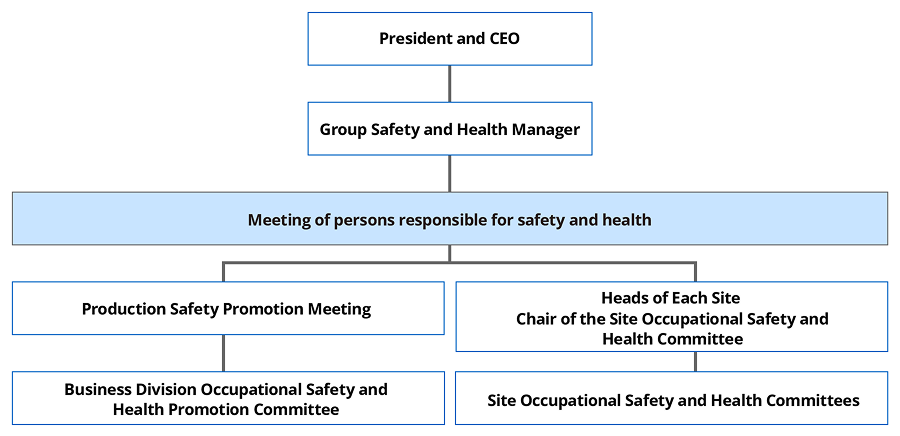
Occupational Safety and Health Management System
All Group companies in Japan and the Group’s major production companies outside Japan have implemented occupational safety and health management systems. Some Group companies have obtained external certification (ISO 45001). Companies that have not obtained external certification also operate and manage their occupational safety and health activities under their own systems based on the Ministry of Health, Labour and Welfare’s Guidelines on Occupational Safety and Health Management Systems, which conform to the ILO Guidelines on Occupational Safety and Health Management Systems. As of March 31, 2026, three Group companies worldwide had obtained external certification, representing 18% of the Group’s employees.
The management systems primarily cover employees, including dispatched workers accepted by Group companies. Konica Minolta also asks outsourced service providers and contractors permanently stationed on its premises to cooperate with occupational safety and health activities through such means as regular safety and health liaison meetings held by the Site Occupational Safety and Health Committee.
Legal compliance management under the management systems covers the Industrial Safety and Health Act and related regulations (Ordinance on Industrial Safety and Health, Ordinance on Health Standards in the Office, Ordinance on Prevention of Organic Solvent Poisoning, etc.), the Labor Standards Act and related regulations (Ordinance on Labor Standards for Women), and other safety and health-related laws and regulations (Fire Service Act, High Pressure Gas Safety Act, Poisonous and Deleterious Substances Control Act, etc.).
| Company | Date | Valid through | Standard |
|---|---|---|---|
| Konica Minolta Business Technologies (Dongguan) Co., Ltd. | Aug. 13, 2020 | Nov. 27, 2027 | ISO 45001:2018 |
| Konica Minolta Opto (Dalian) Co., Ltd. | Dec. 8, 2020 | Dec. 7, 2026 | ISO 45001:2018 GB/T45001-2020 |
| Konica Minolta Business Technologies (Malaysia) Sdn. Bhd. | Jan. 16, 2015 | Jan. 15, 2027 | ISO 45001:2018 |
Initiatives
Providing Safety Training
Konica Minolta provides safety training to all personnel working at its business sites upon hiring and whenever their work assignments change. In addition, as part of level-based education, the company provides safety training for new employees, newly appointed assistant managers, and newly appointed managers, with approximately 350 people participating annually. The company also provides training required for specific workplaces, including training for chemical substance managers and protective equipment wear officers, hazardous materials safety training related to the Fire Service Act, high-pressure gas safety training, and machinery and equipment safety training. Special safety training is also provided for high-risk operations, such as transporting materials by forklift.
Safety Mindset Refresh Education
Since FY2017, Konica Minolta has provided short (five-minute) training sessions aimed at raising employees’ safety awareness by reinforcing the basic mindset and behavior of “protecting one’s own safety.” The company will continue to provide this training. In FY2025, the training was provided monthly via e-learning to approximately 8,800 employees of Konica Minolta, Inc. and Group companies in Japan, as well as employees stationed overseas, with 95% of the target employees completing the training.
At production companies outside Japan, information on accidents that have occurred within the Group is shared using materials translated into English and Chinese, and measures are implemented at relevant locations to prevent similar accidents from occurring. In addition, as part of ongoing safety awareness training, the Group continues to provide training using video materials developed primarily by safety personnel within the Group, based on actual cases of behavior-related accidents that have occurred within the Group.
Hazard Simulation Training
Since FY2014, Konica Minolta has conducted hazard simulation training, primarily at production sites outside Japan, using hazard simulation equipment that allows employees to experience simulated accidents, such as being caught in or between rotating or moving machinery. By giving employees a firsthand sense of the dangers of such accidents, the training is designed to help prevent accidents before they occur. The training was expanded to production sites in Japan in FY2017, and in FY2019, the company also introduced a virtual reality (VR) training program that enables employees to experience simulated hazards.
These training programs are provided continuously to employees in Japan and overseas through regular visits to each production site. They are also incorporated into training for new employees and periodic training programs to maintain and enhance employees’ awareness of accident risks and continuously foster a strong safety mindset.
Strengthening Safety Management
Konica Minolta is strengthening its safety management in response to changes in its businesses and the globalization of its operations.
Strengthening Risk Assessment (Reviewing the Organizational Structure and Framework)
Since FY2016, Konica Minolta has implemented and continuously operated a company-wide framework for conducting risk assessments from a comprehensive perspective encompassing employee safety and health, fire and explosion accidents, environmental impacts, and other factors whenever new equipment or chemical substances are introduced or 4M* changes are made.
Through these efforts, Konica Minolta has identified priority risks with a high potential to lead to serious accidents as “fires and explosions caused by flammable substances, dust, or electrical incidents, and accidents involving workers being caught in or between moving parts of machinery and equipment,” and is implementing measures to prevent occupational accidents based on action plans.
As a specific initiative to prevent major fire and explosion accidents within the Group, Konica Minolta substantially revised its Group Safety and Health Management Regulations in FY2022, taking into account the opinions of external experts. The revision clarified that business divisions and affiliated companies are responsible for taking the lead in conducting risk assessments and defined the organizational structure, responsibilities, and authority. At the same time, Konica Minolta established Detailed Risk Assessment Rules to clarify the rules and procedures for conducting risk assessments. Since FY2022, business divisions and affiliated companies have taken the lead in promoting these activities based on these rules.
Furthermore, Konica Minolta conducts risk assessments of existing equipment and work activities in a planned and continuous manner, rather than limiting them to the introduction of new equipment or chemical substances and 4M* changes.
*4M: Man, Machine, Material, Method
Creating a Culture of Safety
For employees to find their work rewarding and demonstrate their creativity and individuality, it is essential to provide a workplace environment that is free from accidents, promotes good health, and allows employees to work with peace of mind. Konica Minolta believes that creating such a workplace environment requires building a culture in which “Safety Takes Priority Over Everything Else.” During the period covered by the Corporate Plan 2026–2028, beginning in FY2026, Konica Minolta will pursue the following three initiatives to foster a culture of safety:
- Reducing the risk of major and serious accidents by enhancing risk assessments
- Reducing work-related risks by sharing awareness of workplace hazards and implementing management practices that take physical strain into consideration
- Promoting universal safety by raising individual safety awareness and putting safe behaviors into practice
To ensure that the factory accident that occurred in 2021 is never forgotten and that the lessons learned are used to prevent future accidents, Konica Minolta has designated July 6, the date on which the accident occurred, as “Safety Day” since FY2023. On Safety Day, executive officers visit production sites and affiliated companies in Japan and overseas and work to raise safety awareness and foster a culture of safety through dialogue with employees and workplace safety checks.
Furthermore, to preserve and continuously pass on information about serious accidents and the lessons learned from them, Konica Minolta established the “Safety Heritage Room” in FY2026.