
 Search within the site
Human Rights
Basic Concept
Human rights are universally valued rights that all people are born with. In today’s world, there is a growing awareness that businesses can have a great impact on human rights.
The Konica Minolta Group Charter of Corporate Behavior establishes the principles of corporate behavior for Konica Minolta’s business activities, and in April 2022, with the approval of the Board of Directors, added respect for human rights as one of its principles.
Furthermore, based on the Konica Minolta Group’s corporate philosophy and management vision, the Konica Minolta Group Human Rights Policy establishes the Group’s responsibilities and commitment to human rights. This policy was approved by the Management Council in September 2021.
Konica Minolta Group Human Rights Policy
Basic thinking
The Konica Minolta Group has established "Imaging to the People" as its management vision, and aims both to "support people to achieve their own purpose" and "realize a sustainable society" to a greater degree. To achieve this goal, we will strive to fulfill our responsibilities by recognizing respect for human rights as a basic principle of the Konica Minolta Group's business activities.
Based on the UN Guiding Principles on Business and Human Rights, we support and respect the human rights set out in the "International Bill of Human Rights" and the International Labor Organization's Declaration on Fundamental Principles and Rights at Work. In addition, we will comply with the relevant laws and regulations of each country in which we conduct business. In the case of deviations between the laws and regulations of a country and international norms, we will attempt to respect and prioritize international norms to the extent admissible by the laws and regulations of a country.
This policy declares the Konica Minolta Group's responsibility and determination to support human rights based on the Konica Minolta Group's corporate philosophy and management vision, and ranks high among the human rights policies in the Konica Minolta Group.
Scope of application of this policy
This policy applies to all directors, officers and employees of the Konica Minolta Group, which consists of Konica Minolta Inc. and its consolidated subsidiaries. In addition, based on this policy, we will respect human rights and ask business partners and other parties connected to the Konica Minolta Group's business not to violate them.
Initiatives to Respect Human Rights
1) Elimination of discrimination
Within our workforce and in our relationships with business partners, we will strive to eliminate discrimination based on race, gender, nationality, age, sexual orientation and gender identity, religion, ethnicity, disability, pregnancy status, ideology, creed, social status, etc.
2) Consideration for employees
We will respect the diversity, fundamental human rights, and privacy of our employees, strive to eliminate all forms of discrimination within our workforce and in our relationships with business partners, eliminate child labor, forced labor, harassment, etc., and strive to manage appropriate working hours, secure a minimum wage, provide a safe and hygienic work environment, and respect freedom of association and the right to collective bargaining.
3) Consideration for business activities
We will, in accordance with the human rights principles set forth in the Konica Minolta Group's Supply Chain Code of Conduct, require our suppliers to adhere to those principles when they conduct business with us. In addition, we will work to respect our customers' privacy so that we do not cause them to be discriminated against.
Practice of Respect for Human Rights
1) Implementation of human rights due diligence
We will strive to prevent and mitigate negative human rights impacts by establishing human rights due diligence mechanisms, assessing and identifying potential or actual human rights risks, and addressing them.
2) Remedies
We will use a system that can capture human rights concerns, and when human rights violations are alleged, promptly investigate such allegations, in order to take corrective action through appropriate internal and external procedures if it is clear that we have directly caused or been involved in a negative impact on human rights.
3) Education
We will provide appropriate education to directors, officers, employees, etc. so that this policy can be incorporated into all business activities of the Konica Minolta Group.
4) Dialogue with stakeholders
We will seek expert advice from external stakeholders regarding this policy and our efforts based on this policy to strengthen our commitment to respect human rights.
5) Information disclosure
We will disclose the progress of our efforts to address the negative impact on human rights appropriately through our website and Integrated Reports.
April 1, 2022

Toshimitsu Taiko
Konica Minolta, Inc.
President and CEO
In addition, the Konica Minolta Supply Chain Code of Conduct outlines specific actions that each Group company should take, and the Group also requests that its business partners act in accordance with the same standards. This Code is based on the latest version of the Code of Conduct of the Responsible Business Alliance (RBA), which Konica Minolta joined in 2013 to enhance the quality and transparency of CSR procurement.
In its initiatives, Konica Minolta particularly supports and respects the latest versions of the following global principles and international norms:
- Universal Declaration of Human Rights
- International Covenants on Human Rights
- The International Labor Organization (ILO) Declaration on Fundamental Principles and Rights at Work
- United Nations Guiding Principles on Business and Human Rights
- OECD Guidelines for Multinational Enterprises
- United Nations Global Compact
- ISO 26000
- RBA Code of Conduct
Structure
Konica Minolta promotes its human rights initiatives under the leadership of the Group Human Rights Officer (the Executive Officer responsible for human rights), a position established this year. The Corporate Strategic Planning Division, which handles sustainability, plays a central role in advancing these initiatives in collaboration with the Corporate Divisions responsible for promoting them and the business divisions responsible for implementing them.
In the same fiscal year, we established the Human Rights Promotion Committee to govern human rights initiatives across the entire company, aiming to strengthen human rights compliance throughout the Group.
In addition, we are strengthening our governance system by having the Group Human Rights Officer report on the status of human rights initiatives and material issues to the Board of Directors through the President and CEO.
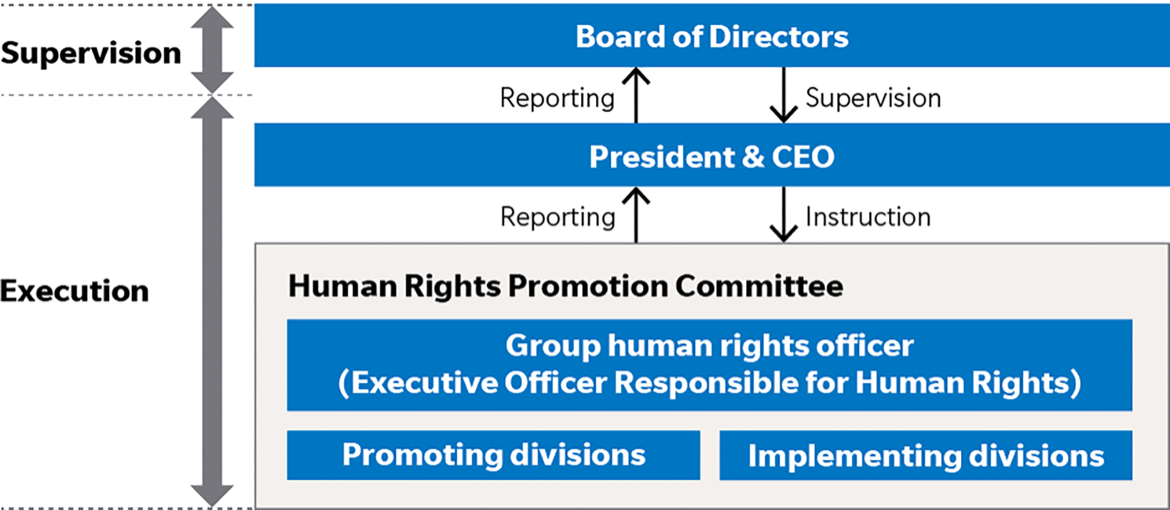
Management Process for Human Rights
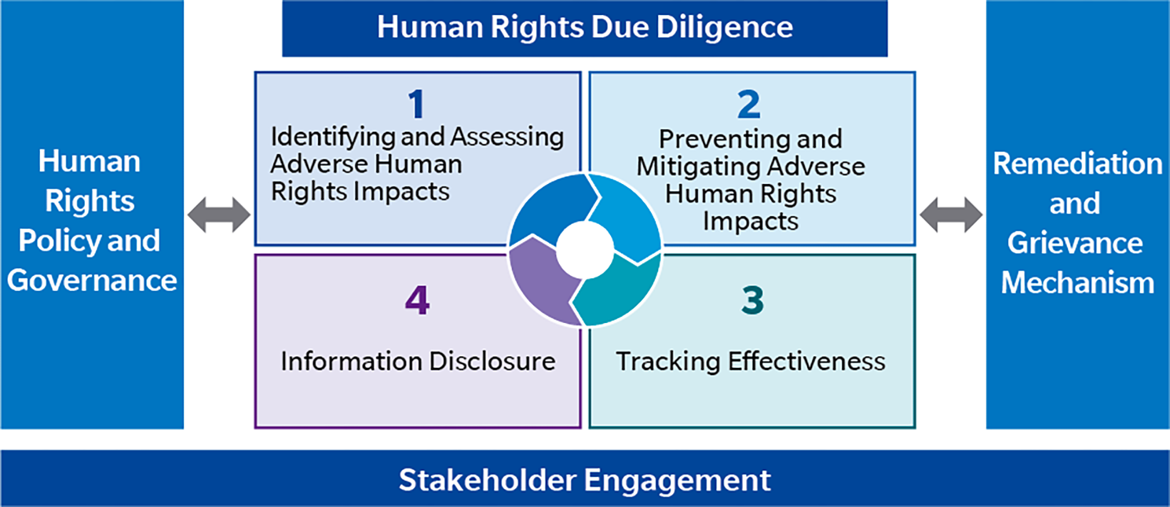
In accordance with the UN Guiding Principles on Business and Human Rights, Konica Minolta is committed to respecting human rights by formulating a human rights policy, implementing human rights due diligence, and establishing remediation and grievance mechanisms.
Human Rights Due Diligence
Konica Minolta has established a human rights due diligence mechanism and continuously works to identify potential and actual human rights risks that its business activities may pose to stakeholders, to consider and implement measures to prevent or mitigate adverse impacts, and to disclose progress on these efforts.
Konica Minolta’s business activities, including new investments, follow-on investments, business expansion through M&A, and participation in new projects, incorporate human rights assessment criteria into investment decision-making processes.
1. Identifying and Assessing Adverse Human Rights Impacts
Based on the list of “Key Types of Human Rights Risks Companies Should Consider,” compiled by Japan’s Ministry of Justice from major international rules, frameworks, and guidelines on human rights, Konica Minolta has organized stakeholders who are potentially or actually affected by its business activities and transactions, along with the human rights issues.
| Human rights risks | Stakeholders | |||
|---|---|---|---|---|
| Examples of potential risks | Workers | Stakeholders other than workers |
||
| Group employees |
Employees of business partners |
Customers | Local communities /Indigenous peoples |
|
| Wages and benefitsInsufficient or unpaid wages, inability to secure a living wage, unequal pay for equal work and qualifications, etc. | Applicable | Applicable | Not applicable | Not applicable |
| Excessive/Unfair laborOvertime work not legally mandated, continuous work, restriction on vacation taking, etc. | Applicable | Applicable | Not applicable | Not applicable |
| Occupational health and safetyInadequate protection of damage to health due to workload, occurrence of occupational accidents, etc. | Applicable | Applicable | Not applicable | Not applicable |
| Freedom of associationForced or non-participation in labor unions and collective bargaining | Applicable | Applicable | Not applicable | Not applicable |
| DiscriminationDiscrimination based on gender, age, nationality, or employee status (regular/irregular) | Applicable | Applicable | Not applicable | Not applicable |
| Bribery/CorruptionBribery of public officials, provision of money or goods during customs clearance procedures | Applicable | Applicable | Not applicable | Not applicable |
| Consumer safety and right to knowProvision of products and services harmful to the mind, body, or health of consumers, product mislabeling, and violation of consumers’ right to know | Applicable | Not applicable | Applicable | Not applicable |
| Gender-related human rights issuesUnequal treatment of men and women such as wage disparity, disadvantages to sexual minorities, discriminatory language in advertising, etc. | Applicable | Applicable | Applicable | Not applicable |
| HarassmentAbuse of power, sexual harassment, maternity/paternity harassment, nursing care harassment, etc. | Applicable | Applicable | Applicable | Not applicable |
| Freedom of speechSuppression of opinions about corporate activities, suppression of employees’ opinions about the company and working conditions | Applicable | Applicable | Applicable | Not applicable |
| Intellectual property rightsNonpayment of compensation for inventions, infringement of personal intellectual property rights, etc. | Applicable | Applicable | Applicable | Not applicable |
| Forced laborLabor without worker consent, involvement in human trafficking, retention of identification documents | Applicable | Applicable | Not applicable | Applicable |
| Child/Youth laborLoss of children’s opportunity to learn, lack of consideration for impact on growth and health and for young workers under 18, etc. | Applicable | Applicable | Not applicable | Applicable |
| Freedom to relocate residenceRelocation of residence against one’s will, eviction of residents due to business activities, forced job relocation, etc. | Applicable | Applicable | Not applicable | Applicable |
| Human rights issues related to ecosystem degradation, water stress, and climate changeEnvironmental damage caused by business activities, ecosystem degradation and water stress, funding of projects that accelerate global warming, etc. | Applicable | Applicable | Not applicable | Applicable |
| Rights of foreign and migrant workersDiscrimination against foreign and migrant workers, working conditions described in a specific language only, exploitation of recruitment commissions, etc. | Applicable | Applicable | Applicable | Applicable |
| Right of access to redressInsufficient recognition of the complaint process, limited access, etc. | Applicable | Applicable | Applicable | Applicable |
| Human rights issues related to technology and AIDiscriminatory human rights issues arising from AI use, discriminatory use of own products | Applicable | Applicable | Applicable | Applicable |
| Right to privacyInappropriate acquisition, storage, disclosure, or provision of personal or sensitive information to third parties | Applicable | Applicable | Applicable | Applicable |
Assessment of Negative Impacts on Human Rights
We evaluated the severity and likelihood of human rights impacts for the identified stakeholders and their associated human rights risks across each stage of the product supply chain (development, procurement, production, logistics, sales, recycling and disposal). The assessment also incorporated the results of risk assessment questionnaires conducted at Group production sites and among key suppliers. Based on these assessment results, we reported and discussed the findings with senior management, including the CEO, and identified the highest-priority human rights risks.
Severity is assessed based on the scale, scope, and remediability of the human rights violation should the human rights risk materialize.
Likelihood is assessed based on the past frequency of occurrence, future probability, and management systems should the human rights risk materialize.
We regularly review the assessment results. For human rights risks considered to have particularly high priority, the departments responsible for human resources, legal affairs, procurement, quality, IT, and sustainability work to prevent and mitigate negative impacts by setting targets, developing and implementing measures, and promoting initiatives.
| KPI | Results | Targets | |||
|---|---|---|---|---|---|
| FY2023 | FY2024 | FY2025 | FY2025 | FY2028 | |
| Number of sites | 30 | 30 | 29 | ― | ― |
| Number of sites assessed |
9 | 30 | 29 | ― | ― |
| Assessment coverage |
30% | 100% | 100% | 100% | 100% |
Risk Assessment Questionnaire for Key Suppliers
| Stakeholders | Human rights risk items identified as high priority |
|---|---|
| Group employees | Excessive/Unfair labor, occupational health and safety, discrimination (women’s advancement), gender-related human rights issues, forced labor, child/youth labor, right to privacy |
| Employees of business partners | Excessive/Unfair labor, occupational health and safety, discrimination, rights of foreign and migrant workers |
| Local Communities/Indigenous Peoples | Forced labor, child/youth labor |
| Customers | Right to privacy |
Human Rights Due Diligence in the Digital Workplace Business
While Konica Minolta conducts human rights due diligence across the Group, differences in the structure of value chains among its businesses led the Company to begin conducting due diligence for each business starting in fiscal 2025. In fiscal 2025, the Digital Workplace Business, with the support of external experts, identified and assessed adverse human rights impacts. Going forward, Konica Minolta will verify the validity of the assessment results through dialogue with external experts and rights holders and identify the human rights risks that should be addressed as a priority.
2. Implementing Appropriate Measures (Prevention and Mitigation of Negative Impacts)
3. Tracking and Evaluation of Effectiveness
Konica Minolta implements appropriate measures and tracks their effectiveness for human rights risks identified as high priority.
| Stakeholder | Human Rights Risk Items Identified as High Priority | Implementing Appropriate Measures (Prevention/Mitigation of Negative Impacts) | Tracking and Evaluation of Effectiveness |
|---|---|---|---|
| Group employees | Excessive/unfair labor Measures to Address Overwork |
Overtime working hours are tracked through the attendance system | No upward trend in overtime hours |
| Occupational Health and Safety Managing Occupational Safety and Health |
Risk assessments are conducted to respond to business changes Safety patrols and safety education are implemented |
The number of serious accidents remains at zero | |
| Discrimination (women’s advancement) DE&I | Development of individual training plans for female leader candidates and training thereof Promotion of male employees' participation in childcare and enhancement of support for balancing work and caregiving | The ratio of female managers is on an upward trend | |
| Gender-related human rights issues Compliance | Sexual harassment prevention guidelines are established, and harassment prevention education is implemented If an employee commits discrimination or harassment, corrective measures or disciplinary action are taken in accordance with the rules of employment | Out of 34 human rights-related internal reports, including sexual harassment and discrimination, there were no serious cases requiring public disclosure were reported | |
| Forced labor | Confirmation of alignment between international standards and disciplinary regulations | Abolishment of wage reduction measures in disciplinary actions | |
| Child labor and youth labor | Thorough age verification is conducted during hiring in each country | No cases of child labor | |
| Right to privacy Information Security | Education on personal information protection and information security is conducted A group-wide system (KM-CSIRT) is established to prepare for incidents | Incident reports to KM-CSIRT were handled appropriately with no impact on business | |
| Employees of business partners | Excessive/unfair labor, occupational health and safety, discrimination, rights of foreign and migrant workers Sustainable Procurement Initiatives | Compliance with the Konica Minolta Supply Chain Code of Conduct (=RBA Code of Conduct) is requested Implementation of Self-Assessment Questionnaires (SAQ) for critical suppliers and formulation of improvement plans based on SAQ results | SAQs were conducted for 181 out of 183 important suppliers Formulation of improvement plans completed for 91% of targeted suppliers |
| Local Communities/Indigenous Peoples | Forced labor, child labor and youth labor Responsible Minerals Procurement Initiatives | Implementation of responsible mineral procurement | In the Digital Workplace and Professional Print businesses, the percentage of 3TG smelters confirmed to be conflict-free or undergoing the audit process is 65% Confirmed that toner, optical lenses, and some functional film products, which are among the main products, are conflict-free |
| Customers | Right to privacy Information Security (Protection of Personal Data)Customer Responsibility and Quality | A personal information protection policy and regulations in compliance with GDPR have been formulated Product security guidelines have been established, and the Group as a whole promotes secure development and operation processes for products and services | The number of serious security incidents related to products remains at zero |
Other Initiative Examples within the Group
Konica Minolta continuously undergoes third-party audits (RBA VAP Audits) to reduce human rights risks at its own production sites. As of April 1, 2026, the following three major sites hold certifications.
| Site name | Country | Certification rank | Certification expiration date |
|---|---|---|---|
| Konica Minolta Business Technologies (DONGGUAN) Co., Ltd. | China | Platinum | Aug. 22, 2027 |
| Konica Minolta Business Technologies (Malaysia) Sdn. Bhd. | Malaysia | Platinum | Sep. 25, 2027 |
| Konica Minolta Mechatronics Co.,Ltd. (Mikawa) | Japan | Platinum | October 9, 2026 |
Living Wages
Konica Minolta not only complies with minimum wage requirements in each country and region where it operates, but also strives to ensure appropriate wage levels that enable employees to maintain motivation in their work. In fiscal 2021, Konica Minolta investigated the actual status of living wage payments to employees.
A living wage consists of basic living expenses and taxes. The market basket method is generally used to estimate basic living expenses, though in some countries the Basic Needs Budget standard is applied. In addition, since regional differences within a single country must also be considered, Konica Minolta calculates living wages with reference to sources such as the Japanese Trade Union Confederation and the WageIndicator Foundation. As a result, no significant issues were identified concerning the payment of living wages.
4.Information Disclosure
Konica Minolta regularly discloses its initiatives in a timely manner through its website and Integrated Report.
Grievance Mechanism
Based on the UN Guiding Principles on Business and Human Rights, Konica Minolta has established a grievance mechanism to provide appropriate remediation and remedy when a negative impact on human rights has occurred, or is feared to occur, in relation to Konica Minolta's business activities and supply chain. When an allegation of a human rights violation is made through the reporting system, Konica Minolta promptly conducts an investigation. If it is clearly determined that the company has caused or contributed to a negative impact on human rights, the company takes corrective actions through appropriate internal and external procedures.
All Stakeholders
Engagement and Remedy Platform
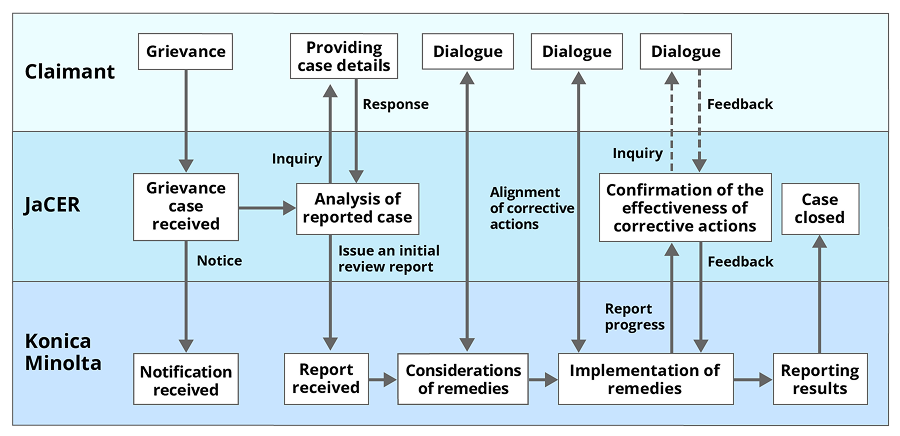
As a regular member of the Japan Center for Engagement and Remedy on Business and Human Rights (JaCER), Konica Minolta utilizes the “Engagement and Remedy Platform” operated by JaCER to receive grievances related to human rights. This platform functions as a non-judicial grievance mechanism, utilizing specialized expertise from a third-party perspective to support the fair and appropriate handling of cases.
This mechanism is available to all stakeholders, including employees, business partners, supply chain workers, local communities, and others involved in Konica Minolta’s business activities. Anonymous reporting is permitted. In addition, the use of representatives or supporting organizations is also permitted, ensuring that complainants are able to participate in the process in an informed and equitable manner.
In accepting grievances, Konica Minolta strives to provide an environment in which individuals can raise concerns with confidence, and takes appropriate measures to prevent any form of disadvantage, retaliation, or reprisal. Following the receipt of a grievance, procedures and each stage of the process are carried out in accordance with the procedures established by JaCER, and cases are handled appropriately depending on their nature. While sharing progress with the reporter, Konica Minolta conducts necessary fact-finding and dialogue, and considers and implements measures toward appropriate and effective remedy. These actions are undertaken in alignment with internationally recognized human rights standards.
Konica Minolta analyzes the content and trends of grievances received and utilizes the findings to enhance its human rights due diligence and to develop measures to prevent recurrence, thereby strengthening the effectiveness of the grievance mechanism and promoting continuous improvement. In addition, with due consideration for personal information and confidentiality obligations, Konica Minolta seeks to ensure transparency regarding the overall operation of the grievance mechanism by also referring to information disclosed by JaCER.
Group Employees
Help Line within the Konica Minolta Group
Konica Minolta has established a Whistle-blowing System (Help Line) not only within the Group in Japan but also overseas. The Help Line is an anonymous reporting system, and whistleblowers are not subject to adverse treatment.
Each report made is examined fairly, equitably and with integrity to determine the need for an investigation. The content of a hotline report in each case is kept confidential and investigated in detail. In the event of a compliance issue, the main department for the hotline system works in cooperation with the relevant departments to correct the problem and prevent any recurrence.
The Chief Compliance Officer reports all information on the records of the whistle-blowing systems to the Audit Committee regularly.
In fiscal 2025, there were 34 Help Line cases related to human rights issues (abuse of power, sexual harassment, discrimination, and inappropriate treatment).
Furthermore, there were no serious issues that required public disclosure.
Harassment Helpline
Konica Minolta recognizes that ensuring a healthy and respectful workplace environment is a fundamental corporate responsibility. To prevent harassment and to respond promptly and appropriately should any incident occur, Konica Minolta has established the “Harassment Helpline.” The Harassment Helpline strictly safeguards the privacy of individuals seeking consultation and maintains complete confidentiality regarding all matters discussed. Employees will not suffer any disadvantage or adverse treatment as a result of seeking consultation. All consultations received are handled fairly and appropriately in accordance with the “Harassment Response Process.”
Employees of Business Partners
Help Line: Suppliers
Help Lines are open to suppliers in Japan, China, and Southeast Asia, and have also been made available to suppliers in Europe. In North America, the Help Line is open to all stakeholders, including suppliers.
There were no reports from suppliers in FY2025.
Customers
Gathering Vulnerability Information
Konica Minolta has established KONICA MINOLTA PSIRT* as a Companywide organization to manage information on the vulnerabilities of its products and services, and to pursue necessary measures. When KONICA MINOLTA PSIRT receives a vulnerability report from an outside stakeholder about Konica Minolta's products or services, it takes appropriate action in compliance with the international vulnerability handling process.
For further information on these initiatives, please see below:
Remediation
For human rights risks identified through human rights due diligence and grievance mechanisms, Konica Minolta implements appropriate remediation by incorporating the voices of affected or potentially affected stakeholders, as well as advice from internal and external experts. The following are specific examples.
Konica Minolta Group:
2024
During the RBA VAP audit of Konica Minolta Mechatronics Co., Ltd. Headquarters, an evacuation exit that was not easily accessible was identified in part of the designated evacuation route in the event of a fire, and additional construction work for the evacuation exit was carried out. In addition, although there was a wage reduction penalty in the disciplinary section of the rules of employment, it was determined that this provision constituted unpaid wages, and the rules of employment were revised retroactively, extending the revision to cover Konica Minolta, Inc. as well.
2025
In an RBA VAP audit conducted at Konica Minolta Business Technologies (Dongguan) Co., Ltd., it was confirmed that warning labels were missing from some electrical boxes inside the factory, and the necessary warning labels were promptly installed. In addition, it was found that some on-site service providers had set their monthly social insurance contribution bases below the level required by law. We requested corrective action from these providers, and corrections were made to meet the appropriate legal standards.
Business Partners:
2024
Information was received from stakeholders regarding two suppliers in Malaysia and one production contractor in Thailand concerning the exploitation of foreign workers through recruitment fees and insufficient safety measures. Konica Minolta requested the suppliers and production contractors to confirm the facts, implement corrective actions if the facts are confirmed, and have a third party verify the corrective actions. Corrective actions (e.g., refunds, provision of appropriate protective equipment) and third-party verification of the corrective actions are completed.
2025
As a result of the SAQ, it was confirmed that a supplier evaluated as high risk lacked policies prohibiting the charging of recruitment fees and limiting working hours to less than 60 hours per week. In response, the supplier took corrective measures by establishing management regulations that explicitly prohibit charging job seekers fees during the recruitment process and specify standards of less than 60 working hours per week and an average of no more than 20 hours of overtime per week.
Stakeholder Engagement
We engage in dialogue with stakeholders to strengthen our efforts to respect human rights.
Group Employees
Labor-Management Management Council
Konica Minolta, Inc. has concluded a collective labor agreement, and regular meetings of the joint management council are held four times a year with the president’s attendance to provide an opportunity to explain the Company’s management situation to the labor union and give the labor union an opportunity to explain its policies to Company management. Many other Group companies also have their own labor unions and employee associations and have built good labor-management relations.
Employees of Business Partners
Supplier Meetings
See below for more information on our initiatives:
Customers
Customer Service Desk
Konica Minolta has established call centers and web-based consultation services around the world for each of its products and services. Not only does it swiftly respond to inquiries and information on product defects received at each contact point, but Konica Minolta is also consolidating this information to monitor quality status and customer requests. The Company has also established an AI Ethics Review Committee with outside experts to verify the appropriate use and application of AI technology.