
 Search within the site
Customer Responsibility and Quality
Basic Concept
Konica Minolta aspires to maximize customer satisfaction and trust by providing products and services of superior value. The Group has articulated its basic approach to accomplishing this in the Konica Minolta Quality Policy, which governs Group companies worldwide. One issue of particular importance is ensuring safe, reliable products and services, and thoroughly preventing quality compliance issues. Accordingly, Konica Minolta has established a unified quality assurance system across the Group, and addresses quality assurance in terms of the entire product lifecycle. Furthermore, Konica Minolta is determined to help create a better world by solving customers’ challenges. To do this, the Company seeks to build deeper relationships with customers so that it can discover and satisfy both apparent needs and latent expectations.
Konica Minolta Quality Policy
The Konica Minolta Group ensures maximum satisfaction and trust by our customers, paying the utmost attention to our customers and giving our top priority to the quality of products and services.
Our concept is to make steady progress in quality based on quantitative measurement and analysis of accurate data. This basic concept is demonstrated in the following affirmation:
“ Management Based On Facts”
Achieving the industry's top level Customer Satisfaction
We will provide products and services of high quality and high reliability to achieve the industry's top-level of Customer Satisfaction through continuous analysis of market trends and steady efforts for improvement.
Providing advanced products that satisfy customers' potential needs
We will always pursue ease of use from our customers' viewpoint with products on the cutting-edge of trends.
Establishment and development of a global Quality System
We will establish and develop a global integrated Quality System throughout the Konica Minolta Group, including worldwide affiliated companies.
Quality Management in the total life cycle of products and services
We will implement Quality Management to achieve our target based on quantitative measurement of quality at each life-cycle stage of products and services -- starting from planning, developing, manufacturing, usage, and disposal.
Continued enhancement of Quality Assurance Process
We will continue to improve job processes voluntarily and aggressively in order to enhance the Quality Assurance Process.
Minimization of product quality risks
We will take proactive measures and promptly respond to our customers in order to eliminate risks to our customers and our company caused by quality problems.
Disclosure of product safety information
We will actively disclose product safety information to ensure our customers will use our products without any anxiety and to fulfill our accountability to society.
April 1, 2022

Toshimitsu Taiko
President and CEO
Konica Minolta, Inc.
Structure
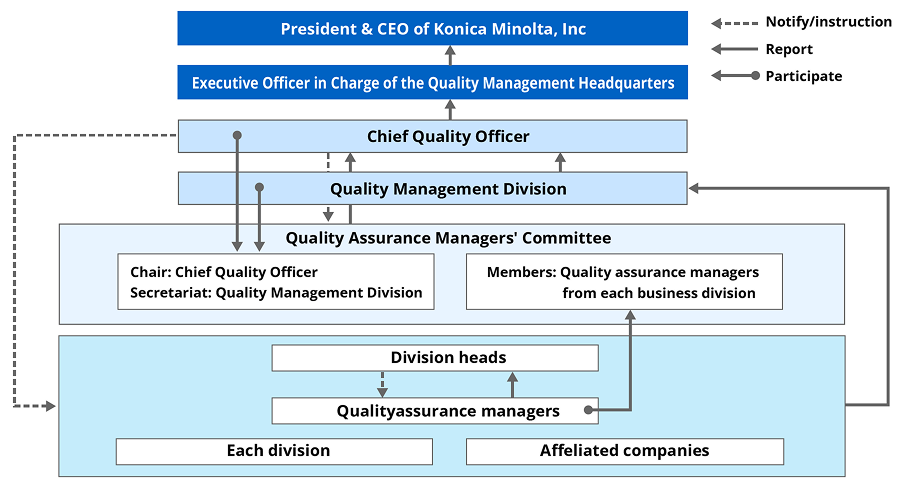
The Chief Quality Officer oversees all quality management operations.
Konica Minolta has established a Quality Assurance Managers’ Committee that supervises Group-wide quality management. This committee is chaired by the Chief Quality Officer, who has responsibility for and authority over all quality matters for the entire Group. The committee meets on a quarterly basis, in principle. In addition to promoting quality planning and monitoring progress, it shares information and discusses quality assurance. Furthermore, each business works to continuously improve quality by thoroughly implementing the PDCA cycle for quality issues.
Strategy, Goals and Results
Focusing on Risk Reduction and Maintaining and Enhancing Organizational Capabilities
In light of dramatic changes in the external environment — such as recent global affairs, increasing security threats, and stricter digital legal regulations — as well as internal challenges like decreasing personnel and skills due to an aging workforce, Konica Minolta’s Medium-Term Quality Plan and Strategy place priority on reinforcing the foundation of quality assurance. By focusing on "risk reduction" and "maintaining/enhancing organizational capabilities" to minimize quality-related losses, the Company aims to contribute from a quality perspective to the achievement of its business goals.
Based on this strategy, the following KPIs have been established:
Key Measures and KPIs
Konica Minolta works to prevent serious product accidents by globally implementing initiatives ranging from the development and provision of secure products and services with strict quality compliance, to their operation and maintenance.
| Results | Targets | ||||
|---|---|---|---|---|---|
| FY2023 | FY2024 | FY2025 | FY2025 | FY2028 | |
| Number of serious product accidents* |
0 | 0 | 0 | 0 | 0 |
- *Serious product accidents: Covers cases where the life or body of a product user is seriously harmed, or property other than the product is seriously damaged.
- *Scope of tabulation: All Konica Minolta products.
| Results | Targets | ||||
|---|---|---|---|---|---|
| FY2023 | FY2024 | FY2025 | FY2025 | FY2028 | |
| Number of serious product security incidents* |
0 | 0 | 0 | 0 | 0 |
- *Serious product security incidents: Covers product security matters that have a severe and material impact on the business of the product/service user.
For past results, please refer to the ESG Data (Social Data).
Initiatives
Risk Reduction Initiatives
Strengthening Quality Compliance
In response to the risks of quality misconduct, failures to obtain required certifications, and regulatory non-compliance that have frequently occurred at other companies recently, Konica Minolta is engaging in preventive activities as one of its highest-priority themes.
To strengthen quality compliance, the Company is reinforcing governance to prevent not only quality misconduct but also non-compliance with laws and regulations, certifications, contracts, and other requirements. Risk reduction is achieved by driving the PDCA cycle for improvement activities based on regular organizational diagnostics and awareness surveys of quality personnel. In addition to fostering quality awareness regularly through hierarchical training and awareness-raising, the Company operates a system and mechanism to collect newly issued laws, regulations, and certification requirements on a monthly basis, ensuring company-wide dissemination and operational implementation to ensure compliance.
Enhancing Product Security
With the advancement of the digital society and the evolution of new technologies, the products and services provided by Konica Minolta run the risk of exposing customers to security threats. To minimize these risks, Konica Minolta is strengthening the enforcement of internal regulations related to its service businesses and security responses. As measures to handle incidents and prevent threats, the Company centrally manages information regarding product vulnerabilities company-wide to drive necessary actions. It also carries out "KONICA MINOLTA PSIRT" (Note) activities via a company-wide shared organization designed to cooperate with public institutions and external bodies.
Furthermore, based on the concept of Coordinated Vulnerability Disclosure, Konica Minolta has established a framework to receive vulnerability information from external security researchers, customers, and other stakeholders. A designated web contact point has been made public; when a report is received, PSIRT promptly evaluates the content, coordinates product fixes or collaborates with relevant organizations as necessary, and discloses information at appropriate times. Through these efforts, the Company strives to continuously improve product security in collaboration with external stakeholders and achieve high transparency in information disclosure.
Additionally, as the sale of products and services utilizing AI increases, Konica Minolta has established an AI governance structure. It works to reduce the risk of ethical and legal issues in AI utilization by conducting risk assessments and holding deliberations through the AI Ethics Review Committee, which consists of internal and external AI experts.
- (Note)KONICA MINOLTA PSIRT: Product Security Incident Response Team
Promoting Secure Development and Operation Processes
Konica Minolta is committed to developing and operating secure products and services.
Konica Minolta is globally committed to preventing serious product security incidents by developing and providing secure products and services and taking initiatives to operate and maintain them securely.
Product Security Guidelines
Konica Minolta has established the Product Security Guidelines, which serve as internal regulations and procedures for assuring secure development and operation, and it carries out secure development and operation processes for products and services across the Group. The Product Security Guidelines are continuously updated in accordance with global trends, national regulations, and external standards. Development and operation in conformity with the Product Security Guidelines apply to all products and services of the Konica Minolta Group. This commitment lasts the entire life cycle, from the planning and proposal of products and services to their disposal and end of service, and includes the supply chain, such as development and operation contractors and suppliers. The Product Security Guidelines mandate Security by Design and the maintenance of an appropriate level of risk-based cybersecurity. They define protective measures for confidentiality, integrity, availability, and authenticity, including data protection, unauthorized access prevention, tamper prevention, vulnerability countermeasures, secure data deletion, and service continuity assurance. Furthermore, the Company has defined a Vulnerability Disclosure Policy and a Vulnerability Response Policy (scheduled for public release in FY2026) to prevent security incidents and minimize risks to customers and systems.
In addition, Konica Minolta regularly holds company-wide Product Security Promotion Committee meetings to discuss product security issues, and strives to continuously enhance its security level by sharing information on the most effective practices from inside and outside the Company.
Company-wide implementation system
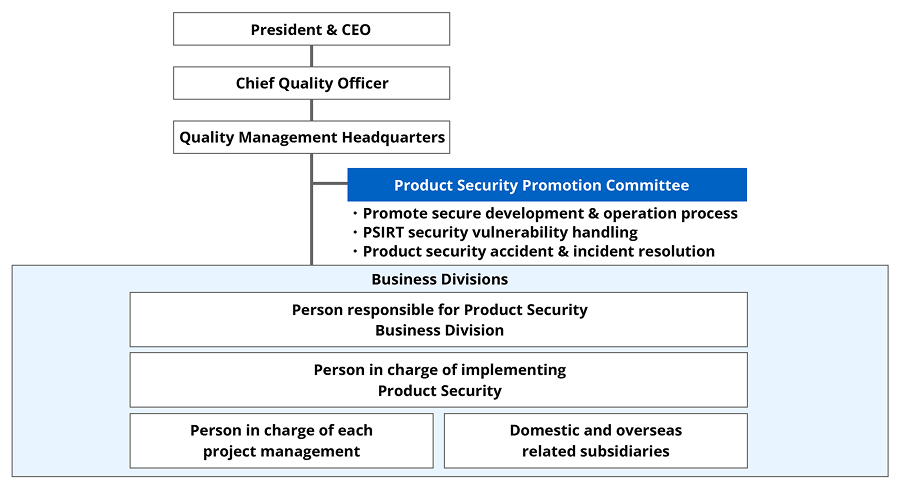
Konica Minolta, Inc. established a company-wide system for implementing product security, giving the Chief Quality Officer responsibility for it. Under the supervision of the Quality Management Headquarters, the Company is expanding the product security promotion activities to all business divisions.
Threat Analysis and Security Measures
When developing products and services, Konica Minolta conducts threat analyses in the upstream stage of development in order to eliminate system design vulnerabilities and prevent security incidents from occurring down the line. Envisioned security threats to assets that need to be protected are comprehensively identified, and security measures to counter those threats are studied and reflected in the requirements definition.
Moreover, Konica Minolta set up a Secure Development CoE consisting of internal security experts to assist the improvement of professional skills related to product security in each department.
Vulnerability Assessment
Software developed by Konica Minolta, and the Open Source Software (OSS) modules and applications incorporated into it, may have security flaws called vulnerabilities. Since leaving vulnerabilities unaddressed can lead to security incidents caused by cyberattacks, vulnerability assessments must be performed during the development phase and any problems must be fixed before the launch of the product or service. Konica Minolta centrally manages OSS usage across the Company and has made available multiple static analysis tools (SAST) and dynamic analysis tools (DAST) company-wide, which function as vulnerability diagnostic tools for detecting and correcting software and system vulnerabilities. In addition, regarding products and services for which security risks are of particular concern, Konica Minolta takes even stronger security measures, such as outsourcing penetration testing.
Secure Operation and Maintenance
Konica Minolta has established and deployed within the company guidelines for secure operation and maintenance so that following market launch customers can continue to use products and services with peace of mind. The guidelines are used in an effort to prevent security incidents caused by oversights or errors in market support.
Product Security Training
Konica Minolta has prepared several educational programs for employees to raise their awareness of and enhance their skills in product and service security, while ensuring the thorough implementation of secure development and operational processes.The Company conducts multiple sessions of new employee training, general product security training, and threat analysis workshops to provide training to all employees involved in products and services that require security considerations. Konica Minolta will continue to expand and enhance these training programs to further improve the level of product security across the organization.
Gathering and Addressing Vulnerability Information
Konica Minolta will continue to gather and address vulnerability information after shipment and/or operation commencement of products and services, to continue providing safe and secure products and services.
Gathering and Addressing Disclosed Vulnerability Information
New vulnerability information for software is discovered and reported daily. Approximately 50,000 new vulnerability records (actual result in FY2025) were published in NIST's*1 NVD*2 in the United States in that one year alone. That is why it is necessary to gather vulnerability information and address the vulnerabilities even after the launch of products and services. Konica Minolta monitors this information on a daily basis, including open databases of vulnerability information other than NVD. This allows Konica Minolta to catch information that may affect its products and services at an early stage and spread it throughout the Company while implementing countermeasures and mitigation steps as necessary to reduce risks for affected products and services.
- *1NIST: National Institute of Standards and Technology
- *2NVD: National Vulnerability Database, released by NIST
KONICA MINOLTA PSIRT
In December 2017, Konica Minolta established and began operating KONICA MINOLTA PSIRT,*1 a company-wide organization for cooperation with external public organizations. PSIRT manages information on product and service vulnerabilities throughout the Company and takes necessary measures. It also works with the CSIRT team, which handles security incidents for internal IT assets, to establish a system to roll out necessary responses globally. Furthermore, in May 2019, it joined FIRST,*2 an international forum of CSIRT and PSIRT teams from various countries, and put in place a system that enables inter-company information sharing and contribution to security.
If PSIRT discovers vulnerability information that could affect Konica Minolta's products and services, it follows internal rules governing how to handle vulnerability information to verify, triage, and address the vulnerabilities, and consider the disclosure of information as necessary. The internal rules are based on NIST's Cyber Security Framework,*3 FIRST's PSIRT Services Framework,*4 and other Japanese and international guidelines.
An important role of PSIRT is to receive and respond to vulnerability information from external stakeholders. If vulnerabilities in Konica Minolta's products or services are discovered by security researchers, security vendors, or others, PSIRT acts as a direct or indirect point of contact to report vulnerability information. In the event a vulnerability report is received, PSIRT will take appropriate action in accordance with international vulnerability handling processes.*5*6*7
- *1PSIRT: Product Security Incident Response Team
- *2FIRST: Forum of Incident Response and Security Teamsopens in a new window
- *3Cyber Security Frameworkopens in a new window
- *4PSIRT Services Frameworkopens in a new window
- *5ISO/IEC 29147: Information technology — Security techniques — Vulnerability disclosureopens in a new window
- *6ISO/IEC 30111: Information technology — Security techniques — Vulnerability handling processesopens in a new window
- *7Information Security Early Warning Partnership Guidelineopens in a new window
Responding in the Event of a Product Security Incident
In the event of a product or service security incident in the market, Konica Minolta will strive to respond promptly.
Escalation System in the Event of a Product Security Incident
Konica Minolta works to prevent security incidents through secure development and operation processes and to gather and address vulnerability information after launch, but the possibility of problems caused by design bugs and operational oversights or errors cannot be completely eliminated. In addition, cyber-attack methods continue to become increasingly sophisticated, making it nearly impossible to completely eliminate security incidents.
Konica Minolta responds to market quality issues based on its Group Market Quality Control Rules. In the event of a product or service security incident, it registers information in a Group-wide Market Quality Alert Database, the same as when product quality-related issues occur, and immediately sends the information to relevant persons within the Company, including the Chief Quality Officer. Information is also sent to the Chief IT Officer and to CSIRT, and a company-wide effort is made to quickly recover from security incidents, analyze their causes, and prevent recurrence. In the unlikely event of a leakage of a customer's confidential information or personal information due to an incident caused by a product or service, Konica Minolta will apologize and explain the facts to the customer and promptly report the incident to the relevant authorities and organizations.
Improving Market Quality
Improving the Quality Assurance System
Konica Minolta has established a quality assurance system. It is striving to improve its ability to resolve market quality problems that are related to the safety of products and services and is working to avoid serious accidents and reduce quality problems.
Konica Minolta regularly holds quality meetings across the Group to discuss product safety and other quality-related issues and work to continuously improve quality by thoroughly implementing the PDCA cycle.
Addressing Market Quality Issues
Whenever a problem related to product and service quality occurs, sales sites around the world are required to register information in a Group-wide Market Quality Alert Database immediately. Registered information is instantly sent to the appropriate supervisor and shared with relevant departments. Using this system, the Group takes action to prevent a recurrence by thoroughly investigating all registered incidents, analyzing the causes, implementing countermeasures, and reflecting these in technical and assessment standards. In the unlikely event of a safety-related incident, a report will be immediately filed with the supervisor of the individual business and shared with the Chief Quality Officer, as well as with the departments in charge of quality assurance, corporate communications, and legal affairs, regardless of the cause of the problem. When a quality problem with a potentially serious risk arises, a Quality Problem Countermeasure Conference is convened based on the Group Market Quality Management Rules in order to promptly deal with the issue and ensure thorough information disclosure.
Application of Risk Maps
Konica Minolta utilizes risk maps as a way to assess product safety. These maps describe the degree of risk by the severity and frequency of accidents occurring in the market. Using these maps, the Group undertakes objective assessments of the risk of product quality problems in the market and evaluates the effect of countermeasures. The Group pursues high safety levels by using the risk maps as risk assessment tools in the development process as well.
Specifically, the Business Technologies Business and the Healthcare Business consolidate, scrutinize, and identify, in accordance with stated rules, information provided by customers worldwide. With respect to information involved in product safety, they apply risk management techniques. By clarifying its criteria, the Group can respond quickly to the market, determine root causes, and improve procedures.
Visualization and Continuous Improvement of Quality Costs
Konica Minolta continuously conducts improvement activities in pursuit of high quality. Since 2015, the Company has measured the losses associated with activities caused by quality defects (quality costs), setting targets for continuous initiatives and driving the PDCA cycle.
Sharing Information about Quality Problems and Cross-Deploying Countermeasures within the Group
Konica Minolta holds an Annual Incident Report Conference to share information about product safety and product security incidents that occurred in the previous fiscal year. This conference serves as a platform to share case studies of product-related incidents in the market and initiatives for preventive measures across all businesses. By doing so, the Company aims to enhance safety awareness, foster a culture of safety, and prevent accidents before they occur or from recurring throughout the Group. Starting in FY2025, the scope of the conference was expanded beyond "incidents" to encompass "all quality issues and quality compliance," aiming to further elevate the "importance of quality" and the "understanding and recognition of quality assurance activities."
Enhancing Product Safety Standards
MFPs and printers used in offices must be designed so that misusage and breakdowns do not cause electric shocks, smoking, or injuries to users. For this reason, Konica Minolta has established independent product safety standards that exceed the requirements of the legal standards and include rules requiring the detailed check of every aspect of its products. Past quality problems are thoroughly analyzed, the causes are identified, and measures to deal with the problems are investigated. The results of this process are reflected in updated product safety standards.
Continuous implementation of this process prevents the recurrence of quality-related problems and prevents new problems from arising.
Product Safety Training
Konica Minolta has developed a Group-wide product safety training system for technicians involved in design and development, manufacturing technology, procurement, and quality assurance. The courses are designed to increase technicians' knowledge of product safety issues and increase their awareness of potential problems. The Company has also introduced refresher courses that employees can take repeatedly to retain their knowledge and awareness. A questionnaire is given to trainees after the course is finished to verify that it is benefiting them in their actual work. The results have been fed back to the training planners to help improve the content of the program. Going forward, Konica Minolta will continue to foster a strong quality mindset through ongoing product safety training, while further enhaning employees’ product safety awareness and skills.
Initiatives for Maintaining and Enhancing Organizational Capabilities
Maintaining and Enhancing Organizational Capabilities through TQM
Konica Minolta continuously refines its organizational capabilities to simultaneously fulfill business strategies and deliver value to customers. Playing a central role in this effort is Total Quality Management (TQM).
In Konica Minolta's approach to TQM, a top-down method is used to execute Policy Management, ensuring that every individual on the frontlines understands executive management's policies and integrates them into daily operations. Concurrently, as a bottom-up activity to elevate the entire organization, the Company practices "Process Improvement" — Konica Minolta's unique QC circle activity — to implement improvements based on logical thinking. Furthermore, Quality Education develops people who support quality, building the foundation for "Process Improvement." Through this two-way, top-and-bottom approach, the Company connects strategy with frontline execution, leading to solid results.
Strengthening Action Capabilities for Policy Management
Through Policy Management, which ensures frontline employees understand and implement executive policies in their daily work, Konica Minolta bridges the gap between strategy and frontline execution to drive reliable results. By thoroughly executing the PDCA cycle, the Company enhances the speed and quality of improvements, which helps ensure target achievement. Furthermore, starting in FY2026, the Company will promote Policy Management education for all managers and above corporate-wide. It will also host cross-organizational networking events for Policy Management operators to share organizational challenges and solutions, exchange opinions, and revitalize these initiatives.
Strengthening Logical Thinking Skills through Process Improvement
"Process Improvement" is deployed as a company-wide initiative that extends beyond manufacturing divisions to include administrative and indirect departments. Measures are tailored to the specific circumstances of each organization, achieving higher operational efficiency, human resource development, and workplace revitalization through improvements based on logical thinking. These activities have spread to Group companies in Japan and overseas. Every year, Champion Conventions are held both domestically and internationally to share excellent case studies, serving as learning forums that elevate overall organizational capability and contribute to global value creation.
Training Specialized Personnel through Quality Education
Konica Minolta utilizes a skill framework called Career Development Support (CDS) to visualize individual strengths and operational capabilities, which is leveraged for career development and personnel assignment. The Company has systematized and operates a "Quality Education Program" that links this CDS framework with educational seminars designed to improve quality-related capabilities. By focusing heavily on training the human resources who sustain product and service quality, Konica Minolta boosts practical execution skills on the frontline.
Initiatives for Improving Customer Satisfaction
Strengthening Customer Relationships
Earning more trust and a higher appraisal from customers by building long-term relationships
Continuous after-sales service is necessary for products such as IT devices, medical devices, and measurement devices handled by Konica Minolta. The Company is determined to increase the confidence and trust of its customers through this kind of long-term relationship and hopes to establish rapport that will lead to customers recommending Konica Minolta to other potential customers. That is why the Company actively gathers feedback from customers, has established a system for using it to improve products and services, and is attempting to enhance customer relationship management Group-wide.
Providing Customer Value Through a Specialized Organization Closely Connected to Customers
We have created a specialized organization to increase the speed of decision-making and feature implementation and build stronger relationships of trust with customers in areas such as industrial and textile printing, where requests for customization from customers are frequent. The specialized organization works closely with the development, quality assurance, customer service, and business divisions to communicate directly with customers, which enables it to quickly respond to special media, provide optimal customization of workflows and software, and make functional improvements that increase equipment reliability. These customer-focused efforts and requests have resulted in increased print volumes for customers and the number of new installations.
Co-Creation with Customers through Agile Development
One of the post-printing processes is banding, where a paper band is wrapped around printed materials. Traditionally, customers had to perform this task manually, resulting in a high workload, increased risk of human error, and challenges in inventory management. In response, many customers strongly requested automation of the banding process. Recognizing the customers’ strong desire to see automated banding implemented and demonstrated as soon as possible, Konica Minolta developed a hardware solution using an agile development approach. This hardware connects third-party banding machines with Konica Minolta’s commercial printers. Remarkably, within just one week of receiving the request, we showcased a concept machine with automated banding functionality at an exhibition—an achievement that led directly to product adoption.
By modularizing the desired functions based on customer feedback and achieving overall product functionality through the combination of these modules, we enabled small-scale investment and rapid delivery. To rapidly validate value for clearly defined customer needs, we applied agile development not only to software but also to hardware, responding with speed and flexibility. Through iterative expansions and customer collaboration, we were able to turn these concepts into commercial products.
In this way, Konica Minolta is promoting and deploying agile initiatives company-wide to swiftly deliver value to customers.
Deep Engagement in Customers’ Production Processes to Support DX in the Printing Business
To accelerate the digital transformation (DX) of the printing industry, Konica Minolta launched an initiative called “Workflow DX.” This initiative involves deeply immersing ourselves in customers’ production environments to identify and address the remaining analog steps in digital printing workflows. Through co-creation with customers, we support the digitalization of their production processes. We work closely with customers to understand both the direction of business transformation set by management and the challenges faced on the production floor. Together, we identify digital solutions that bridge this gap and propose practical approaches. There are three key points in our proposals for digitalizing production processes: (1) Can manual operations, such as number of physical touches, be reduced, allowing operators to shift time from repetitive tasks to more creative work? (2) Can work progress be visualized and the effects of improvements be measured? (3) Is the investment feasible? To realize these goals, our ICT specialists analyze how best to combine the customer’s existing systems with Konica Minolta products, third-party solutions, and customized tools. Starting from co-creation, we aim to build a circular supply chain optimized for digital printing—enhancing the value of print, revitalizing the industry, and contributing to environmental impact reduction through supply chain reforms that include logistics.
Global Deployment of NPS® Surveys to Measure Customer Relationship Management in the Business Technologies Business
In 2012, the Business Technologies Business created a Customer Relations (CR) Division and adopted Net Promoter Score® (NPS®) as a target indicator. It developed its own scientific approach, adding NPS® to the conventional customer satisfaction survey and deploying it globally. Today, the results are being utilized to improve product and service quality.
In FY2017, a transaction survey system was introduced to ascertain customer satisfaction at the points of contact with the Company, such as telephone inquiries and repair service, and to obtain NPS® for these points of contact. In FY2019, the system was expanded to more countries, and in FY2020, a service improvement process was started based on the system. This process will enable the needs and negative experiences of every customer to be ascertained in real time, in order to make rapid improvements. The Division is working to further improve NPS® by developing PDCA cycles to address overall issues brought to light by the NPS® surveys and individual customer issues identified by the transaction survey.
*Net Promoter Score®(NPS®): an indicator that measures the percentage of customers who recommend the Company and its products and services to others. Net Promoter Score® and NPS® are registered trademarks of Bain & Company, Inc., Fred Reichheld and Satmetrix Systems, Inc.
The NPS® survey program has been expanded globally by increasing the number of countries in which the PDCA cycle deployment program is implemented. As of April 2026, the program has been deployed in 28 countries across Japan, the United States, Europe, and the Asia-Pacific region.
NPS® survey results had continued to improve since the full-scale global rollout of the survey in FY2014, reaching 22 points in FY2020. Subsequently, however, customer satisfaction related to product delivery and toner shipments declined significantly, resulting in a drop in NPS®. Konica Minolta took these results seriously and addressed the issues by eliminating supply delays and implementing customer care programs.
As a result, NPS® improved to 20 points in FY2025.
Konica Minolta will continue to restore customers' trust by advancing its customer care programs and other measures.
The Company also measures customer satisfaction in its Healthcare and Industry businesses and leverages the results to improve product and service quality to satisfy customers.
Support Systems
System Built to Provide Globally Uniform Support
Many customers running global businesses centrally control at their head offices the maintenance and management of IT systems, including MFPs used in offices around the world. When requesting support from a device manufacturer, there are times when the head office, as the single point of contact, and the office actually needing support are in different regions. Accordingly, device manufacturers must also establish a global structure to provide accurate and timely support.
This is why Konica Minolta has built a new system to provide globally uniform support. Support staff assigned to sales companies worldwide have been organized and the contact point for customers has been centralized at the Global Support Center (GSC). By using purpose-built IT tools, support requests received by the GSC are shared with personnel around the world, resulting in timely and appropriate support with the dispatch of local customer engineers to handle hardware issues and specialized staff members providing remote support to solve software issues. Further, the level of service is standardized by creating a globally shared database of inquiries and the results of responses.
CR Master Program: A Program for Developing Personnel with Strong Customer Relations Skills
Konica Minolta runs the CR Master Program, an education and certification program that systematizes its unique customer relations (CR) activities with the purpose of improving the skills of CR promotion personnel at sales companies worldwide. Sales companies participating in this program expressed a strong desire for an educational program geared toward all employees, not just CR promotion staff. In response, the Company introduced the "CR White Belt" in FY2017 — an e-learning program designed to show frontline members customer-centric mindsets and behavioral guidelines. Thanks to these initiatives, the understanding of CR has steadily spread and taken root across sales companies.
Furthermore, for CR promotion personnel, the Company launched Community Calls in FY2023 to share CR activity case studies from various countries and deploy them as initiatives that can be utilized in other regions. In 2025, the Company held workshops to drive region-specific strategies. After clarifying regional policies and key challenges, CR activities are now evolving into practical initiatives aligned with these regional strategies.
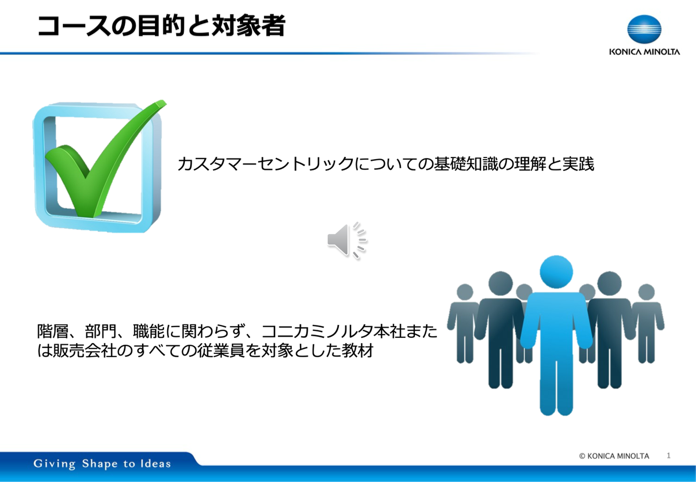
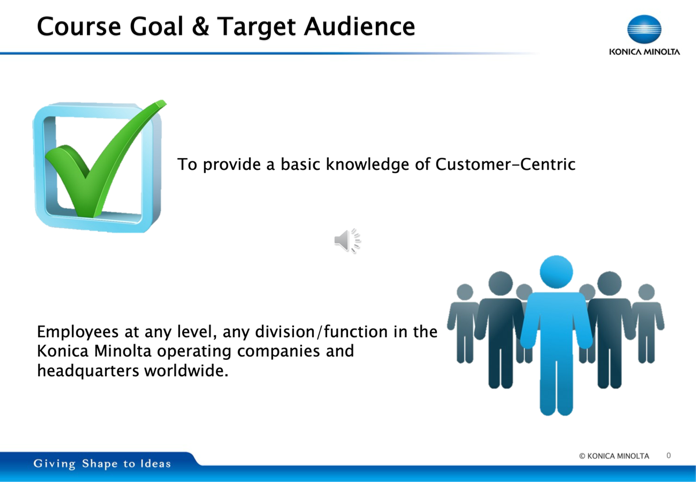
A screen from the e-learning material for the Customer Relations White Belt
Implementation of Training, Including for External Partners, to Raise Support Quality
The Business Technologies Business is determined to provide a consistently high level of service to customers everywhere in the world. To that end, it conducts various kinds of technical training on products for the Group's own customer engineers and also for external distribution partners.
In Product Service Training, trainees acquire the skills and knowledge essential for the installation, setup, maintenance, and repair of each product. The training includes two different learning methods: instructor-led training to boost practical skills and knowledge acquisition via e-learning.
Konica Minolta's own technical certification program, Outward, is designed to keep improving the technical skills of customer engineers. This program is organized into five certification levels starting with Associate and going up through Professional, Expert, and Master to Diploma. It enables the gradual upgrading of skills, from the acquisition of the basic knowledge needed to provide support for Konica Minolta's products to the mastery of high-level specialized skills.
By making these training programs available to more and more engineers worldwide, the Konica Minolta Group will continue to enhance customer satisfaction globally.
Promoting the Adoption of Remote Maintenance
Konica Minolta iCare, the remote management service for MFPs provided by the Company’s Digital Workplace Business, ensures secure status sharing and aims to reduce downtime by preventing malfunctions and enabling quick responses when they occur. In addition to automatic fault reporting, it manages the status of parts and consumables, enabling automatic toner delivery and engineer visits for consumable replacement at the appropriate time. Over one million Konica Minolta iCare units are operating worldwide, and feedback on actual operating conditions is used to improve the accuracy of fault prediction daily. Konica Minolta iCare data incorporates a big data analysis environment, building analytical models based on repeated machine learning, time-series forecasting, and verification. It offers various analytical models, such as optimizing toner replacement based on predicting print volume for each customer and analyzing call center call history, supporting customers with advanced data mining.
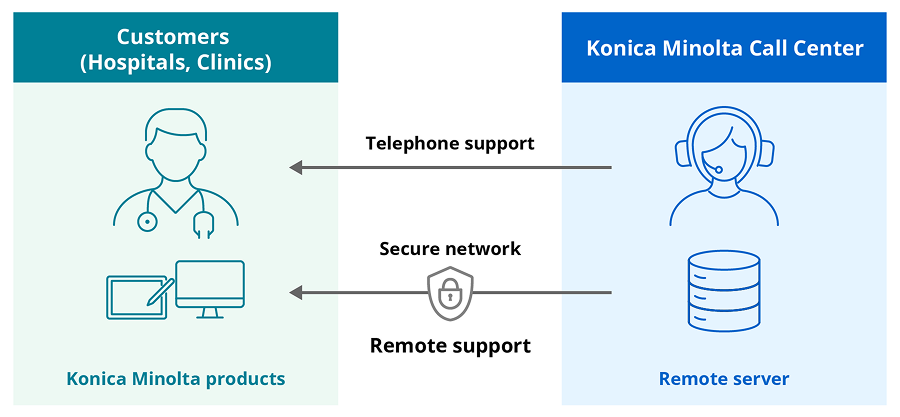
Products provided by the Healthcare Business are used in healthcare settings where patient lives may depend on the equipment, so there is a need for especially rapid responses to product failures and problems. Konica Minolta has established a call center that operates around the clock, every day of the year, to resolve disruptions on the medical frontlines. The Company established key performance indicators (KPI) focusing on reduction of customer wait time on the phone, improvement of the call center's ability to resolve problems on its own, and improving customer satisfaction. It works to provide better services in all of these areas.
As part of that effort, the call center in Japan has been actively promoting the adoption of remote maintenance for the quick resolution of problems by remotely operating products at customers' locations through the Internet. This allows problems to be fixed remotely without having to send out customer engineers, while reducing downtime for products and services and shortening diagnostic interruptions in healthcare settings.
In FY2025, around 70% of the calls received by the call center were from customers using remote maintenance. As a result, downtime has been shortened by about 50,000 hours per year,*1 representing an approximately twofold reduction in downtime compared to FY2010, and we have maintained this level since 2018.
In FY2017, Konica Minolta became the first company in the Japanese healthcare industry to obtain COPC certification,*2 and it will continue to maintain and develop the quality of its call center by meeting the strict certification standards.
- *1Calculated based on Konica Minolta's indicators
- *2COPC certification: An international quality standard for call centers only provided to organizations with outstanding performance.
Remote Maintenance System
Creating Customer Value with Design Thinking
Developing Quality Improvement Activities from the Customer’s Perspective
The staff of Konica Minolta's sales companies are in daily contact with customers. As part of the Company's effort to improve quality from the customer's perspective, sales company staff participate in sales company joint evaluations and take part in evaluating quality in the development stage. In addition, since FY2017, C-PIUZ* activities have been conducted to obtain the candid opinions of customers regarding quality. These activities allow staff from the quality assurance and development departments to visit customers together with sales company staff. Through this activity, employees gauge customer feedback and make use of this information to improve products and services.
Additionally, Konica Minolta uses design thinking to uncover the value that customers are truly seeking. In FY2018, it established processes and methods for hypothesis verification in the development stage, and to determine whether the value is actually recognized by the customer once the product is on the market. The results are applied to the development of products and services from customer perspectives.
*C-PIUZ: Customer-Problem In Using to Zero, a unique Konica Minolta initiative to reduce quality problems that occur when customers are using the product.
Promoting Service Development Using Design Thinking
Design thinking is a process and mindset where challenges are defined based on empathy for the customer, ideas are generated from those challenges, and value is refined.
At Konica Minolta, the Design Center plays a central role in introducing "design thinking." In collaboration with business divisions, it develops valuable services from the customer’s perspective rather than a manufacturer perspective. The company engages in value creation while remaining close to customers' actual workplaces across a wide range of fields — including the printing, manufacturing, and healthcare sectors, as well as the office domain where working styles are diversifying. For example, for multi-functional peripherals (MFPs) deployed globally, concepts are generated under the philosophy of "designing the experience" by understanding user challenges and country/industry-specific working styles through interviews and workplace observations. Furthermore, by repeating prototyping and verification, the Company pursues "comfort" and translates it into tangible value.
In recent years, the Company has also focused on the customer experience after a service is introduced, engaging in cross-organizational improvement activities in cooperation with sales companies. This reinforces quality improvement from the perspective of long-term experiential value. Konica Minolta will continue to pursue the creation of value truly sought by customers across various business domains, contributing to the resolution of social challenges.
Activities and Tools That Incorporate Design Thinking