 Search within the site
Environmental Management
Promotion System
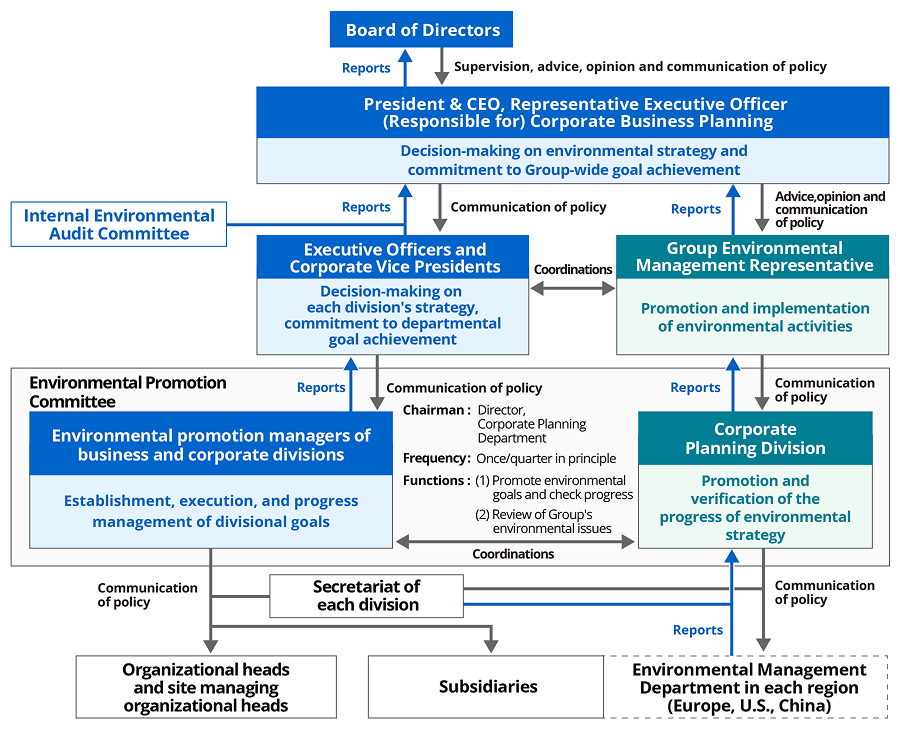
The President and CEO has ultimate responsibility for and authority over all environmental management, including climate change issues, and is also accountable for its effectiveness. The President and CEO appoints the Group Environment Management Representative to lead and promote environmental management and handle environmental measures. The Group Environment Management Representative formulates a medium-term environmental plan, which is then approved by the Board of Directors as a corporate management plan. In addition, the Group Environment Management Representative reports monthly to the President and CEO and the Audit Committee, established by the Board of Directors, on the progress made in environmental management. The Audit Committee continuously monitors and verifies the overall execution status of environmental management, primarily led by the President and CEO.
Discussions and decisions regarding important environmental issues occur at management councils and other meetings attended by the President and CEO, Executive Officers and Corporate Officers. This aims to improve the linkage with management and business strategies, treating environmental issues similarly to other critical management challenges.
Konica Minolta has established the Environmental Promotion Committee to review and promote the Group's medium-term environmental plans. Chaired by the Head of the Corporate Planning Division, the committee is composed of Environmental Promotion Officers appointed from the business and corporate divisions. The committee deliberates upon medium-term and annual environmental plans, reviews quarterly progress, and discusses environmental issues affecting the Group.
Environmental Audits
At Konica Minolta, the Internal Environmental Auditing Committee directs the internal environmental auditing for the entire Group.
Through internal environmental audits, which are conducted at least once a year, the Group verifies the adequacy and effectiveness of management systems. Additionally, by checking the implementation status of the medium-term plan, audits ensure that management systems are functioning effectively in all the Group's organizations.
Environmental Management System
To raise the efficiency of environmental management throughout the Group, Konica Minolta operates its management system based on ISO 14001 and has established a basic policy requiring all group production sites worldwide to obtain ISO 14001 certification.
See Environmental Data in ESG Data for the list of Konica Minolta Group companies that have acquired ISO 14001 certification:
Environmental Risk Management
Konica Minolta treats environmental risks as business risks. Risks are managed under the Risk Management Committee, chaired by the officer in charge of risk management appointed by the Board of Directors, to prevent risks from materializing.
See below for more information on risk management.:
Operating globally, Konica Minolta has established a global compliance management system to ensure strict compliance with environmental laws and regulations at all production and sales sites.
To ensure that production sites and sales companies in each region can reliably comply with local environmental laws and regulations, Konica Minolta has built a management structure centered on its environmental organizations in Europe, North America, China, and Japan. Under this system, the Group complies with relevant laws and regulations, including chemical substance regulations, product content restrictions, recovery and recycling regulations, and energy-saving regulations in each country.
In fiscal 2025, Konica Minolta conducted compliance checks across all Group companies and found no major violations of environmental laws or regulations.
Product Assessment System
Product assessment
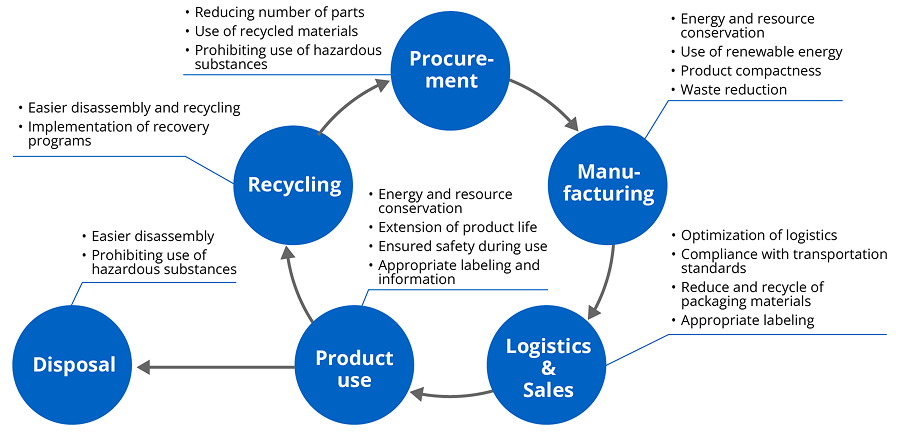
When developing a new product, the Konica Minolta Group identifies the impact the product would have on the environment throughout its lifecycle, from its manufacture and distribution to its use and disposal, while setting evaluation criteria and carrying out assessments.
The Group sets targets in line with its own evaluation criteria for environmental impact and carries out product assessments as part of its product commercialization flow. Only products whose status is checked and that have cleared the targets are sent to market. This rigorous process has ensured that Konica Minolta complies with the most recent environmental laws, properly manages hazardous chemical substances, improves the environmental performance of its products, and complies with various countries' environmental labeling schemes.
Equipment Assessment
At each Konica Minolta site, an assessment system is in place for the installation, replacement, relocation, modification, removal, repair and repainting of equipment, as well as for changes to land conditions. The purpose of these assessments is to evaluate environmental impacts and safety, ensure compliance with applicable legal requirements, and minimize impacts on the surrounding environment and working environment. Each site conducts assessments in accordance with established procedures and operates equipment and processes only after confirming that they meet the prescribed criteria.
Emergency Response
Reporting rules have been established to ensure that the company responds promptly and appropriately to crises caused by various risks. These rules have been thoroughly communicated to executive officers and its Group companies. In line with these reporting rules, the executive responsible for risk management takes the leading role in managing information on disasters and accidents that occur around the world and other crises.
See below for more information on establishing the crisis management system:
At Group companies in Japan covered by the integrated ISO 14001 certification, each department identifies events that could have a significant environmental impact in the event of an emergency, such as abnormal conditions or natural disasters, based on the Konica Minolta Environmental Management Manual. Response procedures have also been established, and regular training is conducted. Based on the Emergency Response Procedures prepared by each department, training is carried out at least once a year. For example, the Company conducts spill containment drills simulating chemical leaks into storm drains and evacuation drills simulating explosions caused by solvents catching fire, thereby maintaining a system to minimize damage in the event of an accident.
Each department has also established an emergency communication system to report to the Group Environment Management Representative on the same day as the incident, and all are working to take appropriate measures.
Environmental Education
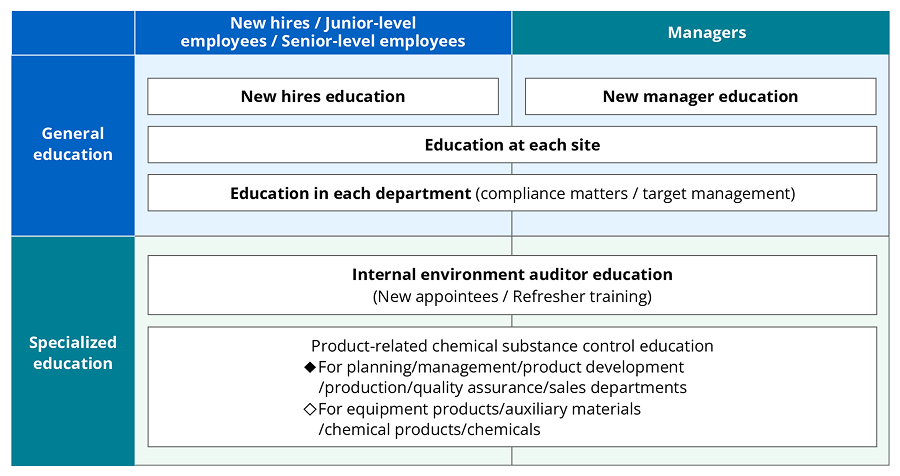
Each Group company provides a range of environmental education to its employees in order to enhance their awareness of and ability to perform environmental activities. Many employees participate in training programs to raise the level of the Group's environmental activities. The content ranges from specialized knowledge to the understanding of issues related to global environmental problems. At least once a year, training is given to new hires, internal environmental auditors, and those involved in chemical substance management related to products.