
 Search within the site
Konica Minolta Environmental Strategy
Basic Concept
Konica Minolta has established the Konica Minolta Group Charter of Corporate Behavior as a set of principles that embody the Konica Minolta Philosophy, which includes Our Philosophy and our management vision. This charter was approved by the Board of Directors in April 2022. It consists of eight principles of conduct and related policies. One of these principles, "3. Addressing Environmental Issues," outlines the Konica Minolta Group’s environmental principles and the Environmental Policy designed to implement these principles.
The Konica Minolta Group aims to promote sustainable development and profitable growth. We integrate environmental, economic and social perspectives into our business strategies so that our business activities are implemented in harmony with human lives and the environment in all aspects.
Our basic approach is to ensure reliable data and achieve the steady resolution of environmental issues through the quantitative measurement of effects and impacts.
Environmental Policy
"Management Based on Facts"
1.Working toward a sustainable society as a global citizen
In response to the call for a sustainable society, we will conduct business activities from the perspective of ongoing enhancement of performance in environmental preservation, economic growth, and social responsibilities (ethics). Every one of us will enhance its knowledge and awareness on the environment, economies, and societies on a global scale and act with responsibility in pursuit of a sustainable society.
2.Compliance with laws and other requirements
We will comply with legal requirements in respective countries and regions, as well as our Group standards. In addition, we will respect, in an equitable manner, the expectations of our stakeholders and consensus in the international community.
3.Consideration for the environment throughout the entire life cycle of products and services
We are committed to reducing the environmental load in all stages throughout the entire life cycle of products and services, recognizing that responsibility for a product rests with its manufacturer.
4.Initiatives to counter global warming
We will continuously reduce greenhouse gas emissions that derive from our business activities from the perspective of the life cycle of our products and services throughout the entire Group, recognizing that global warming is one of the most important world issues.
5.Initiatives toward a recycling-oriented society
We are always reviewing what we can do as a corporate citizen in order to create a recycling-oriented society while striving for minimizing consumption of natural resources and promoting "Zero Waste Emission" activities. In addition, we will accelerate initiatives for the recovery and recycling of end-of-life products and packaging materials.
6.Prevention of chemical pollution and minimization of potential risks to the environment
We will take every countermeasure for preventing chemical pollutions, recognizing that chemical substances can impose significant impact on human health, safety, and the environment. At the same time, we will continuously suppress the use of chemicals and reduce discharge volumes in order to minimize environmental risks.
7.Promotion of information disclosure
We will execute accountability to all the stakeholders by actively disclosing environmental information and ensuring risk communication. We will as well make every effort to accomplish our commitment to the society. Our Environmental Policy is to be disclosed to the public.
8.Establishment of environmental objectives and targets
We establish and administer environmental objectives, targets, and management programs to translate this Environmental Policy into reality. We will continuously review such objectives, targets, and programs for further improvement of our environmental performance.
April 1, 2022

Toshimitsu Taiko
President and CEO
Konica Minolta, Inc.
Environmental Management Concept
Turning Environmental and Social Changes into Opportunities, Not Just Risks
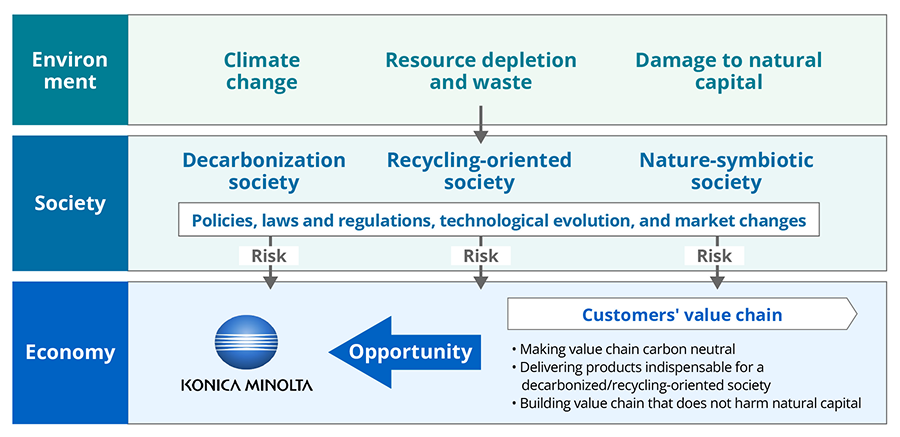
As various environmental issues, such as climate change, resource depletion, and degradation of natural capital, become more serious, society is rapidly changing toward the building of a decarbonized society, circular economy, and society in harmony with nature, accompanied by the strengthening of various policies and regulations, technological evolution, and market changes.
These changes pose a risk of losing business opportunities for Konica Minolta. However, they also represent significant risks for our customers and their supply chains, because providing solutions that help address environmental issues in our customers’ value chains can instead create opportunities for Konica Minolta.
Konica Minolta's approach to environmental management is founded on the belief that solving environmental issues drives business growth and creates new business opportunities. By contributing to the resolution of global environmental issues, including climate change, while achieving sustainable business growth, we aim to become a company that is vital to society.
Konica Minolta’s Approach to Environmental Management
Co-creation with Stakeholders
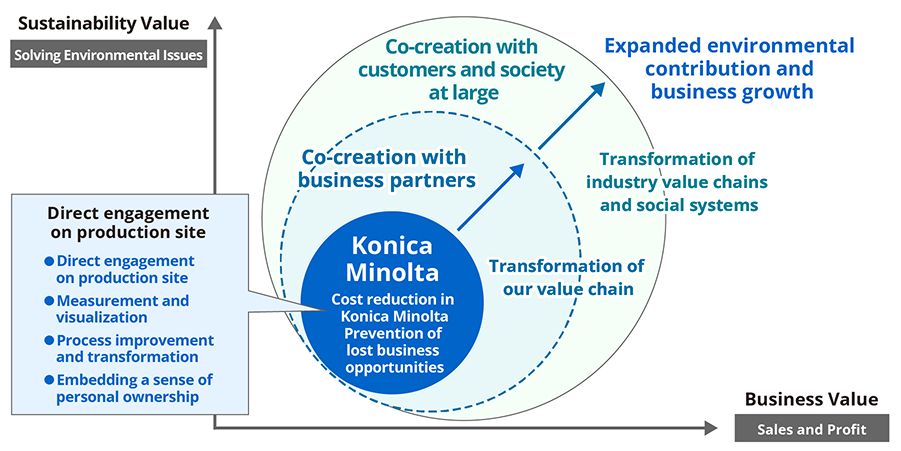
Konica Minolta has assets in the form of knowledge and technologies cultivated through efforts to reduce its own environmental impact, such as on-site engagement in manufacturing, measurement and visualization, and improvement and transformation of production processes. This has firmly established an approach that balances environmental value with business value within our corporate culture.
If we were to use these assets solely to reduce our own environmental impact, our contributions would remain limited to the direct provision of our final products and services to society. Instead, Konica Minolta works with customers and suppliers to drive major reductions in environmental impact that could not be achieved by our company alone, while also expanding business and economic value.
See below for more information on our initiatives:
Konica Minolta’s Value Creation and Its Expansion
Long-Term Environmental Target Eco Vision 2050
Given the urgency of global environmental issues, global businesses have a great responsibility to help build a more sustainable society by reducing environmental impact. Konica Minolta expresses its strong determination to fulfill this responsibility through Eco Vision 2050, its long-term environmental vision looking ahead to 2050.
Eco Vision 2050
-
(1)Achieve net-zero CO2 emissions throughout the product lifecycle by 2050
(2)Increase our CO2 reduction contributions*1 and create cumulative CO2 reduction contributions that exceed our cumulative CO2 emissions since the Konica Minolta integration (2003) by 2050
-
(1)Working toward zero use of natural resources*2, reduce the use of natural resources in our products by 90% or more by 2050
(2)Expand our contribution to reducing the use of natural resources beyond our own products
-
Work to restore and preserve biodiversity
- *1CO2 reduction contributions: The amount of CO2 emissions avoided through the provision of Konica Minolta's products and solutions (Avoided Emissions)
- *2Natural resources: Resources that require new extraction, such as crude oil and mineral resources, and are generally synonymous with depletable resources.
For more details on each long-term vision, please see below:
Environmental Target Setting Process
Environmental Targets of the Medium-Term Environmental Plan 2028
Step 1: Evaluation and Identification of Environmental Material Issues
To establish our environmental targets, we first focus on the environment-related material issues among Konica Minolta's five sustainability material issues — namely, Addressing Climate Change, Effective Utilization of Finite Resources, and Ensuring Safety and Peace of Mind in Society (Chemical Substance Safety). We then conduct an environment-specific materiality analysis to establish more effective and concrete environmental targets and initiatives.
To identify these material issues, we first compile a comprehensive list of issues based on international guidelines and the expectations of diverse stakeholders. We then evaluate the identified environmental issues from two perspectives: the impact Konica Minolta has on the environment and society and the impact environmental and social issues have on Konica Minolta.
We quantitatively assess the impact on our company by estimating potential profit losses in our risk analysis and potential profit gains in our opportunity analysis. Conversely, we assess the impact we have on the environment and society by quantitatively evaluating environmental value—such as the volume of CO2 reductions achieved through successful implementation—for opportunities. For risks, we qualitatively evaluate impacts that may lead to environmental degradation, such as pollution and greenhouse gas (GHG) emissions, based on their scope, degree of impact/restorability, and likelihood of occurrence. The Group Environmental Officer, who chairs the Group Environmental Promotion Committee, verifies the validity of the materiality evaluation process and its results, and identifies the priority environmental material issues that Konica Minolta should address.
Identified Environmental Material Issues
[Opportunities for Each Material Issue]
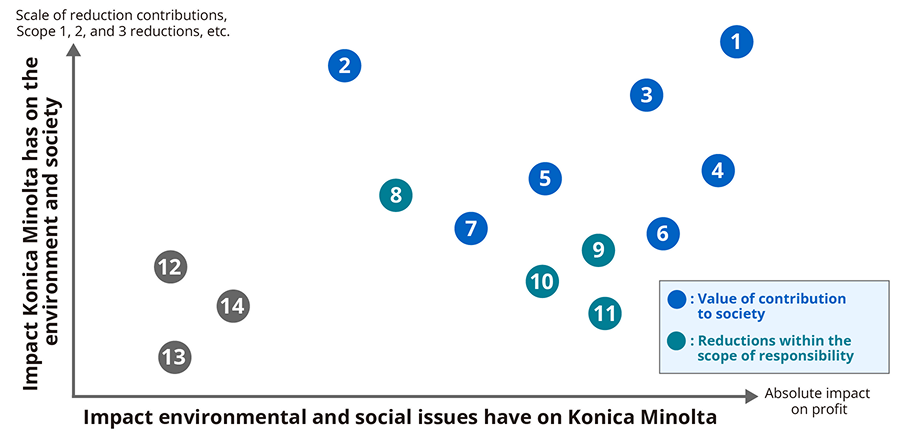
| Plot name |
|---|
| 1Digital solutions transforming the commercial/industrial printing supply chain |
| 2Advanced material identification technology for a circular economy |
| 3Expanding the application of quality inspection technologies and highly durable materials that support the deployment of next-generation energy technologies |
| 4Stable operations and productivity enhancement in semiconductor mass production processes |
| 5Expanding the range of hazardous-substance-free products |
| 6Improving manufacturing efficiency by providing on-demand production processes |
| 7Establishing a stable supply system for materials compatible with a circular economy (Recycled Materials) |
| 8Improving energy productivity at Konica Minolta sites (Scope 1 & 2 reductions) |
| 9Product manufacturing using renewable energy (Scope 2 reductions) |
| 10Expanding products that utilize recycled materials (Scope 3) |
| 11Providing products and services with a low carbon footprint |
| 12Imaging solutions that contribute to disaster prevention and mitigation in response to extreme weather and natural disasters |
| 13Healthcare solutions utilizing diagnostic imaging at disaster medical sites |
| 14Dry textile printing process: Waterless textile dyeing systems for water-stressed regions |
[Risks for Each Material Issue]
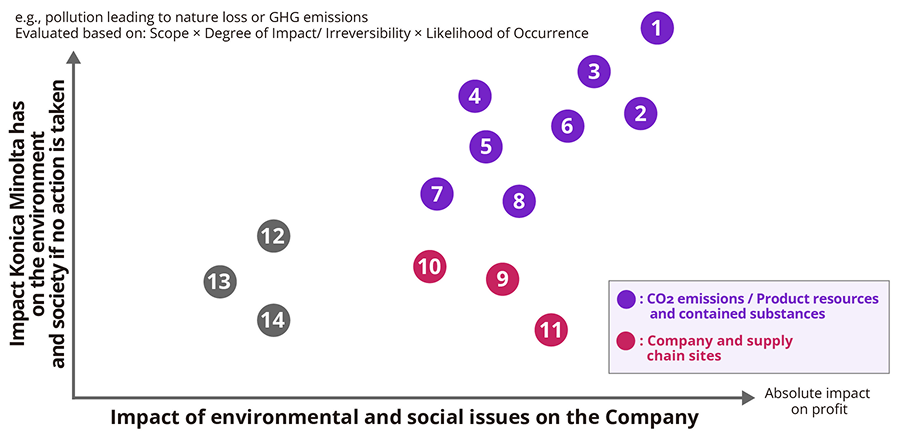
| Plot name |
|---|
| 1Business impact from tighter chemical regulations and stricter pollution prevention measures |
| 2Emission regulations at Konica Minolta sites and the need for fossil fuel alternatives |
| 3Unstable procurement of natural resources due to climate impacts |
| 4Insufficient response to the circular use of depleted resources |
| 5Improving product environmental performance and meeting information disclosure demands |
| 6Delays in net-zero and renewable energy transitions |
| 7Delayed adaptation of Konica Minolta products to a circular economy |
| 8Soil pollution countermeasures at Konica Minolta sites |
| 9Tighter conservation regulations and declining paper demand resulting from diminishing forest resources |
| 10Supplier shutdowns or reduced supply capacity in water-stressed regions |
| 11Supply chain disruption caused by large-scale climate disasters |
| 12Ecosystem degradation and pollution caused by water intake/discharge at Konica Minolta sites |
| 13Invasive species introduction and species extinction |
| 14Pollution caused by waste |
Step 2: Target Setting Process
Next, we formulate our Medium-Term Plan under our environmental management system.
Click here for information on the target-setting process:
Step 3: Targets and Results
See Environmental Data in ESG Data for information on the targets and results established in our Medium-Term Plan: