
 Search within the site
Biodiversity
Basic Concept
Konica Minolta supports the realization of a “nature positive” and “zero deforestation” society as sought by the international community and conducts its business activities in a manner that takes into account its dependence and impact on ecosystems. In collaboration with stakeholders such as business partners and customers, the Company works to reduce its impact on ecosystems and preserve biodiversity.
Furthermore, based on the Konica Minolta Charter of Corporate Behavior, the Company operates its business with consideration for ecosystems. It addresses negative impacts on biodiversity in accordance with the priority order of the mitigation hierarchy (avoidance, minimization, and restoration) to strive for the preservation of vital ecosystems.
Strategy
Konica Minolta has made "working for the restoration and preservation of biodiversity" part of its long-term environmental vision, viewing the preservation of biodiversity as a critical management challenge. To ensure the Company addresses any negative impacts on biodiversity in line with the mitigation hierarchy, it is working to understand its dependence and impact on ecosystems across its business activities, as well as to assess biodiversity-related risks and opportunities. As part of these efforts, the Company actively conducts biodiversity assessments with reference to international guidelines and evaluation tools.
From the perspective of risk assessment, Konica Minolta identifies business activities worldwide that depend on or impact ecosystems. Next, it evaluates the benefits derived from ecosystems (INPUT) and the impact exerted on ecosystems (OUTPUT) at each stage of the product life cycle in order to identify key issues that require attention. Acknowledging the high degree of its dependence and impact on ecosystems within its internal operations (design and manufacturing), the Company has established specific goals, standards, and initiatives tailored to its internal operations. Going forward, Konica Minolta will continue to gain deeper insights into the relationship between business activities and biodiversity, while working to strengthen its initiatives, including the adoption of new assessment methodologies.
In addition, the Company views social and market demands and requests regarding biodiversity as opportunities and is leveraging its proprietary sensing technologies to promote the creation and expansion of solutions that contribute to the preservation of biodiversity in society.
| Organization / Institution | Reference Frameworks (Guidelines, Tools, etc.) |
|---|---|
| Taskforce on Nature-related Financial Disclosures (TNFD) | Final Recommendations |
| United Nations | Millennium Ecosystem Assessment |
| World Resources Institute (WRI) |
Corporate Ecosystem Services Review Aqueduct Water Risk Atlas |
| Ministry of the Environment, Japan |
Guidelines for Private Sector Engagement in Biodiversity Invasive Alien Species Act Act on Conservation of Endangered Species of Wild Fauna and Flora The 5th Red List |
| Japan Business Initiative for Biodiversity (JBIB) | Business & Biodiversity Interrelationship Map |
| Ramsar Convention | Ramsar Sites |
| Kunming-Montreal Global Biodiversity Framework (GBF) | 23 Action Targets for 2030 |
| Keidanren Committee on Nature Conservation | Keidanren Declaration of Biodiversity and Action Guidelines |
See below for more information on our biodiversity-related initiatives:
Initiatives
Consideration of Biodiversity in Procurement
Konica Minolta clearly states in its Procurement Policy that the Group will take the lead in efforts to minimize its impact on ecosystems. It has also established the Konica Minolta Supply Chain Code of Conduct and, based on its Sustainable Procurement Program, requests that business partners cooperate in minimizing negative impacts on natural resources.
Consideration of Biodiversity at Production Sites
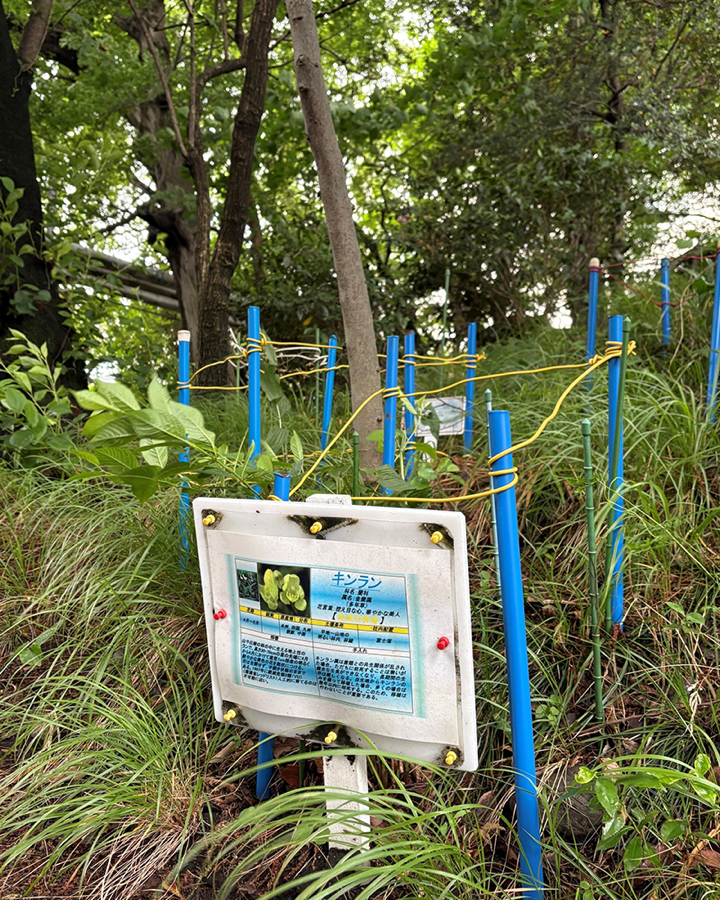
Konica Minolta has verified that it does not conduct production, sales, or other operations within registered wetlands under the Ramsar Convention (ecosystem protection areas). Furthermore, if a threatened or near-threatened species designated by national or regional authorities is discovered within the vegetation on its site premises, the Company makes every effort to properly protect and manage the species by installing signboards or fences.
Contributing to Biodiversity with Products and Services
Chlorophyll Meters Contributing to the Management of Effects on the Environment from Chemical Fertilizers
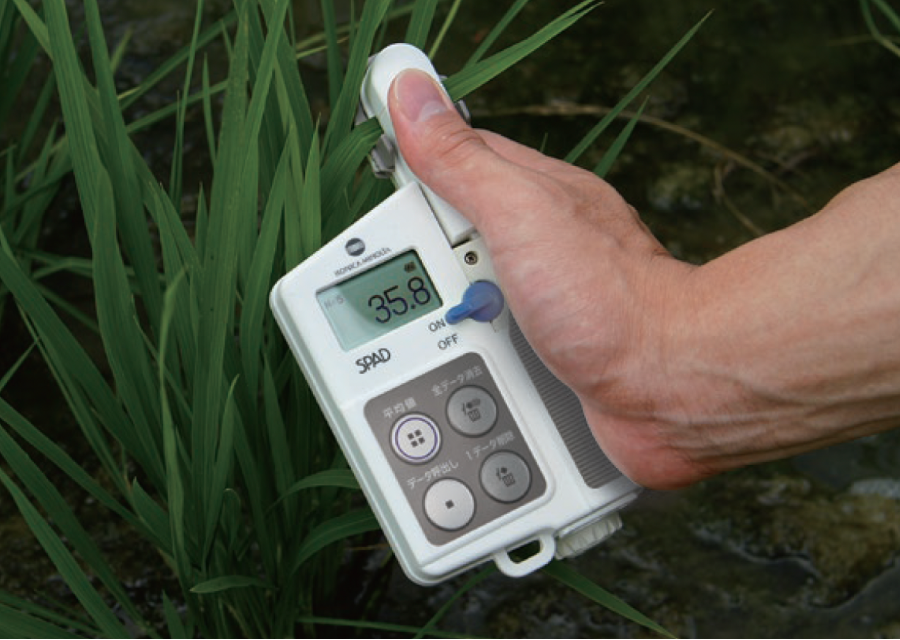
The chlorophyll meter developed by Konica Minolta easily measures in a non-destructive manner the amount of chlorophyll in crops such as rice, wheat, and corn without damaging the plants. Periodically measuring the amount of chlorophyll makes it possible to practice appropriate fertilizer management according to the growth situation.
In this way, Konica Minolta contributes to the implementation of agriculture that is friendly to surrounding biodiversity by avoiding the effects of over-fertilization on the ecosystem, including the soil and groundwater.
Evaluating Light Sources Related to Plant Growth
LED and organic EL technologies are attracting attention as next-generation lighting products. LED in particular has spread not only to general lighting, but also to plant-growing facilities.
The Spectrophotometer CL-500A produced by Konica Minolta can help manage lighting in plant-growing facilities. It can also measure photosynthetic photon flux density (PPFD) and the illuminance spectral waveform of light sources, in applications related to plant cultivation.

Printing Services Using FSC® Certified Paper
Kinkos Japan Co., Ltd., a domestic sales subsidiary, has acquired Chain of Custody (CoC) certification — which manages the processing and distribution processes of the Forest Stewardship Council® (FSC®) — and provides printing services using FSC® certified paper. Leveraging the unique features of on-demand printing to print "what is needed, when it is needed, and only in the amount needed," the subsidiary also contributes to the effective utilization of paper resources and waste reduction. Moreover, it accommodates a wide range of printed materials featuring the FSC® certification mark, such as business cards and pamphlets, supporting customers in their environmentally responsible procurement and sustainability promotion efforts.

Contribution to Local Ecosystems
Forest Preservation and Restoration Activities
Konica Minolta is engaged in activities worldwide that contribute to forest preservation and reforestation, as well as the protection and restoration of ecosystems.
See below for more information on our initiatives: