
 Search within the site
TCFD Disclosures
Governance
Organizational Governance of Climate-related Risks and Opportunities
Konica Minolta positions its efforts to address climate change as one of the key areas managed under its sustainability management. Decisions regarding the setting or modification of key targets are made with the approval of the Board of Directors. Specifically, the Board of Directors approved the setting or revision of targets in 2008, 2017, 2020, and 2023. In March 2026, new climate change targets were also established under the medium-term management plan "Corporate Plan 2026-2028," which began in FY2026, and initiatives toward achieving these targets were launched.
| Year | Approval Items for the Board of Directors |
|---|---|
| 2008 | Long-term environmental target (Eco Vision 2050): Reduce CO2 emissions across the entire lifecycle of Konica Minolta's products by 80% compared to FY2005 levels by 2050. |
| 2017 | Carbon Minus Target: Create avoided CO2 emissions in society and at customers that exceed the CO2 emissions directly associated with Konica Minolta's own products and business activities, working together with stakeholders, particularly business partners and customers. |
| 2020 | Five Material Issues (including "Addressing Climate Change") |
| 2023 | Acceleration of the target year for achieving Carbon Minus to 2025 and establishment of a target of net-zero greenhouse gas emissions by 2050. |
| 2024 | The Compensation Committee selected "CO2 Emission Reductions through Initiatives" as one of the evaluation indicators for medium-term stock-based compensation. |
At Konica Minolta, the President and CEO has ultimate responsibility for environmental management and provides overall direction, while the Group Environmental Officer oversees the implementation of the medium-term plan and reports its progress to the Audit Committee every month.
For details on the governance of environmental issues, including climate change, please refer to Environmental Management System
For details on the governance structure, please refer to the following:
For details on the evaluation and identification process for material issues, please refer to the following:
Strategy
Impact of Climate-related Risks and Opportunities on the Organization's Business, Strategy, and Financial Performance
To address climate change risks, Konica Minolta has established a long-term goal of achieving net-zero CO2 emissions across the product lifecycle (Scopes 1, 2, and 3) by 2050. By integrating climate change-related risks into its business risk management and aligning its medium-term and annual climate action targets with medium-term business plans for product planning and development, production and procurement, sales, and other business activities, Konica Minolta aims to achieve these targets through its business activities.
In terms of opportunities, Konica Minolta aims to drive business growth by increasing its contribution to reducing energy consumption and CO2 emissions at customer companies and across society. The Company is strengthening the core technologies cultivated by each of its businesses since its founding into a suite of evolved core technologies through the use of AI and the integration of technologies across business domains. By leveraging these technologies, Konica Minolta will further contribute to reductions in energy consumption and CO2 emissions by driving transformation in workflows, supply chains, and society, while promoting growth in its Industry Business and creating new businesses that will enable it to remain a company needed by society.
Climate Transition Plan
At Konica Minolta, we view climate change as a critical management issue that affects corporate value. We evaluate changes in the business environment driven by the transition to a decarbonized society in terms of both risks and opportunities, and are accelerating transformation across the entire value chain—including product design, manufacturing, logistics, sales, collection, and recycling—going beyond reductions in greenhouse gas emissions.
Based on this approach, we have established science-based targets (SBTs) aligned with the Paris Agreement and the 1.5°C target and formulated a transition plan to achieve net zero by FY2050. This plan clearly defines short-, medium-, and long-term targets and specific actions. Through the plan, Konica Minolta aims to realize a sustainable society while achieving both decarbonization and business growth.
Initiatives to Reduce Scope 1 and 2 Emissions
Through FY2025, Konica Minolta focused on energy-saving activities in production processes, site optimization, and expanding the use of renewable energy (40% adoption rate) to reduce Scope 1 and 2 emissions.
Toward FY2030, Konica Minolta will promote improvements in energy efficiency through the replacement of aging equipment, site consolidation, reductions in gasoline consumption by sales vehicles through remote services and online sales meetings, and the additional introduction of renewable energy (target adoption rate: 50%), progressively reducing emissions to 160 thousand tons.
Toward FY2035, Konica Minolta plans to reduce emissions to 90 thousand tons by improving production process efficiency and piloting fuel conversion, reducing travel by sales vehicles and transitioning to alternative vehicles, and further expanding the use of renewable energy.
Initiatives to Reduce Scope 3 Emissions
To reduce Scope 3 emissions, Konica Minolta promoted compact and lightweight designs, energy-saving designs, and reductions in air freight through FY2025.
As the Company enters its next stage of growth, emissions targets have been established taking into account business expansion and risks arising from external factors, such as impacts on logistics due to geopolitical factors. The FY2030 target is more ambitious than the target approved by the SBTi.
Key measures include expanding the circular use of resources in products at a rate exceeding business growth, maximizing the use of circular materials (recycled and plant-derived materials), and enhancing energy consumption measurement methods. Through these measures, Konica Minolta plans to progressively reduce emissions to 780 thousand tons in FY2030 and 640 thousand tons in FY2035.
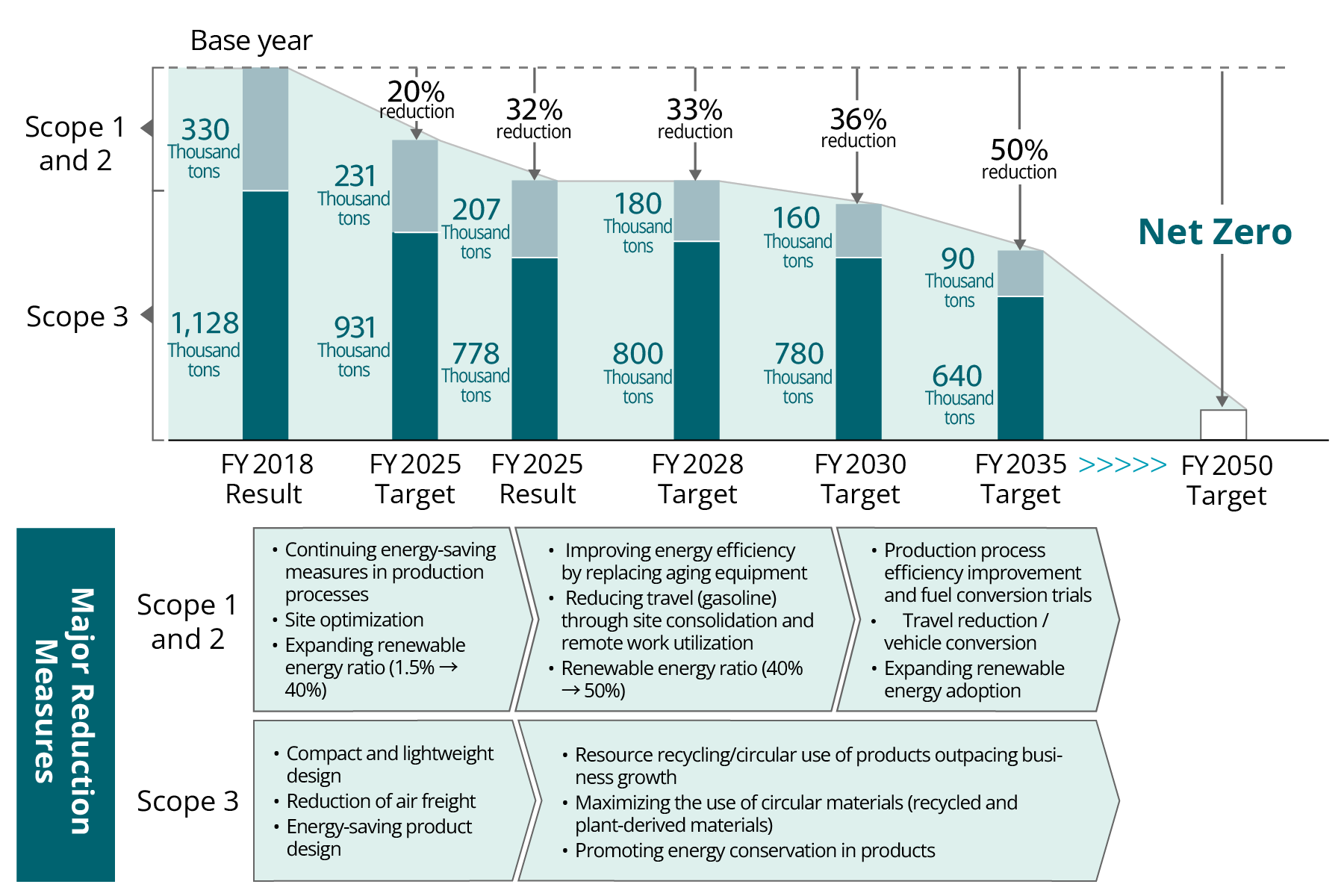
*The FY2025 target is an estimated value following revisions to the calculation methods and scope.
From FY2035 onward, Konica Minolta will advance the transition to a circular business model by extending product lifespans and expanding reuse and remanufacturing. The Company will also accelerate the decarbonization of raw material production in collaboration with suppliers, the transition to low-carbon logistics, and improvements in energy efficiency during product use. Furthermore, Konica Minolta will expand the use of renewable-energy-derived materials and next-generation circular materials to reduce emissions across the value chain.
By steadily implementing these initiatives, Konica Minolta will promote emission reductions aligned with the 1.5°C target. For residual emissions that are technically or economically difficult to avoid, the Company will consider the use of high-quality carbon removals and high-quality carbon removal credits generated from such removals. Through these efforts, Konica Minolta aims to achieve net zero across the value chain by FY2050.
Resilience and Business Strategy
Konica Minolta recognizes the impacts of climate change on its business activities, supply chains, and customer markets as a key management issue. To enhance business resilience to policy, technology, and market changes associated with the transition to a decarbonized society, as well as physical impacts such as the increasing severity of extreme weather events, Konica Minolta assesses climate-related risks and opportunities from a medium- to long-term perspective and incorporates them into its business strategy.
In conducting these assessments, Konica Minolta uses scientific scenarios such as IPCC RCP2.6 and RCP8.5 and the IEA NZE 2050 scenario to analyze the financial impacts of transition risks (policy and legal, technology, market, and reputation) and physical risks (chronic and acute) under a 1.5°C scenario and a scenario exceeding 2°C. The results of the analysis are reviewed and discussed by the Group Environmental Promotion Committee and reflected in the Climate Transition Plan, business strategies, and risk management measures, thereby strengthening the Company's ability to adapt to a changing business environment and enhancing its competitiveness.
For details on the Long-Term Environmental Vision, please refer to the following:
For details on climate change adaptation, please refer to the following:
Implementation and Results of Climate-Related Scenario Analysis
Implementation and Results of Climate-Related Scenario Analysis
Konica Minolta has identified business risks that could affect its business performance in 2030, and business opportunities that can be created by proactively addressing the challenges posed by climate change, based on two scenarios: one in which the global temperature increase is kept below 2°C (equivalent to 1.5°C) and the world transitions to a low-carbon society, and another in which the global temperature increase exceeds 2°C and the physical impacts of climate change materialize.
Scenario analysis is conducted through the following process:
- Identification of business areas subject to climate change scenario analysis.
- Identification of material climate-related risks and opportunities.
- Review of existing scientific scenarios related to climate change.
- Clarification of risks, opportunities, and anticipated financial impacts under each scenario.
- Consideration of future response policies and strategies.
The climate-related financial impacts identified through the scenario analysis are reported to the Group Environmental Promotion Committee, where they are discussed with the relevant business and corporate divisions. The Group Environmental Officer, appointed by the President and CEO, provides instructions to ensure the thorough implementation of future response policies, strategies, and measures throughout the Group.
If the global temperature increase is kept below 2°C (equivalent to 1.5°C) and the world transitions to a low-carbon society:
| Impact on Konica Minolta | Target Segment | Classification | Financial Impact | Time Horizon | Response | |
|---|---|---|---|---|---|---|
| Higher procurement and manufacturing costs | Delayed response to net-zero and renewable energy adoption | Industry Business, Digital Workplace Business, Professional Printing Business | Market / Reputation | High | Short term | Introduce renewable-energy-derived electricity at production, R&D, and sales sites |
| Emissions regulations at our facilities and the need to transition away from fossil fuels | Industry Business, Digital Workplace Business, Professional Printing Business | Policy and Legal | High | Medium to long term | Consider introduction of CO2-free fuels, CCS, etc.; electrify production equipment; develop energy-saving production technologies | |
| Increase in product development costs | Enhancing product environmental performance and responding to information disclosure requirements | Industry Business, Digital Workplace Business, Professional Printing Business | Policy and Legal / Market | High | Short to medium term | Compliance with new standard requirements for environmental labels and product regulations; response to customer procurement requirements |
| Decrease in sales due to changes in demand for products and services | Protective regulations associated with the decline of forest resources and the decrease in paper demand | Digital Workplace Business, Professional Printing Business | Market | High | Medium to long term | Transition to a revenue model not dependent on print charges |
| Impact on Konica Minolta | Target Segment | Classification | Financial Benefit | Time Horizon | |
|---|---|---|---|---|---|
| Higher sales due to changes in demand for products and services | Digital solutions that transform the commercial and industrial printing supply chain | Professional Printing Business | Products and Services | High | Short to medium term |
| Provision of low-carbon-footprint products and services; advanced material identification technologies for a circular economy; greater manufacturing process efficiency through on-demand production processes; expanded application of quality inspection technologies and highly durable materials supporting the deployment of next-generation energy; and stable operations and improved productivity in semiconductor mass production processes | Industry Business | Products and Services | High | Short to medium term | |
| Reduced procurement and manufacturing costs | Improved energy productivity at Konica Minolta sites (Scope 1 and 2 reductions) | Industry Business | Energy Source | Low | Short term |
| Increased revenue through enhanced value of products and services | Manufacturing products using renewable energy (Scope 2 reductions) | Industry Business, Digital Workplace Business, Professional Printing Business | Energy Source | Low | Short term |
| Expansion of the range of products utilizing circular resources (Scope 3) | Industry Business Digital Workplace Business | Energy Source Resource Efficiency | Medium | Short to medium term | |
If the global temperature increase exceeds 2°C and the physical impacts of climate change materialize:
| Impact on Konica Minolta | Target Segment | Classification | Financial Impact | Time Horizon | Response | |
|---|---|---|---|---|---|---|
| Lower revenue due to a reduction in production capacity | Instability in the procurement of natural resources due to climate impacts | Industry Business | Chronic Physical | High | Long term | Product design and development not dependent on particular natural resources |
| Supply chain interruptions following large-scale natural disasters | Digital Workplace Business, Professional Printing Business | Acute Physical | High | Medium term | Establish business continuity management (BCM), decentralize production and supply of consumables by region | |
| Depletion of water resources and restrictions on water intake | Digital Workplace Business, Professional Printing Business, Industry Business | Chronic Physical | Low | Long term | Water risk management and reduction of water consumption at production and procurement sites | |
| Impact on Konica Minolta | Target Segment | Classification | Financial Benefit | Time Horizon | |
|---|---|---|---|---|---|
| Increase in sales due to changes in demand for products and services | Imaging solutions that contribute to disaster prevention and the mitigation of extreme weather and natural disasters, healthcare solutions utilizing diagnostic imaging at disaster medical sites | Imaging Solutions Business | Products and Services | Low | Medium term |
Scenario Analysis Legend
| Segment | Industry Business, Digital Workplace Business, Professional Printing Business, Imaging Solutions Business |
|---|
| Transition Risks | Policy and Legal, Technology, Market, Reputation |
|---|---|
| Physical Risks | Acute Physical, Chronic Physical |
| Opportunities | Resource Efficiency, Energy Source, Products and Services, Market, Resilience |
| High | Additional costs or reduction in profit of ¥1 billion or more |
|---|---|
| Medium | Additional costs or reduction in profit of ¥100 million or more but less than ¥1 billion |
| Low | Additional costs or reduction in profit of less than ¥100 million |
| High | Profit generation of ¥10 billion or more |
|---|---|
| Medium | Profit generation of ¥1 billion or more but less than ¥10 billion |
| Low | Profit generation of less than ¥1 billion |
| Long term | 10 years or longer |
|---|---|
| Medium term | 3 years or longer but less than 10 years |
| Short term | 1 year or longer but less than 3 years |
| The global temperature increase is kept below 2°C (equivalent to 1.5°C) and the world transitions to a low-carbon society | IPCC RCP2.6 Scenario; IEA NZE 2050 Scenario |
|---|---|
| The global temperature increase exceeds 2°C and the physical impacts of climate change materialize | IPCC RCP8.5 Scenario; IEA CPS Scenario |
| Assessment Date | March 2026 |
|---|
Konica Minolta's Climate-Related Risks and Opportunities
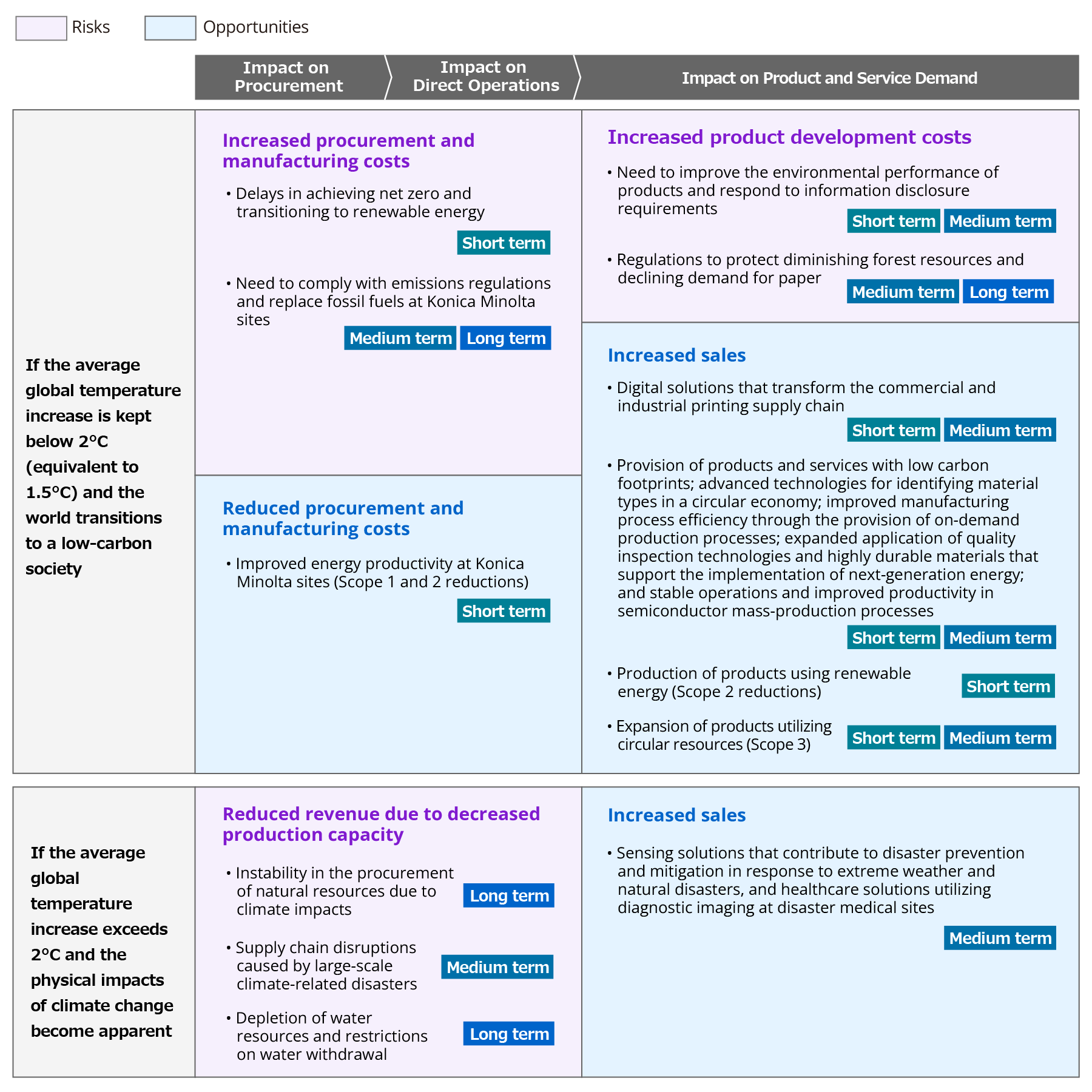
Based on the results of the scenario analysis described above, Konica Minolta has identified material climate-related risks and opportunities in terms of their impacts on its business, strategy, and financial performance. The following outlines the major business impacts, financial impacts, time horizons, and response measures, organized by lifecycle stage (procurement, direct operations, and use of products and services).
Risk Management
Process Used to Identify, Assess and Manage Climate-Related Risks
Konica Minolta defines risk management as activities that seek to maximize returns while minimizing the negative impacts of risks, and assesses risks from a medium- to long-term perspective. Environmental risks, including climate change, are assessed and managed from a medium- to long-term perspective by evaluating the magnitude and uncertainty of climate-related risks under two scenarios: one in which the global temperature increase is kept below 2°C (equivalent to 1.5°C) and the world transitions to a low-carbon society, and another in which the global temperature increase exceeds 2°C and the physical impacts of climate change materialize. Konica Minolta also positions environmental risk as one of the Group's management risks and manages it through the Risk Management Committee.
The Group Environmental Promotion Committee discusses plans and measures for addressing climate change on a quarterly basis. It also reviews changes in risks twice a year and reassesses the risks accordingly. Progress on the plans is reported monthly to the President and CEO by the Group Environmental Officer, who is appointed by the President and CEO. Important environmental issues are also reported by the Group Environmental Officer to the Management Council, other deliberative bodies, and the Risk Management Committee. The Audit Committee regularly receives reports on the progress of management plans for addressing climate change and oversees their implementation.
The risk classification framework used categorizes transition risks as Policy and Legal, Technology, Market, and Reputation, and physical risks as Acute Physical and Chronic Physical.
For details on the risk management structure and risk management process, please refer to the following:
For details on the validity of material issues targeted for risk management, please refer to the following:
Metrics and Targets
Metrics and Targets Used to Assess and Manage Climate-related Risks and Opportunities
Konica Minolta has established Product Lifecycle CO2 Emissions (Scopes 1, 2, and 3*1), renewable energy-derived electricity utilization rate, and Avoided CO2 Emissions*2 (reductions outside Scopes 1, 2, and 3) as metrics for managing climate-related risks and opportunities.
Konica Minolta set a target of achieving, by the end of FY2025, a state in which the avoided CO2 emissions generated in society and at customer sites outside the scope of its product lifecycle exceed its own product lifecycle CO2 emissions. In FY2025, product lifecycle CO2 emissions were 699 thousand tons, while Avoided CO2 Emissions reached 1,118 thousand tons, meaning that the target was achieved.
- *1Scope 1: Direct emissions from the company’s activities, such as fuel use.
Scope 2: Indirect emissions resulting from the use of electricity, heat, and steam supplied by other companies.
Scope 3: Emissions associated with the company's business activities throughout the value chain, excluding Scope 1 and Scope 2 emissions, such as those from raw material procurement, logistics, and product use. - *2Avoided CO2 Emissions: CO2 emissions avoided in society and at customer sites through the provision of Konica Minolta’s products and solutions, outside Scopes 1, 2, and 3 (compared with the market- average alternative that would have been used if Konica Minolta’s products and solutions had not been provided).
For detailed data, please refer to ESG Data (Environmental Data).
1. Greenhouse Gas Emissions (Scope 1, 2, and 3 Emissions)
Product lifecycle CO2 emissions include all Scope 1 and 2 emissions (emissions from the production, sales, and service stages) and emissions from major Scope 3 categories (the procurement, logistics, and product use stages).
Konica Minolta set a target of reducing emissions by 61% from the FY2005 level, to 800 thousand tons, by the end of FY2025. In FY2025, the Company achieved this target by reducing emissions by 66%, to approximately 699 thousand tons (Scope 1: 147 thousand tons; Scope 2: 80 thousand tons; major Scope 3 categories: 472 thousand tons).Konica Minolta obtains third-party assurance each fiscal year for various non-financial data disclosed in its Environmental/Social Data, including CO2 emissions (Scope 1, Scope 2, and some Scope 3 emissions), to ensure the validity of the data. Third-party assurance has been obtained for FY2025 data.
Metrics and Targets under Corporate Plan 2026-2028
Under Corporate Plan 2026-2028, which began in FY2026, Konica Minolta has revised the calculation scope and calculation methods in alignment with the SBTi targets validated in July 2024. The calculation scope covers Scope 1, Scope 2, and major Scope 3 categories (the procurement, logistics, and product use stages previously covered, plus the product disposal stage).
The calculation methods have been revised to standardize the data sources used for emission factors by adopting internationally standardized and publicly available sources, with the aim of clarifying the process for calculating emission reductions resulting from activities and enhancing comparability. As a result of these changes, Konica Minolta has set new targets of reducing emissions by 33% from FY2018 levels by the end of FY2028 (Scope 1, 2, and 3 emissions: 980 thousand tons) and, over the medium-term, by 36% from FY2018 levels by 2030 (940 thousand tons). These changes do not alter the SBTi-validated targets for Scope 1, Scope 2, and major Scope 3 emissions.
| Result | Target | |||||
|---|---|---|---|---|---|---|
| FY2018 (Base Year) | FY2025 | FY2028 | FY2030 | FY2035 | FY2050 | |
| Scope 1 and 2 (Manufacturing; Sales and Service) | 330 | 207 | 180 | 160 | 90 | Net zero |
| Major Scope 3 Categories | 1,130 | 778 | 800 | 780 | 640 | |
| Category 1 (Purchased Goods and Services) | 712 | 502 | - | - | - | |
| Category 4 (Upstream Transportation and Distribution – Product Logistics) | 67 | 26 | - | - | - | |
| Category 11 (Use of Sold Products) | 204 | 148 | - | - | - | |
| Category 12 (End-of-Life Treatment of Sold Products) | 145 | 102 | - | - | - | |
| Total (Scope 1, 2, and 3)* | 1,460 | 985 (32% reduction) | 980 (33% reduction) | 940 (36% reduction) | 730 (50% reduction) | |
(Unit: thousand tons-CO2)
*Note: Figures may not add up due to rounding.
2. Transition Risks
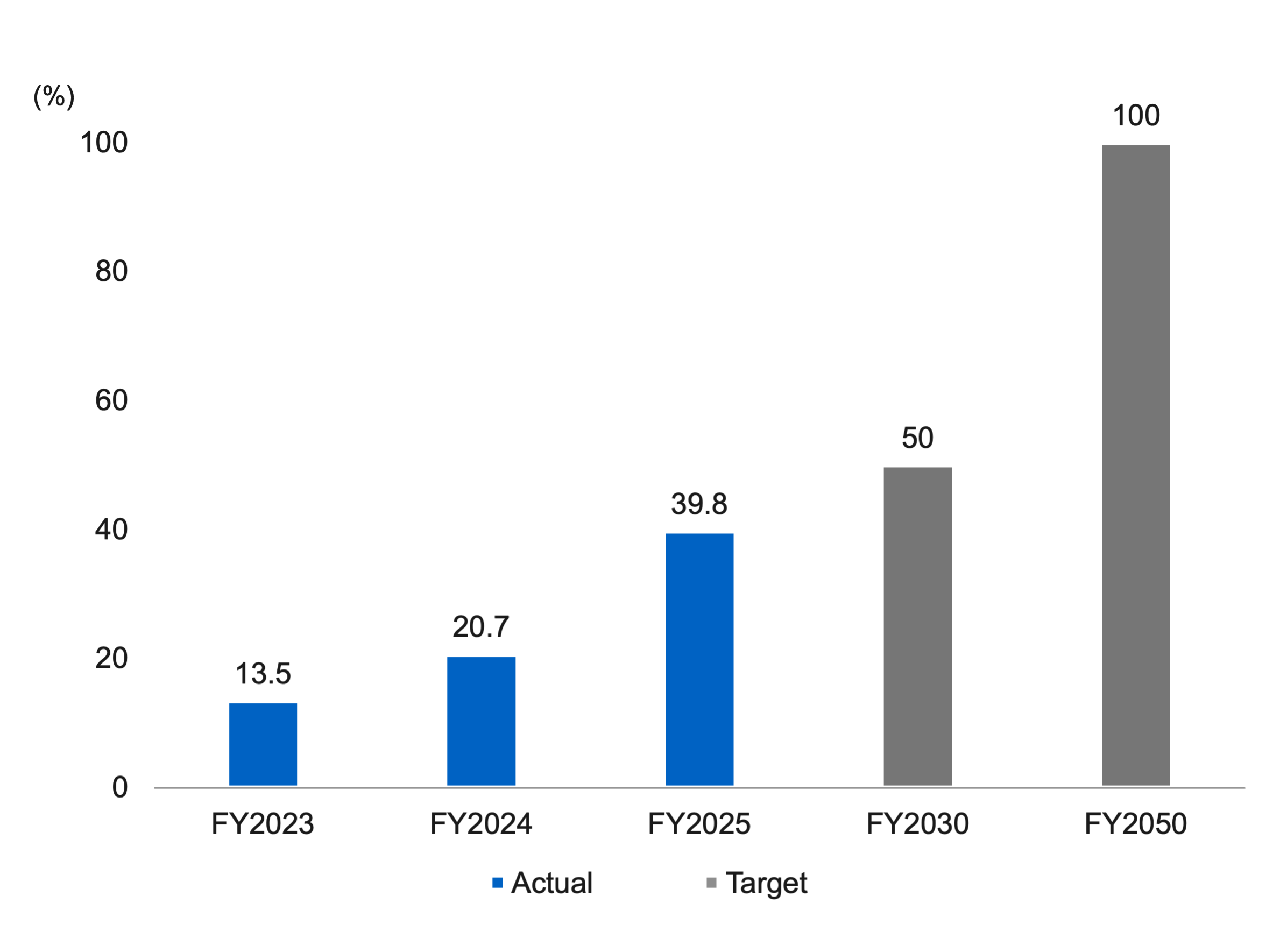
For the renewable energy-derived electricity utilization rate, Konica Minolta has set targets of increasing the proportion of renewable energy-derived electricity used in its business activities to at least 50% by FY2030 and 100% by FY2050, in anticipation of a future in which fossil fuels will no longer be available for use. Increasing this ratio will contribute to reducing Scope 2 emissions. The renewable energy-derived electricity utilization rate increased from 20.7% in FY2024 to 39.8% in FY2025 with the full-scale use of renewable energy-derived electricity at production and R&D sites in Japan.
As part of its initiatives through FY2025, Group companies that manufacture printing materials and consumables such as toner reviewed their electricity supply contracts and utilized "Non-fossil Certificates with Tracking" under renewable electricity plans, achieving 100% renewable electricity use. As a result, 100% renewable electricity use (excluding self-generated electricity) was achieved at all production sites worldwide in the Business Technologies Business (multifunction printers, digital printing systems, and consumables), which accounts for approximately 80% of the Group's total sales.
3. Physical Risks
In the Business Technologies Business, one of Konica Minolta's core businesses, the Company delivers its products to customers around the world. To prevent supply chain disruptions caused by large-scale natural disasters and other events from interrupting product supplies to customers, Konica Minolta traces the supply routes for critical parts and raw materials for which alternatives are difficult to secure back to their raw material sources, while working to secure multiple suppliers and evaluate alternative materials. For major components, the Company is promoting dual sourcing, identifying new suppliers, evaluating alternative parts and materials, accelerating the switch to alternative components and materials, including through design changes, and flexibly reviewing inventory levels.
To prepare for such climate-related disaster risks, Konica Minolta operates its own toner filling facilities in Japan, Europe, and North America and strives to maintain a highly resilient supply chain capable of supplying products in the regions where they are consumed.
4. Climate-Related Opportunities
Konica Minolta has adopted both economic value and environmental value created by providing its products and solutions to stakeholders as metrics for managing climate-related opportunities and has set corresponding targets.
For economic value, Konica Minolta has established "Sales of Contributing Products," "Ratio of Sales of Contributing Products" (the ratio of sales of Contributing Products to total sales), and "Contribution Efficiency of Growth Businesses."
For environmental value, Konica Minolta has established "Avoided CO2 Emissions." In FY2025, the Company worked to expand sales of products such as inkjet (IJ) components and digital printing systems that improve productivity by transforming workflows from analog to digital printing, cinema projector lenses that eliminate the need for power-intensive light sources, and hyperspectral cameras that contribute to resource recycling through advanced identification of waste plastics. As a result, Avoided CO2 Emissions reached 1,118 thousand tons against the FY2025 target of 800 thousand tons.
By FY2050, Konica Minolta aims to achieve 40 million tons of cumulative Avoided CO2 Emissions, exceeding its cumulative CO2 emissions since the integration of Konica and Minolta.
| Management Metrics | Results | Targets | |||||
|---|---|---|---|---|---|---|---|
| FY2025 | FY2026 | FY2027 | FY2028 | FY2030 | FY2050 | ||
| Economic value | Ratio of Contribution Products Sales (%) | 10.8 | 11.2 | 11.1 | 11.1 | TBD | - |
| Environmental value | CO2 reduction contributions (thousand t-CO2) | 1,118 | 1,222 | 1,321 | 1,423 | 1,240 | - |
| Cumulative CO2 reduction contributions (thousand t-CO2) | - | - | - | - | - | 40,000 | |
5. Capital Deployment
Konica Minolta has identified "Addressing Climate Change" as one of the five material issues to be addressed under its long-term management vision. The Company allocates capital to business activities that contribute to enhancing corporate value and realizing a low-carbon society over the medium to long term. Climate change initiatives are integrated into ordinary capital expenditures and R&D activities, and climate-related investments are not separately identified and managed at present. Information on capital expenditures and investments and loans is provided in Corporate Plan 2026-2028, while information on R&D activities is provided under Technology.
For details, please refer to the respective pages.
6. Internal Carbon Pricing
Konica Minolta has introduced an internal carbon price (ICP) to facilitate decision-making on low-carbon investments and promote the implementation of effective energy efficiency measures. The costs, measures, and timeframes required to reduce one ton of CO2 emissions differ between Scope 1 (direct emissions from fuel use) and Scope 2 (indirect emissions from electricity use). To enhance the effectiveness of its ICP, the Group takes into account the distinct environmental value of Scope 1 and Scope 2 emission reductions and applies different carbon prices accordingly.
Carbon prices are set with reference to the regulatory frameworks and market trends in each country. The Company may revise these prices in light of changing circumstances.
7. Compensation
To strengthen incentives to achieve the targets of Corporate Plan 2026-2028 and encourage ownership of the Company's shares, Konica Minolta has introduced performance-linked medium-term stock-based compensation and has included "CO2 Emission Reductions through Initiatives" as one of its non-financial performance indicators.* The amount of stock-based compensation for the President and CEO and other Executive Officers is determined within a range of 0% to 200% after the completion of Corporate Plan 2026-2028, based on the degree of target achievement, and Company shares are granted accordingly.
*At its meeting held in March 2026, the Compensation Committee resolved to revise the compensation system for Executive Officers.