
 Search within the site
Effective Use of Resources through Products and Solutions
Initiatives related to Effective Use of Resources
Products that Reduce the Use of Natural Resources at Konica Minolta
Expanding the Use of Circular Resources
Rollout of Remanufactured Machines
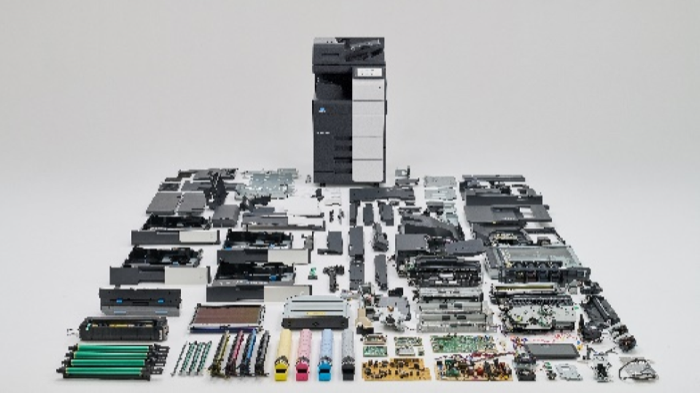
Konica Minolta carries out "remanufacturing" initiatives in which used multi-functional peripherals (MFPs) are disassembled and their parts are reused based on strict standards to produce remanufactured devices.
In June 2026, Konica Minolta launched the "bizhub RM Series" of remanufactured machines*1. At Konica Minolta's remanufacturing plants in Japan, used MFPs are disassembled to the component level and cleaned. Usable parts are carefully selected, while degraded or worn parts are replaced during reassembly. The machines are then released as products after undergoing quality assurance equivalent to that of new machines*2 in accordance with rigorous reuse standards. By achieving an average parts reuse rate of 80% or more (up to 85%), Konica Minolta significantly reduces the input of new natural resources.
- *1:Products that have previously been used in the market and are remanufactured, including modifications affecting their safety, quality, or performance, to restore them to a condition equivalent to that prior to use before being supplied to the market again.
- *2:Newly manufactured products made from new parts that have never been used in the market.
Rollout of Refurbished Models
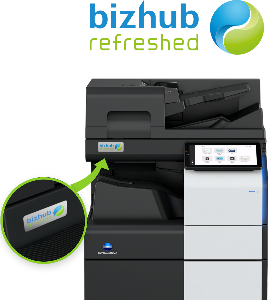
Konica Minolta is implementing initiatives in Europe, Australia, and Japan to collect used MFPs, refurbish* them, and make them available for customers to use again.
In accordance with work standards established by Konica Minolta, the collected MFPs are cleaned and undergo operational checks, data erasure, firmware updates, and safety inspections. Parts are replaced with genuine Konica Minolta parts as needed. A “bizhub refreshed” label is affixed to MFPs that pass the final check as proof that they meet the performance and quality standards required for reliable use.
*Refurbished: Collected equipment is reconditioned and sold as used equipment.
Unlike the remanufacturing described in the previous section, refurbished models do not come with a manufacturer's warranty equivalent to that for new products, but undergo quality checks to ensure reliable use.
Refilling Used Toner Bottles
In 2021, Konica Minolta established a system for refilling collected used toner bottles with toner and began selling the refilled bottles in Europe. This initiative reduces the input of resources required to manufacture new toner bottles.
Use of Recycled Plastic in MFPs
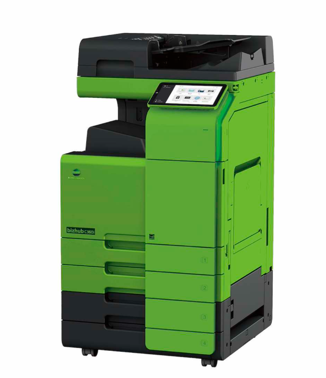
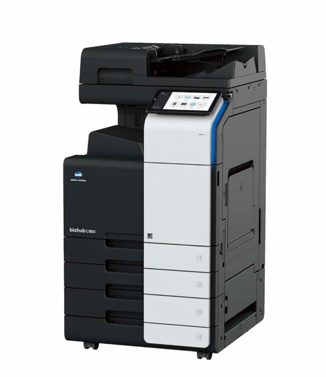
bizhub C360i Series Using Recycled PC/PET
Konica Minolta is promoting the use of recycled plastics in its MFPs, using plastics recycled from used PET bottles and polycarbonate (PC) gallon bottles for exterior parts and ABS resin recovered from used amusement machines for interior parts. To increase the recycled content used in MFPs, the Company has developed chemical processing technologies that improve the strength, flame resistance, and moldability of recycled materials.
The bizhub C360i series, launched in 2019, incorporates recycled PC/PET with recycled content of approximately 70% for exterior parts and recycled ABS resin with recycled content of approximately 95% for interior parts. As a result, recycled materials account for approximately 35% by weight of the total amount of resin used in the MFP.
The successor bizhub C361i series, launched in 2024, also achieves an equivalent or higher recycled content.
Use of Recycled Plastic in MFP Consumables
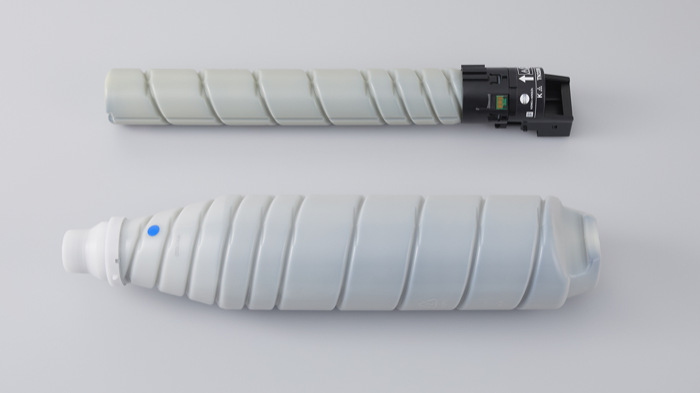
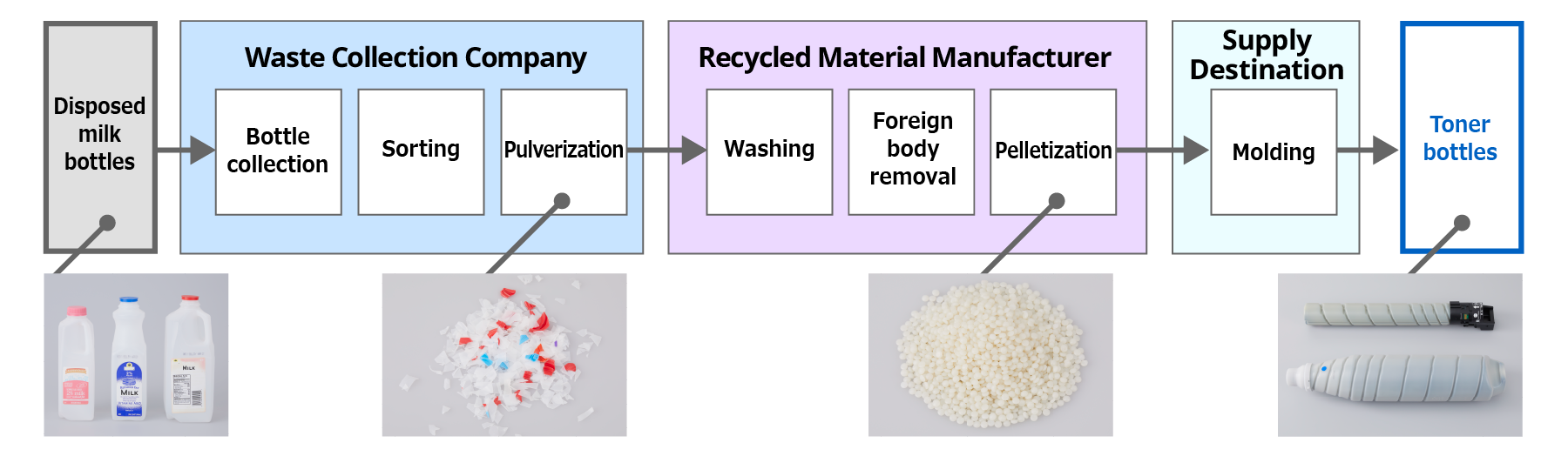
Konica Minolta recycles polyethylene milk bottles into toner bottles for MFPs. The Company has developed washing technology that removes milk odors and microscopic contaminants that could lead to quality deterioration, and has established mass-production operations in Mexico and Malaysia. Konica Minolta has succeeded in increasing the recycled content of the raw materials used for toner containers to 40% and aims to increase it to 100% in the future.
Reducing the Input of Natural Resources
Extending the Lifespan of MFP Units
Process units required for image formation in MFPs have limited lifespans and need to be replaced as necessary. For the bizhub C360i series, Konica Minolta worked to extend the lifespan of drum units, which have particularly short lifespans, achieving a 20% increase compared with previous models. The series also incorporates a mechanism for predicting unit lifespan, enabling customers to replace units at the optimal time before experiencing image defects.
Making Digital Printing Systems Smaller and Lighter
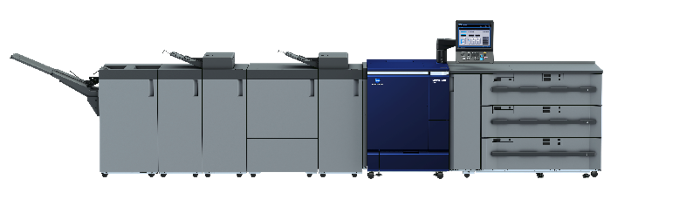
Making products smaller and lighter contributes greatly to reducing raw material use and energy consumption during production, as well as reducing environmental impact during disposal. Through technological development leveraging its core technologies, Konica Minolta is working to reduce the size and weight of its products while improving their performance, and is actively developing products with low environmental impact.
The AccurioPress C7100 digital printing system achieves levels of automation, efficiency, and ease of operation comparable to those of high-speed models, while reducing the width of the main unit by approximately 15% and its weight by approximately 25% compared with the previous model.
Reducing the Thickness of Protective Films for LCD Polarizers
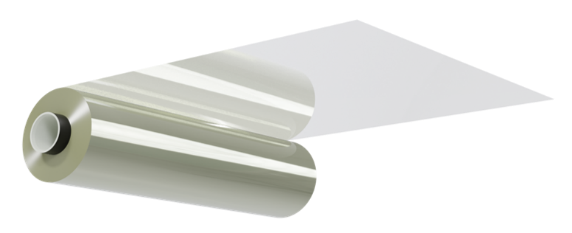
Konica Minolta is leveraging its strengths in film-forming technology to reduce the thickness of TAC* and COP* films used to protect and enhance the functionality of polarizers in liquid crystal displays. This not only contributes to reducing the weight of final products such as laptop PCs and smartphones, but also conserves resources by reducing the amount of material used.
- *TAC: Triacetyl cellulose
- *COP: Cyclo-olefin polymer
Products and Solutions Contributing to Reducing Customers' Use of Natural Resources
Products and Solutions that Contribute to Reducing the Use of Natural Resources
For details on products that contribute to reducing the use of natural resources, please refer to the following:
Other Products and Solutions Contributing to Reducing the Use of Natural Resources
In-Line Pretreatment Ink for Reactive Dyes that Shortens the Inkjet Textile Printing Process and Reduces Chemical Use
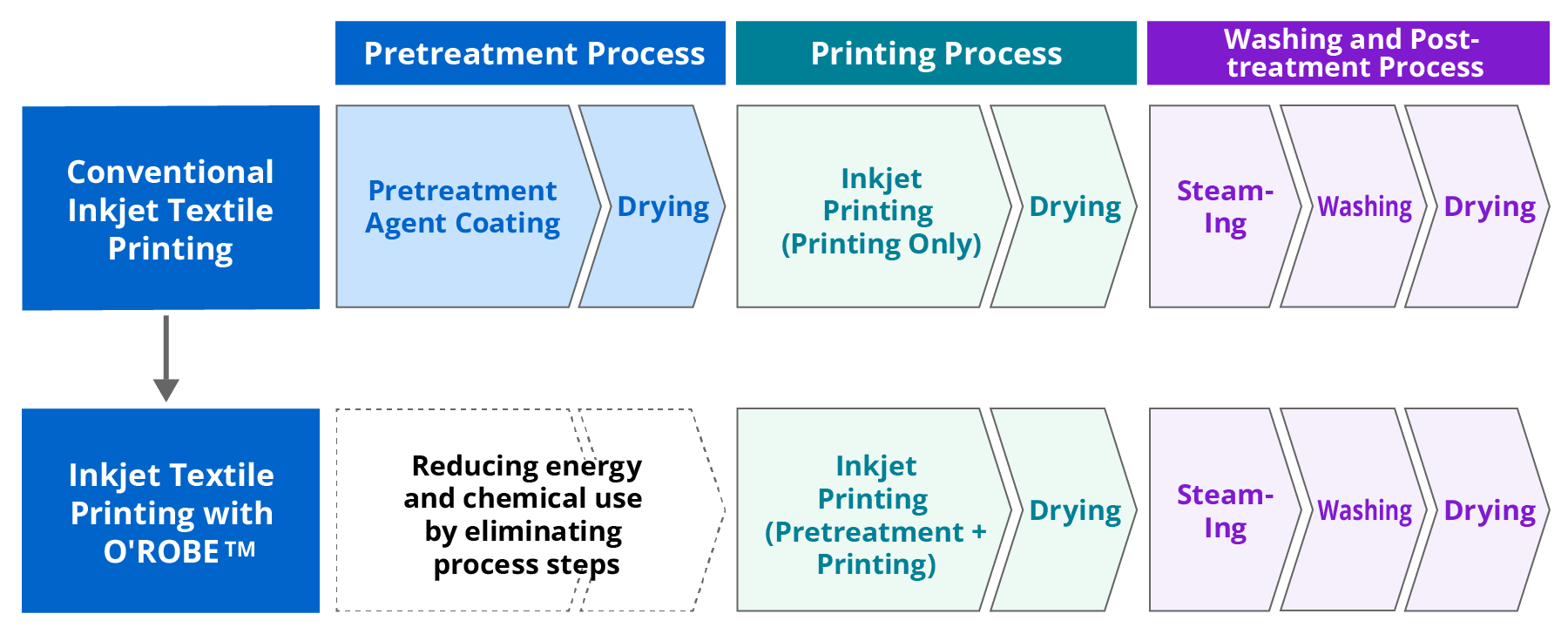
Reactive dye inks used in inkjet textile printing require a pretreatment process in which the fabric is coated with chemicals to ensure deep, vivid colors and prevent fading after washing. The chemicals used must be properly treated when disposed of, and the facilities and costs required for such treatment place a burden on the textile industry.
Konica Minolta launched the in-line pretreatment ink "O'ROBE" in 2025. This ink can be applied simultaneously with the reactive dye ink, precisely in the required amount only where needed. This significantly reduces the amount of pretreatment chemicals used.
Examples of Technology Development Aimed at Contributing to Future Reductions in Natural Resource Use
Technology to Expand the Supply of Recycled Materials with Consistent Quality
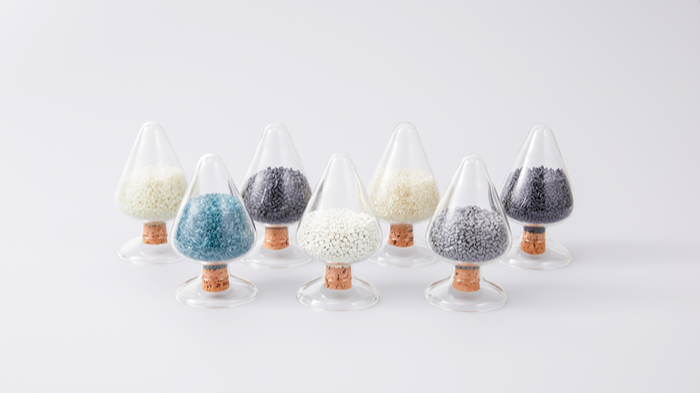
Konica Minolta has used recycled plastics in its own MFPs since 2011 and is advancing initiatives to expand their use outside the Company.
Recycled plastics generally have inconsistent properties due to variations in the quality of the waste plastic used as raw material, making it difficult to ensure high yields during molding. To address this challenge, Konica Minolta uses its sensing and AI technologies to optimize compounding and molding conditions, enabling the consistent production of quality products.
Through a partnership with MJ Material, which specializes in the manufacture and supply of recycled materials, Konica Minolta will make recycled materials available to a broader range of customers, thereby contributing to the more widespread efficient use of resources across society.